
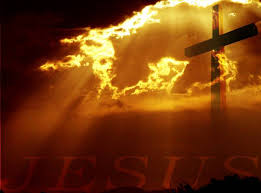
[O]n the panoramic screen of an evolutive world which we have just erected, the whole picture undergoes a most impressive change. When the Cross is projected upon such a universe, in which struggle against evil is the sine qua non of existence, it takes on new importance and beauty—such, moreover, as are just the most capable of appealing to us. Christ, it is true, is still he who bears the sins of the world; moral evil is in some mysterious way paid for by suffering. But, even more essentially, Christ is he who structurally in himself, and for all of us, overcomes the resistance to unification offered by the multiple, resistance to the rise of spirit inherent in matter. Christ is he who bears the burden, constructionally inevitable, of every sort of creation. He is the symbol and the sign-in-action of progress. The complete and definitive meaning of redemption is no longer only to expiate: it is to surmount and conquer. The full mystery of baptism is no longer to cleanse but (as the Greek Fathers fully realized) to plunge into the fire of the purifying battle ‘for being’—no longer the shadow, but the sweat and toil, of the Cross.
Teilhard de Chardin, Pierre (2002-11-18). Christianity and Evolution (Harvest Book, Hb 276) (Kindle Locations 1078-1086). Houghton Mifflin Harcourt. Kindle Edition.

 Teilhard de Chardin
You make me want to read this book, William. I’m reading Ilia Delio’s Emergent Christ and it follows very much the same approach.
Hi Claire:
I enjoy Ilia Delio also and highly recommend her works. She has edited an interesting book that I have not yet read titled “From Teilhard to Omega” which includes essays from leading Teilhard scholars and evolutionary theologians such as Sr. Delio, John Haught, Kathleen Duffy, David Grumett, Ursula King and others. Hopefully I will have a chance to read it and do a book review yet this Spring. I just need more time :-).
Peace,
W. Ockham
There is so much in each sentence that Teilhard has written that a mind like mine can scarcely comprehend after several readings; however, it is certainly worth the effort. “The complete and definitive meaning of redemption is no longer only to expiate: it is to surmount and conquer.” Amen!
Lynda:
Hope you have a blessed Easter Triduum!
Peace,
W. Ockham
“But, even more essentially, Christ is he who structurally in himself, and for all of us, overcomes the resistance to unification offered by the multiple, resistance to the rise of spirit inherent in matter. Christ is he who bears the burden, constructionally inevitable, of every sort of creation.”
I should like to comment on this sentence.
To be clear , I in no way want to disrespect the person of Teilhard. But i have genuine criticism .
I understand that Teilhard is saying that every sort of creation has inevitably an resistance to the “rise of the spirit”.
So God created the universe , matter , and inevitably , matter has an multiple resistance against the spirit . Spirit meaning ; Gods grace , goodness, holiness, etc.
The “resistance” is evil , sin , all the vices , etc, everything which goes against deification .
So, is this not contrary to the reality of christian thought? Being that evil has nothing to do with matter , or creation , but with free acts of the will of persons? Lucifer who became rebellious. Adam and Eve ( or the first humans so you will) who voluntarily choose to turn away from God. Not out of some sort of inevitability of creation, an inherent resistance , but because of totally free will?
These acts of rebellion caused a deep spiritual fall of humanity.
And caused a human condition from which man cannot free himself. Hence the lord send His Son to redeem us .
One can maybe argue : what is the difference with this idea and the way Teilhard sees it , because he – Teilhard also sees Christ as necessary to “redeem”.
Well, … in Teilhards view sin is just inherent to creation , sin is the resistance to the spirit inevitable of creation . ( on what does Teilhard bases the assumption that “resistance of the spirit is inevitable for every creation? Is it not the case that Christianity believes that the Spirit is much stronger and that everything was subjected to the spirit , but that the original sin – out of free will – made an end to that and humanity “lost” the Spirit and the “Fall” was there which indeed did subject man to matter ? Did God not make everything “good” in the beginning ? Was mankind not “very good” ?? ) .
Anyway, if Teilhard is right , there is no culpability…. God can not hold us responsable for evil and sin because that is just inevitable a result of the resistance of matter . So that begs the question ; why would we be thankful to God for redeeming us ? The inevitable resistance of matter is not our fault. ( I a way He is responsabel for that , he created it). Furthermore about Gods mercy for us : what mercy? God created the universe like this , evil being an inherent part of it .
Christ redeemed us , not from a inevitable resistance of matter , but of the loss of Spirit caused by the free will of man. God didnt “will” a evolution in the sense of Teilhard. God created “creation” good and very good. Creation was naturally subjected the the Spirit which was very much alive in Man ánd mankind would have developed naturally under guidance of the Spirit , without sin. But Man lost the Spirit by an act of free will , original sin , not by necessity but by pure free will. This is why it was so bad and Christ the incarnated God had to suffer and shed his blood.
This is in my humble opinion Christianity.
as a sidenote;
According to Christianity there is also a pure spiritual realm : the heavens with their inhabitants, the spirits or angels . Part of the angels rebelled against God , and became fallen Angels . How does this fit in Teilhards thinking? spirit should not give resistance to “The Spirit” , I would think.
So one of the fallen convinced humankind to join that rebellion and disobey Gods command. Causing the los of Spirit for mankind ; the Fall.
What does Teilhard say about this? Because it quiet incompatibel with his theory of evolution, I think.