Teilhard de Chardin Quote of the Week (March 31, 2014): Everything That Rises Must Converge (Part I)

everything_that_rises

[This Quote of the Week is inspired by the fact that I am rereading Flannery O’Connor]

“It is true that at the outset it presupposes a certain fundamental concept of the place of Man in Nature. But as it rises above this rationalized common platform it becomes charged with a thousand differing potentialities, elastic and even fluid—indivisible, one might say, by the expressions of hostility to which Thought, in its gropings, may temporarily subject it. Indivisible and even triumphant: for despite all seeming divisions (this is what matters) it continues unassailably to draw together and even to reconcile everything that it pervades.

Take the two extremes confronting us at this moment, the [Atheist] and the Christian, each a convinced believer in his own particular doctrine, but each, we must suppose, fundamentally inspired with an equal faith in Man. Is it not incontestable, a matter of everyday experience, that each of these, to the extent that he believes (and sees the other believe) in the future of the world, feels a basic human sympathy for the other—not for any sentimental reason, but arising out of the obscure recognition that both are going the same way, and that despite all ideological differences they will eventually, in some manner, come together on the same summit? No doubt each in his own fashion, following his separate path, believes that he has once and for all solved the riddle of the world’s future. But the divergence between them is in reality neither complete nor final, unless we suppose that by some inconceivable and even contradictory feat of exclusion (contradictory because nothing would remain of his faith) the [Atheist], for example, were to eliminate from his materialistic doctrine every upward surge toward the spirit. Followed to their conclusion the two paths must certainly end by coming together: for in the nature of things everything that is faith must rise, and everything that rises must converge.”


Pierre Teilhard de Chardin. The Future of Man (Kindle Locations 2891-2904).

Posted in Teilhard Quote of the Week | Tagged , , , , , , , , , , | 3 Comments

Christopher Hitchens: An Excess of Errors

m.servetus's avatarMythos/Logos

I recently finished reading the late Christopher Hitchens’ book god is not Great: How Religion Poisons Everything.

In some parts, the book is delightful, and I admire the author’s courage.  Although the social penalties for atheism are much less in contemporary democratic societies than in other societies, past and present, there is also personal courage in facing up to the possibility that there is no God and no afterlife, which can be a distressing and demoralizing experience for many.  The author’s main points about the inaccuracy or falsity of religious beliefs about cosmology and history, as well as the persistent use of religion historically to rationalize evil behavior (such as the trading or keeping of slaves) have been made by others, but the author’s arguments are not entirely unoriginal, and I definitely learned some new things.

Having said that, I also need to say this: god is not Great is filled with many…

View original post 1,748 more words

Posted in Uncategorized | 1 Comment

Sunday Reflection, Fourth Sunday of Lent (March 30, 2014): Trust in the Slow Work of God

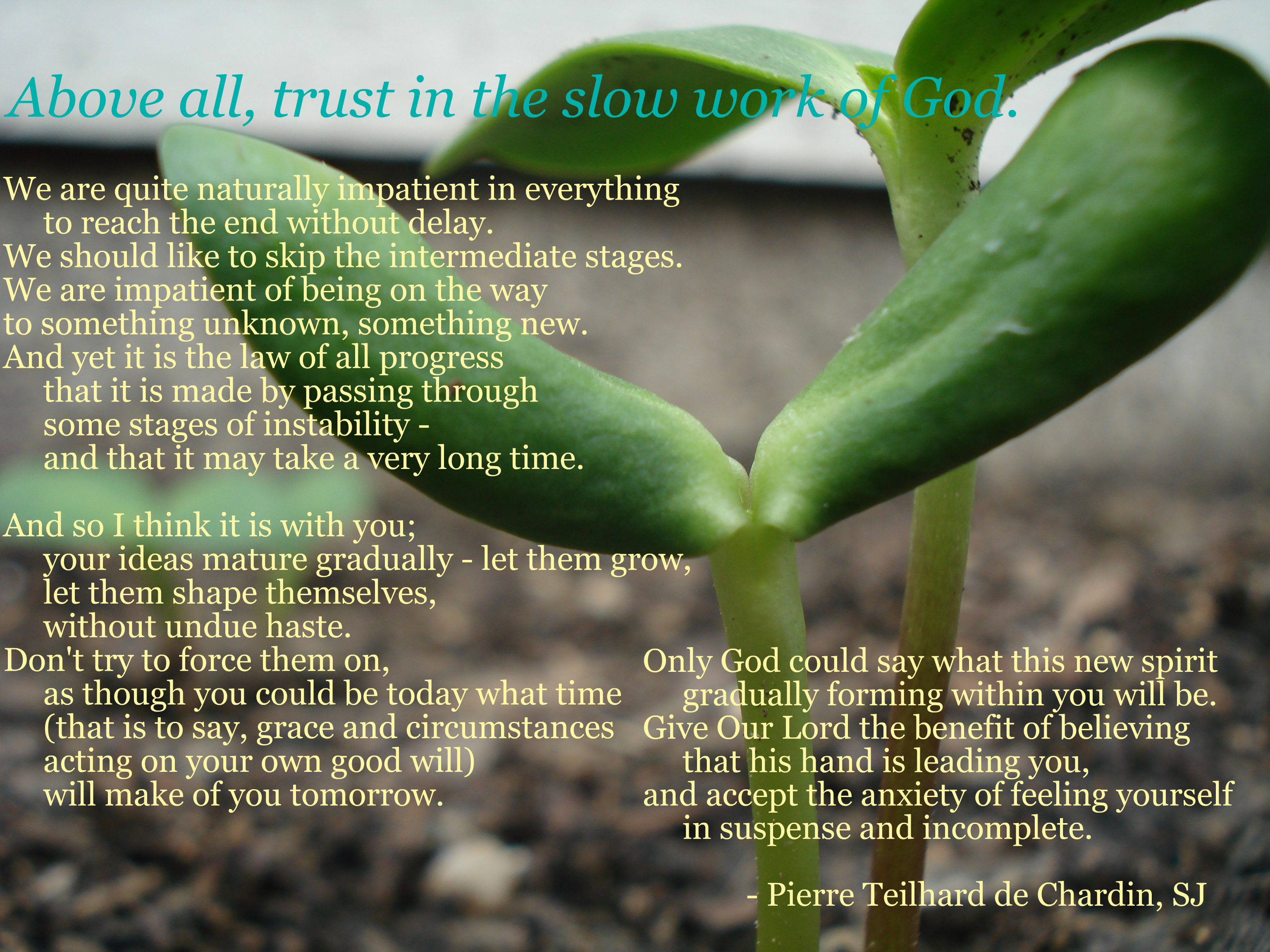
sunflower seedlings

“Live as children of light, for light produces every kind of goodness and righteousness and truth.” — Eph 5:8-9

This weekend is the Fourth Sunday in Advent. The readings can be found here.  The themes focus on the metaphor of living in the blindness of the shadow self and trusting in God to heal us.

Today’s reflection comes from an anonymous author (primarily because I found it online but can not find the author) and focuses on trusting God to assist in our healing. You can find the full homily here, but set forth below is an extended summary:

“There is none of us here today who is not in need of healing of some kind. While for some of us, that desired healing is physical, for most of us, the healing we need and seek is something spiritual and moral. We seek healing from our weaknesses and sins, from the flaws and bad habits we fall into it, from the mistakes we have made and the ways we have wounded other people and turned away from God, choosing to live selfishly rather than lovingly.

… And God does heal us in those ways. But, for most of us, the healing is not as dramatic and life-altering as it was for the man in today’s Gospel reading. For many of us, the healing that we experience is not a “one-shot deal”. On the contrary, it is a slow, gradual transformation of our hearts and minds, learning to turn away from our sins and follow the example of Jesus. For most of us, it doesn’t happen overnight. It’s not the work of a single day or month—not only the work of a single season of Lent, which is precisely why the Church offers us this sacred opportunity, this six-week journey, every year. And with each Lent, hopefully we are a little bit more Christian than we were last Lent … a little more loving, a little more generous, a little more prayerful, a little more faith-filled. For most people, the law of spiritual growth is a law of gradual change. It isn’t instantaneous; on the contrary, it is the slow, patient work of a lifetime, allowing God into our lives, so that He can become more and more truly the master of our hearts and minds.

And for many of us, the single greatest help we have on that journey of growth and spiritual development is the Sacrament of Reconciliation. In that sacrament, we can admit in all humility: “Lord, I’m on the journey … but I’m not there yet”. We can come to the Lord in our frailty and our need, and admit that, although we have made some real progress in some areas of our lives as Christians, there are other areas where we continue to struggle, when our weaknesses run deep, and where our sinful behaviors seem to be stubbornly hard to uproot and totally eliminate. For many of us, it can be frustrating, to confess the same sins over and over, and we can have a sense of not making progress—at least not progress in the sense that our culture thinks of it.

But God thinks differently. God knows us intimately, through and through. And God is infinitely patient … Whether we realize it or not, when we turn to God in Confession, we allow God’s love and mercy to work on us, to slowly but surely smooth the rough edges of our lives, to slowly but surely re-orient us, so that our focus can be on loving God and others once more. It probably won’t happen suddenly and dramatically … and sometimes the changes in us can be so small and gradual that we don’t know them. But faith tells us that, if we are willing to trust in God’s mercy, that mercy does heal us, and does make us different. As the great Jesuit theologian Teilhard de Chardin once wrote

“Above all, trust in the slow work of God.

We are quite naturally impatient in everything to reach the end without delay. We should like to skip the intermediate stages. We are impatient of being on the way to something unknown, something new.

And yet it is the law of all progress that it is made by passing through some stages of instability—and that it may take a very long time.

And so I think it is with you; your ideas mature gradually—let them grow, let them shape themselves, without undue haste. Don’t try to force them on, as though you could be today what time (that is to say, grace and circumstances acting on your own good will) will make of you tomorrow.

Only God could say what this new spirit gradually forming within you will be. Give Our Lord the benefit of believing that his hand is leading you, and accept the anxiety of feeling yourself in suspense and incomplete.”

Resources:

Living Space
Creighton Online Ministries
David Backes Homily
Jesse Rogers Reflection
Robert Barron Homily
Prepare for Mass

Posted in Sunday Reflections | Tagged , , , , , , , , , , , , , , , , , , , , , , , , , | 4 Comments

Can Science Completely Explain the Universe without God?

A great video by the Magis Center


About this video

“It’s been asserted by some prominent physicists that science can explain the universe without the need for a transcendent Creator – the implication being that science can give a complete theory for explaining everything about the universe. But is this the case? In this Magis videocast, Karlo Broussard, apologist and speaker for The Magis Center, explains that because science relies on the inductive method in order to validate its hypotheses science can never completely explain everything about the universe much less give a complete explanation that negates the need for God.”

Posted in Reason and Faith, Uncategorized | Tagged , , , , , , , , , , | 5 Comments

Mary’s Fiat and Our’s

Posted in Uncategorized | 1 Comment

Teilhard de Chardin Quote of the Week (March 24, 2014): Unity, Love and Consciousness

love_consciousness

The more, as an irresistible effect of technical progress and reflection, mankind becomes conscious of the immensity, and even more the organicity, of the world around it, the more the necessity for a soul makes itself felt: for a soul that is capable of maintaining and directing the vast process of planetization in which we are involved. The more, too, it becomes clear that the only form of spirit capable of producing this soul is that which we defined earlier as sustaining and impelling the universe in the direction of progressively better forms of arrangement: . . . the spirit of greater love and greater consciousness.

Teilhard de Chardin, Pierre (1972-10-18). Activation Of Energy (p. 226). Houghton Mifflin Harcourt. Kindle Edition.

Posted in Teilhard Quote of the Week | Tagged , , , , , , , , | 1 Comment

Sunday Reflection, Third Sunday of Lent (March 23, 2014): Renewal in Baptism

baptism

This weekend is the Third Sunday of Lent. The readings can be found here.  The theme of the readings centers around water. Water is crucial for our survival and virtually every culture has had water as part of its core religious rituals.  Christianity has used water as part of the sacred sacrament of baptism.  Water is the external manifestation of the internal surrendering our ego to God and becoming incorporated more fully into God’s people.  According to the Catechism of the Catholic Church (1213), during baptism, we are “reborn as sons [and daughters] of God; we become members of Christ, are incorporated into the Church and made sharers in her mission: ‘Baptism is the sacrament of regeneration through water in the word.’ ”

Today’s reflection comes from the Irish Jesuits and Living Space.  You can find the entire reflection here but set forth below is an extended summary:

The Gospel which we have just heard is about the Woman at the Well and it also centres around the theme of water and life.

Marginalised groups

The woman can be said to represent three oppressed groups with which Jesus and the Gospel are interested:

– women

– prostitutes and sexually immoral people generally

– all kinds of outsiders, people who are unclean, infidels, foreigners…

The story begins by Jesus showing himself as a person in need: tired, hungry and thirsty.  We constantly have remind ourselves how genuinely human Jesus was, “like us in all things but sin”.

He asks help from a person he was supposed to avoid (a strange woman on her own) and also to hate (a Samaritan).

She is very surprised at his approach but her surprise allows Jesus to turn the tables and offer her “living water”.  She, understanding him literally, asks how he can give it as he has no bucket.  But the water that Jesus will give is different.  Those who drink it will never be thirsty again and it gives eternal life.  Again, literally, the woman wants this water that lasts forever.  Then she will never have to trudge to the well again.

What is this water that Jesus speaks about?  It is God’s Spirit which comes to us in Baptism.

Baptism is not just a ritual producing magic effects.  It is the outward, symbolic sign of a deep reality, the coming of God as a force penetrating every aspect of a person’s life.

And this happens through our exposure to Jesus and to the Gospel vision of life and our becoming totally converted to that vision.  This can only happen through the agency of a Christian community into which we are called to enter.  As the Second Reading says today, “God’s love has been poured into our hearts through the Holy Spirit”.  It is not just a question of a ritual washing or immersing and saying magic words but of a real drinking in of that Spirit.  The spirit quenches our thirst, not by removing our desire for God’s presence but by continually satisfying it.

* * * 

‘Stay with us’

Many Samaritans came to believe in Jesus because of the woman’s witnessing.  Then they asked him to stay with them, otherwise he would have continued on his journey.  Jesus often needs to be invited to stay.  Remember the two men walking to Emmaus?  He would not have stopped if they had not invited him to stay the night.  He stands at the door and knocks but he will not come in unless invited.

As a result, in this story many in that Samaritan village came to believe in Jesus.  And they said: “It is no longer because of what you [the woman] said that we believe, for we have heard for ourselves,  and we know that this is truly the Saviour of the World.”  For our catechumens, and for all of us, the faith that has been handed on must become our own faith.  So that, even if everyone around us were to abandon Jesus, I would not.  Ultimately faith is totally personal.  “I live, no not I, but Christ lives in me.”

Let us pray today that all those preparing to be baptized at Easter may find that life-enriching faith for their lives.

Additional Resources:

Living Space
Creighton Online Ministries
Prepare for Mass
Fr. Robert Barron Podcast

Posted in Sunday Reflections | Tagged , , , , , , , , , , , , , , , | 2 Comments

Grace Over Karma

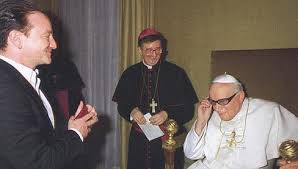
Bono sharing his signature sunglasses with St. John Paul II

Bono sharing his signature sunglasses with St. John Paul II

“It’s a mind-blowing concept that the God who created the universe might be looking for company, a real relationship with people, but the thing that keeps me on my knees is the difference between Grace and Karma. . . I really believe we’ve moved out of the realm of Karma into one of Grace. . . You see, at the center of all religions is the idea of Karma. You know, what you put out comes back to you: an eye for an eye, a tooth for a tooth, or in physics—in physical laws—every action is met by an equal or an opposite one. It’s clear to me that Karma is at the very heart of the universe. I’m absolutely sure of it. And yet, along comes this idea called Grace to upend all that “as you reap, so you will sow” stuff. Grace defies reason and logic. Love interrupts, if you like, the consequences of your actions, which in my case is very good news indeed, because I’ve done a lot of stupid stuff.”

– Bono interview with Michka Assayas, from Christianity Today, 2005

Posted in Uncategorized | Tagged , , , , , , , , | 12 Comments

Teilhard de Chardin Quote of the Week (March 17, 2014): Mysticism and Spirit

St.patrick

[I]t is clear that since all time Christianity has, by virtue of its structure, fallen into equilibrium in the direction of the spirit of unification and synthesis: God finally becoming all in all within an atmosphere of pure charity (‘sola caritas’). . . Nevertheless, that is far from meaning that the centric and centrifying character of the movement can be considered as having yet been perfectly defined, either in its mystical expression or in its dogmatic formulation. In the first place, mystically speaking, it is difficult not to be aware of considerable traces of fusionism in the appeals directed towards the inexpressible by an Eckhart or even a John of the Cross: as though, for those great contemplatives, the two isotopes of spirit were still appreciably confused.

Teilhard de Chardin, Pierre (1972-10-18). Activation Of Energy (p. 225). Houghton Mifflin Harcourt. Kindle Edition.

Posted in Teilhard Quote of the Week | Tagged , , , , , , , | 1 Comment

“Cosmos”: A Teaching Moment For The Church

Posted in Uncategorized | 2 Comments