

-
Recent Posts
-
Top Posts & Pages
- Writings By Teilhard de Chardin
- Teilhard de Chardin Quote of the Week (August 5, 2013): Mass on the World
- The Noosphere (Part I): Teilhard de Chardin's Vision
- Teilhard de Chardin and the Cross as Symbol for Purification of Being
- The Noosphere (Part II): Christian Concepts of the Noosphere
- 1 day 4 Popes
- About Me
- The Early Years (1881-1899)
- Life of Teilhard de Chardin: Discovery of Peking Man and Travels (1928-1940)
- Empty Your Cup, and Become What You Receive
Twitter Updates
Tweets by Teilhard_usArchives
Teilhard de Chardin
Ignatian Spirituality
- A Seat at the Table
- Blog at the Raft
- Creighton University On-Line Ministries
- God in All Things
- Ignatian Educator
- Ignatian Spirituality
- Ignatian Spirituality: Set the World Ablaze
- Jesuit Collaborative
- Jesuit Prayer
- Jesuit.org
- Keeping Company
- Living Space
- Magis Center for Catholic Spirituality
- Remembering Father Doyle
- Sacred Space
- The Teilhard Project
- This Ignatian Life
- Whosoever Desires
Reason, Science and Faith
Spirituality and Psychology
Other Cool Sites
- Anacephalaeosis
- Ancient Christian Wisdom
- Christian Humanist
- Concerned Catholics of Montana
- Cookie Crumbs to Live By
- Divine Office
- Filling My Prayer Closet
- Gaudete Theology
- Hunt for Truth
- Inner Explorations
- Jesus Creed
- Mags Blackie
- Meditation Travelogue
- Noah Project
- The Aspirational Agnostic
- The Culture Monk
- The Joy of Nine
- Today's Questions
- Word on Fire
- words of THE WORD
Categories
Meta
Teilhard de Chardin Quote of the Week (February 10, 2014): Communion with Others

It happens sometimes that a man who is pure of heart will discern in himself, besides the happiness which brings peace to his own individual desires and affections, a quite special joy, springing from a source outside himself, which enfolds him in an immeasurable sense of well being. This is the flowing back into his own diminutive personality of the new glow of health which Christ through his Incarnation has infused into humanity as a whole: in him, souls are gladdened with a feeling of warmth, for now they can live in communion with one another. They see with amazement that the monstrous multitude of human kind forms but one heart and one soul, indistinguishable from the Heart and Soul of Christ. But if they are to share in this joy and this vision they must first of all have had the courage to break through the narrow confines of their individuality, depersonalize themselves, so to speak, in order to become centered in Christ.
Teilhard de Chardin, Writings in the Time of War, p. 111.
Posted in Teilhard Quote of the Week, Uncategorized
Tagged agape, Catholic, Christ, Christian, Communion, God, joy, love, Omega Point, peace, Pierre Teilhard de Chardin, teilhard, teilhard de chardin, Unity, universal, Writings in Time of War
13 Comments
Sunday Reflection, Fifth Sunday in Ordinary Time (February 9, 2014): Salt of the Earth
“Share your bread with the hungry, shelter the oppressed and the homeless; clothe the naked when you see them, and do not turn your back on your own. Then your light shall break forth like the dawn, and your wound shall quickly be healed.” — Isaiah 58:7-8
This weekend is the Fifth Sunday in Ordinary Time. The readings can be found here. The theme is being a witness to the Christian faith in the world. Today’s reflection is from Living Space, a site of the Irish Jesuits. You can read the full reflection here but set forth below is an extended summary.
“Today’s Gospel follows immediately on the Beatitudes. And the readings are saying that the Beatitudes must not only be lived but seen to be lived. The Gospel reminds us that it is essential for the Christian disciple both to be seen and heard. Christianity is not a private religion. I am not just a Christian for me only. Christianity is a vision which is meant to change the world and there is no doubt that, to a great extent it has.
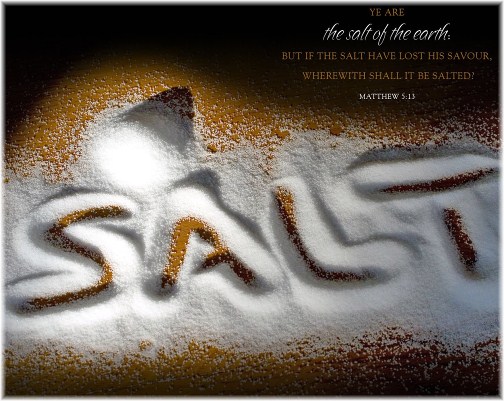
Jesus uses a string of images to express this: He wants his disciples to be the salt of the earth. Salt is a basic and essential item in our diet but it had a particular value in ancient culture. It is a purifier, a seasoning and a preservative. This was especially the case in the days before refrigeration. Today we tend to take too much salt and are warned against it. But in older times it was a precious and often expensive commodity and because of its value it was often a favourite item of taxation. We remember Gandhi’s famous campaign against the salt tax imposed by the British in India.
What Jesus emphasises is its distinctive taste. We often judge food by saying it has too little or too much salt. Christians then, by their Gospel-centred lives, are to give a distinctive taste to society. Those who really have the spirit of the Beatitudes (including non-Christians) will permeate the world, renew it and retard its social and moral decay.
But salt only produces its effect when it is totally merged with the food. It is indistinguishable from the rest of the food but its presence or absence is very obvious. The Christian, too, can only be truly effective when he or she is fully a member of society and, at the same time, gives an unmistakable taste to that society.
There have been times when Christians felt that they should keep away from the “world”. Monks and nuns, who were among the most committed Christians, built large walls around their property to keep the “world” out. (Although they did have a visibility of their own especially in an all-Christian society. Their very separation from the rest of society and the lives they led were mean to be a challenge. In a secular and pluralist society such a witness may give a very different message and be less effective.)
In our Western society, we often put salt on the side of the plate. This is like the Christian who does have taste but who lives on the fringes of society and makes no impact on it. This can happen very easily when, for instance, we have a parish which is only concerned with its own spiritual well-being and makes no effort to reach out. There are many parts of our society, especially the commercial, industrial and entertainment areas where the Church is often totally absent. The other extreme is when a Christian is totally immersed in secular society but has nothing to give. This is like the tasteless salt which is good for nothing.”
Posted in Sunday Reflections, Uncategorized
Tagged 5th Sunday in Ordinary Time, Beatitudes, Catholic, Christ, Christian, Fifth Sunday in Ordinary Time, Gospel of Matthew, Jesus, Matthew, Poor, Reflections for Fifth Sunday in Ordinary Time, salt, salt of the earth, service, Sunday Readings, Sunday Reflections, Unity
2 Comments
Sabbatical and View from Space

View of United Kingdom and Ireland from space. Note that there are no political borders, which is one of the many reasons I enjoy views from space.
I will be visiting my brother in England (with an excursion to Ireland to see some ancestral heritage) the next couple of weeks. I will have the Sunday Reflections and Teilhard de Chardin Quote of the Week but other postings and responses are likely to be sporadic.
Posted in Uncategorized
Tagged England, Ireland, peace, sabbatical, United Kingdom, Unity, view from space
10 Comments
Love, Shakespeare and Teilhard de Chardin
I came across this article by author, columnist, radio host and Lutheran minister Dr. Mark J. Molldrem in the Beaver Dam Daily Citizen newspaper. Beaver Dam is a small town in Wisconsin (population 16,243) close to where I live. The article speaks about February as the month of love with references to William Shakespeare and Teilhard de Chardin. You can read the entire article here but set forth below is an extended excerpt:
Every generation has its collection of songs and poems and stories about love that inspires the mind, warms the heart and emboldens the will. Love stirs the deepest level of the human spirit. Among the best of writers in our Western culture who has stirred the heart-strings of love in readers and theater-goers is William Shakespeare.
* * *
“…Love is not love/which alters when it alteration finds/…O, no! it is an ever-fixed mark,/That looks on tempests and is never shaken;” Love is the disposition of the soul towards another person that is the gift of committed relationship despite the “warts and all” in the other. Love’s throne is not the sexual organs, but the soul. This means that one can love even a scoundrel; it means that love can root deeper, even when the sexual blossoms have fallen off the flower; it means that love can grow in the midst of devastating circumstances; it also means that one can love the one with whom living in a marriage relationship is no longer viable and changes must be made. Love does not mean one has to “like” others or even do what only “feels comfortable and cozy” in relationship with others.
* * *
One may question the veracity with which to hold these insights without questions or provisional circumstances; yet, they do indeed challenge us to explore the depth of our own understanding and devotion to love—as they call us to delve deeper to discover that passionate fire that warms our breath. As Pierre Teilhard de Chardin (paleontologist priest) has written: “The day will come when, after harnessing space, the winds, the tides and gravitation, we shall harness for God the energies of love. And on that day, for the second time in the history of the world, we shall have discovered fire.”
Not Sure Whether to Laugh or Cry: Evolution and Faith
“Worship him, I beg you, in a way that is worthy of thinking beings” — Romans 12:1 (Jerusalem Bible Translation)
My news feed included this article from the Christian Science Monitor on a “debate” this evening between Bill Nye and Ken Ham. I am not the most up-to-date person on popular culture and I had not previously heard of either Bill Nye or Ken Ham. However, I was surprised to learn that this “debate” was moderated by CNN and will have over 80 news organizations in attendance.
I have previously compared “debates” like this as akin to a food fight between two-year olds: there is some nominal entertainment value but the level of intellectual discourse is nonexistent and there is a huge mess that needs to be cleaned up. I have also previously written about the poor state of scientific and theological literacy in Western Culture.
I do not have time to do a thorough reflection on this topic but I compare the Nye/Ham media event with a 2008 conference hosted by the Vatican Pontifical Academy of Sciences on “Scientific Insights into the Evolution of the Universe and Life”. This conference included leading scientists and theologians from around the world, including Stephen Hawking, Martin Rees, Francis Collins, Pope Benedict XVI, Cardinal Christoph Schönborn and many others.
There were over 600 pages of transcripts and discussions but a summary of the conference was provided by Professor Christian de Duve:
There was little disagreement on major issues. The participants unanimously accepted as indisputable the affirmation that the Universe, as well as life within it, are the products of long evolutionary histories. They rejected as objectively untenable the so-called ‘creationist’ view based on a literal interpretation of the biblical account of Genesis, a view not to be confused with the belief, legitimately held by many, in a creator God. Benedict XVI in his opening address to the participants proposed a valuable approach based on a metaphysical interpretation of the creation clearly different from that of the ‘Creationists’: ‘A decisive advance in understanding the origin of the cosmos was the consideration of being qua being and the concern of metaphysics with the most basic question of the first or transcendent origin of participated being. In order to develop and evolve, the world must first be, and thus have come from nothing into being. It must be created, in other words, by the first Being who is such by essence.’
Several contributions reviewed recent developments in cosmology. Attention was drawn to a number of still unsolved problems, including dark matter, dark energy, black holes, and the possibility that our Universe may be only one among a huge number of universes (multiverse), perhaps the only one that happens by chance to have physical constants such that complex forms of matter, including living beings, can arise. The latter hypothesis, however, is purely speculative and may well remain so, because of a lack of means of either proving or disproving it.
Special attention was paid to the solar system and, within this system, to planet Earth and the emergence of life on it. The question was raised whether other such systems, possibly including planets bearing life and, perhaps, intelligence, might exist elsewhere in our galaxy or in others. This has become a major subject of astronomical research. More than 300 planets have been discovered around nearby stars and intense efforts are made to devise technologies that would allow signs of life to be detected. The search for extraterrestrial intelligence (SETI) has been underway for some time and is being expanded, without, however, having yielded any positive result so far.
Many discussions were devoted to the origin and evolution of life. It was generally admitted that all known living beings, including humans, descend from a single ancestral form of life that appeared on Earth several billion years ago. How this form originated is not known but is believed by a majority of experts to have involved special chemical reactions that were rendered possible, perhaps even imposed, by the physical-chemical conditions under which they took place. Particularly impressive in this respect is the recent discovery that a number of typical building blocks of life, including sugars, amino acids, and nitrogenous bases, arise spontaneously, together with numerous other organic compounds, in many parts of the Universe. Not all scientists, however, believe this remarkable fact to be relevant to the origin of life.
A key event in the long history of life on Earth was the appearance, between 2.4 and 2.0 billion years ago, of molecular oxygen, a product of photosynthetic organisms and an essential prerequisite to the formation of aerobic forms of life, including all animals (and humans). Another decisive event was the development of eukaryotic cells which eventually gave rise to the multicellular plants, fungi, animals, and humans. Although many details remain to be clarified, the actual occurrence of biological evolution is no longer just a theory, strongly suggested by fossil evidence, but not conclusively demonstrated by it. Evolution is now supported by overwhelming molecular proofs and has acquired the status of established fact. In the words of His Holiness John Paul II, it is “more than a hypothesis”.
A link to all of the speeches and discussions is set forth below. I hope to discuss these topics in more depth in the future but in the mean time I am deciding whether to laugh or cry over the level of the level of scientific and theological discourse in our culture.
Scientific Insights into the Evolution of the Universe and of Life
Posted in Reason and Faith, Uncategorized
Tagged Bill Nye, Cardinal Christoph Schönborn, creationism, evolution, faith and reason, Francis Collins, Ken Ham, Martin Rees, Pierre Teilhard de Chardin, Pontifical Academy of Sciences, Pope Benedict XVI, science and faith, Stephen Hawking, teilhard, teilhard de chardin, Vatican
2 Comments
The 10th Anniversary of the Launch of Facebook and the Noosphere

Today is the tenth anniversary of the launch of Facebook by Mark Zuckerberg. I am not a regular Facebook user. I have a Teilhard de Chardin fan page and for my other identity I mostly use it to see the pictures that my wife posts of our children and follow the activities of friends. However, I am amazed at how ubiquitous it is. I was reading a post on Jericho Tree this morning on this phenomenon and some stats are interesting:
By the end of 2013, Facebook was being used by 1.23 billion users worldwide, adding 170 million in just one year.
* * *
“What Facebook is doing with a site used by 1 billion people a day is an order of magnitude greater than anything – it’s a remarkable feat of engineering,” he said, pointing to the fact that London is still the only English-speaking city in Facebook’s top 10. “It’s not just about the US anymore – tech is now a global phenomenon.
Over 60 years ago, Teilhard de Chardin predicted that the next stage of human evolution would be a widespread convergence of human consciousness in what he called the Noosphere. As Teilhard de Chardin wrote on January 18, 1950:
“Essentially, in the twofold irresistible embrace of a planet that is visibly shrinking, and Thought that is more and more rapidly coiling in upon itself, the dust of human units finds itself subjected to a tremendous pressure of coalescence, far stronger than the individual or national repulsions that so alarm us. But despite the closing of this vise nothing seems finally capable of guiding us into the natural sphere of our interhuman affinities except the emergence of a powerful field of internal attraction, in which we shall find ourselves caught from within. The rebirth of the Sense of Species, rendered virtually inevitable by the phase of compressive and totalizing socialization which we have now entered, affords a first indication of the existence of such a field of unanimization and a clue to its nature.”
Pierre Teilhard de Chardin. The Future of Man (Kindle Locations 4429-4434).
The rapid development of technology (including sites such as Facebook) are starting to break down the tribal barriers that have existed for over 200,000 years and we are currently experiencing the beginning stages of the Noosphere as predicted by Teilhard de Chardin.
Posted in Uncategorized
Tagged Catholic, Christian, Facebook, jericho tree, Mark Zuckerberg, Noosphere, Omega Point, Pierre Teilhard de Chardin, teilhard, teilhard de chardin, Unity
10 Comments
Teilhard de Chardin Quote of the Week (February 3, 2014): Unification of Humanity
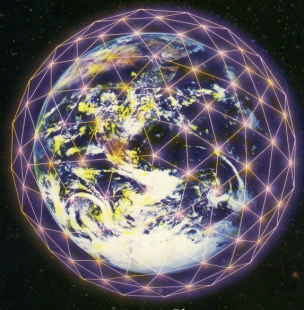
A depiction of the Noosphere
From his Essay: “The Psychological Conditions of the Unification of Man”
If there is one event that is insidiously and irresistibly engrossing our thoughts, adding every day a further complication, it is undoubtedly that of the unification of man. All around us the ride of the world’s economic, political and psychic socialization is continually invading, and even submerging, the life of even the humblest.
Teilhard de Chardin, Pierre (1972-10-18). Activation Of Energy (Kindle Locations 1961-1963). Houghton Mifflin Harcourt. Kindle Edition.
Sunday Reflection, Feast of the Presentation of the Lord (February 2, 2014): Helping to Heal a Broken World

An example of what Teilhard de Chardin may have experienced in World War I
This weekend is the Feast of the Presentation of the Lord. The readings can be found here. This Feast occurs at the end of the Infancy Narratives in the Gospel of Luke and is rich with symbolism of both the continuity of Christianity as an evolution of Jewish theology and the message of the commonality of all humanity that Christianity offers.
The reflection for this week however, comes from a homily given last weekend by friend of the blog, Deacon David Backes. Dr. Backes used Pope Francis’ imagery of the Church as a field hospital in a battlefield. This description was more than a metaphor in the life of Teilhard de Chardin. Teilhard served as a stretcher bearer in World War I and was present as some of the bloodiest battles of the trench warfare of the war. For his bravery, Teilhard was awarded For his bravery Teilhard was awarded the Medaille Militaire and the Croix de Guerre.
This experience had a formative effect on Teilhard’s philosophy and during this period he developed some of his key ideas of the evolution of humanity towards the Noosphere and how suffering is sometimes a necessary element in the transformation of humanity (both at the individual and collective level).
Dr. Backes’ homily focuses on how healing power can transform us to break down the barriers that divide us to recognize our common humanity. I encourage you to read the entire homily here but set forth below is an extended summary:
We are naturally drawn to people who use their authority not to condemn, not to force things upon us, but to listen, to touch, to show compassion. In short, to heal.
That’s what we see in the Gospels. That’s the way Jesus lived out his own authority. In today’s reading we see two things going on: Jesus announces that the kingdom of God is not only for some distant future but is present right now; and then he invites people in by preaching the word, calling people by name, and especially by healing.
About a third of the content of the Gospels relates to healing. Jesus made it clear that the healing of our bodies, our emotions, our spirits, is at the very heart of the kingdom of God among us. The healings were not simply for those who received them. They were for everyone. They were powerful signs that helped open people’s hearts to the possibility that the reign of God IS now, just like Jesus said. They showed people that sin did not take away God’s love and mercy; that they were beloved children of God and if they took the chance to take his hand he would never let go.
Pope Francis is trying to restore that same dynamic today. He sees a world that is very unforgiving, and a Church that too often enters into that unclean spirit of the world. He says, “The thing the church needs most today is the ability to heal wounds and to warm the hearts of the faithful…. I see the church as a field hospital after battle. It is useless to ask a seriously injured person if he has high cholesterol and about the level of his blood sugars! You have to heal his wounds. Then we can talk about everything else. Heal the wounds, heal the wounds.”
In the Gospel, we see Jesus heal the wounds, and that built up hope and drew people to him, people who were more ready to listen to his life-giving words. And then he started to grow his kingdom by calling people and inviting them to join him. Now, our Gospel passage makes it sound as though the apostles dropped everything right at that very moment and took off with Jesus. But in the Gospel of Luke, this calling of the apostles occurs after Jesus has been in Capernaum for a while. In fact, Peter had come to know Jesus earlier, when Jesus came into his home and cured his mother-in-law of a severe fever. Even for the apostles, being exposed to Jesus’ healing ministry helped open their hearts to his calling.
So it is with us today. The world is filled with such suffering, and such unhealthy responses to it, that for the Church to really show us the reality of Christ it must become like a field hospital after battle, healing wounds and opening hearts in the process. We are all the church, so this means each of us.
This week I pray for the grace to follow the call of Pope Francis and emulate the example of Teilhard de Chardin to help heal the wounds that I have caused through my selfishness and inaction.
Posted in Sunday Reflections
Tagged Catholic, David Backes, Deacon David Backes, Feast of the Presentation of the Lord, field hospital, Fourth Sunday in Ordinary Time, France, Gospel of Luke, healing, Mass, Noosphere, Omega Point, pain, Pierre Teilhard de Chardin, Pope Francis, spirituality, Sunday Readings, Sunday Reflection, teilhard, teilhard de chardin, Unity, universality, World War I
5 Comments
 Teilhard de Chardin