St. Francis of Assisi (October 4)

St. Francis of Assisi

St. Francis of Assisi

St. Francis lived 800 years ago. For both Christians and non-Christians, he is one of the most popular and respected Christian saints. He had a radical message for the love of God and creation. When Cardinal Jorge Mario Bergoglio was elected Pope, he said that “he took to heart the words of his friend [who told him to remember the poor] and chose to be called after St. Francis of Assisi, ‘the man of poverty, the man of peace, the man who loves and protects creation,’ the same created world with which we don’t have such a good relationship. How I would like a church that is poor and that is for the poor,’ ” You can read more about the significance of Cardinal Bergoglio taking the name of Francis of Assisi in the articles in America Magazine here and here by Franciscan Daniel P. Horan.

I note with irony that the first Jesuit Pope would choose the name of the founder of the Franciscans and that a Franciscan would write glowingly of the first Jesuit Pope in a Jesuit magazine. This is a very impressive symbol of harmony as it was a Franciscan Pope (Clement XIV) who suppressed the Jesuits, not to mention the otherwise turbulent history of these two orders.

Francis was born, one of seven children, in September 1181 the son of Pietro di Bernardone, a wealthy cloth merchant, and his wife Pica Bourlemont in Assisi, in Tuscany, Italy. As a young man he helped his father in running the family business but was also prominent in the social life of the pleasure-seeking well-off.

Already at this stage his concern for the poor and outcasts, such as lepers, was noticeable.  One day he heard a voice which seemed to come from a crucifix in the small rundown church of San Damiano in Assisi.  It said: “Francis, Francis, go and repair my house which, as you can see, is falling into ruins.”  Francis understood the words literally and immediately got to work. He sold some of his father’s cloth in order to pay for the repairs.  This led to a lengthy dispute with his father which ended in Francis renouncing his inheritance and getting rid of his fancy and expensive clothes. The bishop of Assisi gave him some simple attire and Francis embarked on a totally new way of living.  In the beginning, his aim was primarily devotional. He wanted to be close to Christ on the Cross.  But later he would also declare his allegiance to Lady Poverty, using the contemporary language of courtly love.  He began to lead a life of extreme simplicity. With money he begged from the people of Assisi he was able to rebuild the church of San Damiano.  In fact, he restored several ruined churches, among them the Porziuncola, the little chapel of St Mary of the Angels, just outside Assisi, which later became his favorite abode.

He became a wandering beggar, in solidarity with those who were genuinely poor (and they would have been many).  He looked after social outcasts, especially lepers (and those who were thought to have leprosy).  There is the famous image of him overcoming his distaste and fear by embracing a leper. Then seven other men joined him. They lived together at the Porziuncula in Assisi, close to a leper colony.

Within a year Francis had eleven followers. Francis chose never to be ordained a priest and the community lived as “lesser brothers” (fratres minores) – the name by which the order is still known. The brothers lived a simple life in the abandoned leper house of Rivo Torto near Assisi.  They spent much of their time as wandering preachers in Umbria, bringing a message of cheer and song and making a deep impression on the people.

In 1209 Francis led his followers to Rome to seek permission from Pope Innocent III to found a new religious order. The pope agreed to meet with Francis and his companions.  He consented to an informal recognition of the group and, when they had increased in numbers, they could return for more formal recognition. The group then received the tonsure and Francis himself was ordained deacon, allowing him to read the Gospel in church. Obedience to the pope would be a central feature of Francis’ First Rule (Regula Prima) drawn up and approved in 1210.

Among those who heard Francis preach was Clare of Assisi and she immediately knew to what she was called. Her brother Rufino, too, joined the new order.  On Palm Sunday, March 28, 1211 Francis received Clare at the Porziuncola and thus was founded the Order of Poor Dames, later called Poor Clares.

The friars increased greatly in numbers (up to 5,000), new houses were being established outside Italy.  The greater numbers now called for better organisation and administration which Francis’ simple rules could not deal with.  The Church authorities, too, saw the Order as an important instrument of reform, even to making some of the friars bishops.  Francis felt that this might compromise the witness through poverty which was in itself a criticism of the materialist attitudes affecting the Church.  Francis then resigned his position as Minister General at the General Chapter of 1220. In this way, Pope Benedict XVI, predecessor to Pope Francis, was also emulating the actions of Francis.

He was succeeded by Brother Elias of Cortona. In 1221 Francis drew up another Rule. After some changes, it was finally approved as the Regula Bullata by Pope Honorius III.  The Order now had the full approval of the Church authorities but it involved concessions with which Francis was not at all happy. In 1221 Francis also initiated the Third Order by which married people could live according to the Franciscan spirituality.

It is in the later years of his life that some of the best known events took place.  They include the setting up of a Christmas crib.  It is said that Francis – who was never more than a deacon – read the Gospel with such passion that people wept.  The famous Canticle of the Sun was written in 1224 when he visited Clare, who was seriously ill at the time. And it was also in 1224 that, during an ecstasy, he experienced the stigmata, by which the wounds of the crucified Jesus appeared on his body.

It was soon after this that he became ill and also blind.  He suffered greatly from well-intentioned but crude surgery.  In the end he was brought back to the transito, the hut for sick friars, next to the Porziuncola. Here, in the place where it all began and feeling the end approaching, he spent the last days of his life dictating his spiritual testament. He died on the evening of October 3, 1226 singing Psalm 141.  He was just 45 years of age.

He was canonized, only two years after his death, on July 16, 1228 by Pope Gregory IX.  The following day, the pope laid the foundation stone for the Basilica of Saint Francis in Assisi.   Assisi is now a pilgrimage center for people from all over the world. He is regarded as the patron saint of animals, birds, the environment, and Italy. 

Sources:

Living Space
Wikipedia

Posted in Uncategorized | Tagged , , , , , , , , , , , , | 5 Comments

Scientific Potpourri (October 4, 2013)

Curiosity Rover Struck Water on Mars

Curiosity Rover Struck Water on Mars

Below are some of the top stories in astronomy, cosmology and evolutionary biology from the last couple of weeks:

Curiosity Finds Lots of Water on Mars. From The Guardian: Water has been discovered in the fine-grained soil on the surface of Mars, which could be a useful resource for future human missions to the red planet, according to measurements made by NASA’s Curiosity rover. Each cubic foot of Martian soil contains around two pints of liquid water, though the molecules are not freely accessible, but rather bound to other minerals in the soil. The Curiosity rover has been on Mars since August 2012, landing in an area near the equator of the planet known as Gale Crater. Its target is to circle and climb Mount Sharp, which lies at the center of the crater, a five-kilometer-high mountain of layered rock that will help scientists unravel the history of the planet.

Early Hominoids Saw Black Hole Light in the Sky. From New Scientist: Some 2 million years ago, around the time our ancestors were learning to walk upright, a light appeared in the night sky, rivalling the moon for brightness and size. But it was more fuzzball than orb. The glow came from the supermassive black hole at our galaxy’s heart suddenly exploding into life. This novel picture emerges from work announced this week at a conference in Sydney, Australia, which ingeniously pieces together two seemingly unrelated, outstanding galactic puzzles.

Scientists Create Never Before Seen Form of Matter.  From Science Daily: Harvard and MIT scientists are challenging the conventional wisdom about light, and they didn’t need to go to a galaxy far, far away to do it. Working with colleagues at the Harvard-MIT Center for Ultracold Atoms, a group led by Harvard Professor of Physics Mikhail Lukin and MIT Professor of Physics Vladan Vuletic have managed to coax photons into binding together to form molecules — a state of matter that, until recently, had been purely theoretical. The work is described in a September 25 paper in Nature. The discovery, Lukin said, runs contrary to decades of accepted wisdom about the nature of light. Photons have long been described as massless particles which don’t interact with each other — shine two laser beams at each other, he said, and they simply pass through one another.

Ancient Soils Reveal Clues About Early Life on Earth. From Science Daily: Oxygen appeared in the atmosphere up to 700 million years earlier than we previously thought, according to research published today in the journal Nature, raising new questions about the evolution of early life. Researchers from the University of Copenhagen and University of British Columbia examined the chemical composition of three-billion-year-old soils from South Africa — the oldest soils on Earth — and found evidence for low concentrations of atmospheric oxygen. Previous research indicated that oxygen began accumulating in the atmosphere only about 2.3 billion years ago during a dynamic period in Earth’s history referred to as the Great Oxygenation Event.

Lunar Orbiters Discover Source of Space Weather Near Earth.  From Science Daily: Solar storms — powerful eruptions of solar material and magnetic fields into interplanetary space — can cause what is known as “space weather” near Earth, resulting in hazards that range from interference with communications systems and GPS errors to extensive power blackouts and the complete failure of critical satellites. New research published today increases our understanding of Earth’s space environment and how space weather develops. Some of the energy emitted by the sun during solar storms is temporarily stored in Earth’s stretched and compressed magnetic field. Eventually, that solar energy is explosively released, powering Earth’s radiation belts and lighting up the polar skies with brilliant auroras. And while it is possible to observe solar storms from afar with cameras, the invisible process that unleashes the stored magnetic energy near Earth had defied observation for decades.

Massive Dinosaur Fossil Unearthed in Canada. From the CBC: A massive dinosaur fossil has been found by a pipeline crew near Spirit River, Alta. The 30-metre-long fossilized skeleton was found Tuesday when a backhoe operator working on the Tourmaline Oil Corp. pipeline installation moved some earth, inadvertently breaking off a piece of the fossil. Thinking he had simply chipped off a section of rock, the backhoe operator laid the piece to the side and turned to resume excavation work. That’s when he saw the exposed fossil in the embankment in front of him. As soon as he saw the fossil, the operator stopped digging and work on the site was shut down until experts could be brought in. Palaeontologists from the Tyrell Museum and National Geographic arrived at the site Wednesday and will soon be joined by Pipestone Creek Dinosaur Initiative head palaeontologist, Dr. Matthew Vavrek.


Posted in Uncategorized | Tagged , , , , , , , , , , , , , , | 3 Comments

Intersection of Faith and Science: Vatican Astronomer Guy Consolmagno, S.J. (More Interviews)

Brother Guy Consolmagno, S.J. at the intersection of faith and science

Brother Guy Consolmagno, S.J. at the intersection of faith and science

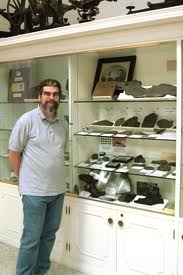
One of my favorite speakers is Brother Guy Consolmagno, S.J. Consolmagno is an M.I.T. graduate and research astronomer and planetary scientist at the Vatican Observatory. Consolmagno has served on the governing boards of the Meteoritical Society; the International Astronomical Union’s (IAU) Division III, Planetary Systems Science (secretary, 2000 – present) and Commission 16, Moons and Planets (president, 2003-2006); and the American Astronomical Society Division for Planetary Sciences (chair, 2006-2007). He has also authored or coauthored five astronomy books. His full biography is set forth below. Due to his work as a world-class astronomer and a Jesuit, Consolmagno is directly positioned at the intersection of faith and science.

This week, I had the pleasure of listening to a recent podcast interview on the outstanding site Catholic Lab. For those who are not familiar with that site, I highly recommend it as the host, Ian Maxfield, does a great job of resources, including podcasts, books, downloads, etc. that show the long and largely harmonious history of faith and science. His interview with Brother Consolmagno is another treat and I highly recommend it.

For good measure, set forth below is a Brother Consolmagno’s 2013 TEDx presentation which is outstanding.

Here is a link to other interviews with Brother Consolmagno. Here is Brother Consolmagno’s full biography from the Vatican Observatory:

Br. Guy Consolmagno SJ was born in 1952 in Detroit, Michigan. He obtained his Bachelor of Science in 1974 and Master of Science in 1975 in Earth and Planetary Sciences from the Massachusetts Institute of Technology, and his PhD in Planetary Science from the University of Arizona in 1978. From 1978-80 he was a postdoctoral fellow and lecturer at the Harvard College Observatory, and from 1980-1983 continued as postdoc and lecturer at MIT.

In 1983 he left MIT to join the US Peace Corps, where he served for two years in Kenya teaching physics and astronomy. Upon his return to the US in 1985 he became an assistant professor of physics at Lafayette College, in Easton, Pennsylvania, where he taught until his entry into the Jesuit order in 1989. He took vows as a Jesuit brother in 1991, and studied philosophy and theology at Loyola University Chicago, and physics at the University of Chicago before his assignment to the Vatican Observatory in 1993.

In spring 2000 he held the MacLean Chair for Visiting Jesuit Scholars at St. Joseph’s University, Philadelphia, and in 2006-2007 held the Loyola Chair at Fordham University, New York. He has also been a visiting scientist at the Goddard Space Flight Center and a visiting professor at Loyola College, Baltimore, and Loyola University, Chicago.

Br. Consolmagno has served on the governing boards of the Meteoritical Society; the International Astronomical Union’s (IAU) Division III, Planetary Systems Science (secretary, 2000 – present) and Commission 16, Moons and Planets (president, 2003-2006); and the American Astronomical Society Division for Planetary Sciences (chair, 2006-2007).

He has coauthored five astronomy books: “Turn Left at Orion” (with Dan M. Davis; Cambridge University Press, 1989); “Worlds Apart” (with Martha W. Schaefer; Prentice Hall, 1993); “The Way to the Dwelling of Light” (U of Notre Dame Press, 1998); “Brother Astronomer” (McGraw Hill, 2000); and “God’s Mechanics” (Jossey-Bass, 2007). He also edited “The Heavens Proclaim” (Vatican Observatory Publications, 2009).

Br. Consolmagno is curator of the Vatican meteorite collection in Castel Gandolfo, one of the largest in the world. His research explores the connections between meteorites and asteroids, and the origin and evolution of small bodies in the solar system. In 1996, he spent six weeks collecting meteorites with an NSF-sponsored team on the blue ice of Antarctica, and in 2000 he was honored by the IAU for his contributions to the study of meteorites and asteroids with the naming of asteroid 4597 Consolmagno.


Posted in Reason and Faith | Tagged , , , , , , , , , , | 14 Comments

Teilhard de Chardin Quote of the Week (September 30, 2013): Unity in Diversity and Love

earth_love

“Christianity is pre-eminently a faith in the progressive unification of the world in God; it is essentially universalist, organic and ‘monist’. There is obviously some special quality in this ‘pan-Christic’ monism. Since, from the Christian point of view, the universe is finally and permanently unified only through personal relations (that is, under the influence of love) the unification of beings in God cannot be conceived as being effected by fusion, with God being born from the welding together of the elements of the world, or on the contrary by absorbing them in himself. It must be effected by ‘differentiating’ synthesis, with the elements of the world becoming more themselves, the more they converge on God. For it is the specific effect of love to accentuate the individuality of the beings it associates more closely. Ultimately, God is not alone in the totalized Christian universe (in the pleroma, to use St Paul’s word); but he is all in all of us (‘en pasi panta theos’): unity in plurality.” (emphasis added)

Teilhard de Chardin, Pierre (2002-11-18). Christianity and Evolution (Harvest Book, Hb 276) (Kindle Locations 2276-2284). Houghton Mifflin Harcourt. Kindle Edition.

Posted in Teilhard Quote of the Week | Tagged , , , , , , , , , , , | 2 Comments

Feast of St. Jerome (September 30)

St. Jerome

St. Jerome

Saint Jerome (347 — 420) was a theologian and historian, who also became a Doctor of the Church. He is best known for his translation of the Bible into Latin (the Vulgate), and his commentaries on the Gospel of the Hebrews. His list of writings is extensive and he is widely regarded as one of the leading theologians of the Patristic Age.

Jerome was born about 341 at Strido in Dalmatia (modern-day Croatia). He received his first education from his father and then was taught by the grammarian Donatus in Rome. His study of rhetoric is apparent in the quality of his later writing. Prior to his baptism just before 366 he liked to visit the churches and catacombs of Rome. He also travelled in Gaul, his native Dalmatia, and Italy. It was at Trier he decided to become a monk with some good friends in Aquileia. But, after a quarrel, arising from some real or supposed scandal, Jerome left for Palestine. In 374 he was in Antioch in Syria where two of his companions died and Jerome himself became seriously ill. It was during his sickness that he had a dream in which he saw God condemning him for being a Ciceronian rather than a Christian and this experience affected him for a number of years. He became a hermit in the Syrian desert for five years, gave up his beloved classics and began learning Hebrew in order to study the Old Testament in its original language. With his knowledge of Greek and his training in style and rhetoric, he was now ready for his future work as a writer and translator.

Unfortunately Jerome also had the reputation of being cantankerous and sarcastic which led to his making a number of enemies all during his life.

He was raised to the priesthood in Antioch, even though he did not want to be ordained and in fact never celebrated the Eucharist. He then went to study in Constantinople under Gregory of Nazianzus where he felt more at home than with monks in the deserts of Syria. He translated Eusebius’ Chronicle from Greek into Latin as well as some of Origen’s homilies. He also wrote his first scriptural work on the Vision of Isaiah, which in a later form was dedicated to Pope Damasus I.

He returned to Rome as interpreter to Paulinus, a claimant to the See of Antioch, and was retained as ‘secretary’ by Damasus, then a very old man. He produced a number of small pieces, mainly involving translations of scripture. It was at this point that he began the enormous task of making a standard Latin text of the whole Bible. It was not really a completely new translation but more a revision of existing texts made from the original Hebrew and Greek. He began with the four gospels and the psalms. He eventually completed almost the whole text of the Bible which became known as the Vulgate (literally, ‘popularised version’). He also wrote much appreciated commentaries on the Prophets and the Letters of the New Testament. His commentary on Matthew’s gospel became a standard work.

During his three years in Rome he also became the spiritual director of a group of semi-monastic women. This relationship gave rise to some gossip, generally regarded as unjustified but it was not helped by his sarcasm and arrogance. He left Rome in 385, as he had left Syria and Constantinople before, under something of a cloud. He determined to make a new start, this time in Bethlehem, where Paula, one of his Roman directees, established a convent and Jerome a monastery. It was here that he would spend the rest of his life teaching, writing and studying.

During his life he had three aims: to produce the most accurate version of the Bible and explaining the meaning of the text through sound interpretation. He also believed that monastic life should be based on Scripture-centered prayer, what we now call Lectio Divina. Such a life should be based on the teachings of the Gospel and Paul and its finest example was Mary.

Although marred by his difficult temperament, his learning had no equal at that period except for Augustine. His Letters are regarded as the finest of the time. And his deep spirituality and austerity of life were unquestioned.

Jerome died in Bethlehem on September 30, 420 and was buried under the church of the Nativity there, close to the graves of his spiritual companions, Paula and Eustochium, and close to the traditional site of the birth of Christ. Later his body was translated to the basilica of St. Mary Major in Rome.

In art, it has been common to represent Jerome as a cardinal, although there was no such thing at the time. Even when shown as a scantilly clad anchorite, with cross, skull and Bible as the only furniture of his cell, the red hat or some other indication of his rank is usually introduced somewhere. He is also often shown with a lion, due to a medieval story in which he removed a thorn from a lion’s paw, and, less often, an owl, the symbol of wisdom and scholarship. Writing materials and the trumpet of final judgment are also part of his iconography. One Renaissance pope commented that it was well Jerome was shown holding a stone, representing his penitential life, because otherwise it would be difficult to regard him a saint!

He is recognised as a saint by the Catholic Church, the Eastern Orthodox Church, the Lutheran Church, and the Church of England (Anglican Communion). 

Sources:

Living Space
Wikipedia

Posted in Uncategorized | Tagged , , , , , , , , , | 3 Comments

Sunday Reflection, 26th Sunday in Ordinary Time (September 29, 2013): Establishing the “I-Thou” Relationship

Humans were made for interconnectiveness in an "I-Thou" relationship

Humans were made for interconnectiveness in an “I-Thou” relationship

“This encounter with personalism [in the thought of Martin Buber] was for me a spiritual experience that left an essential mark” — Pope Benedict XVI

“When I confront a human being as my Thou and speak the basic word I-Thou to him, then he is no thing among things nor does he consist of things. He is no longer He or She, a dot in the world grid of space and time, nor a condition to be experienced and described, a loose bundle of named qualities. Neighborless and seamless, he is Thou and fills the firmament. Not as if there were nothing but he; but everything else lives in his light.” — Martin Buber

This Sunday is the 26th Sunday in Ordinary Time. You can find the readings here. The Gospel reading is the famous story of the rich man and Lazarus. The rich man is condemned to eternal absence of God, not for actions he did, but for his inaction of ignoring Lazarus, the poor beggar outside his door. This story highlights a key insight of what it means to be human, one that profoundly affected by spiritual life.

Humans are deeply interconnected. We are meant to be in relationship with each other and with our Creator. Martin Buber, the 20th century Jewish philosopher who deeply influenced the thought of Pope Benedict XVI, described this interconnectivenss as a successive series of individuals treating others as unique children of God, rather than objects to be used. Buber termed this the “I-Thou” relationship. According to the site AngelFire:

“Martin Buber’s I and Thou (Ich und Du, 1923) presents a philosophy of personal dialogue, in that it describes how personal dialogue can define the nature of reality. Buber’s major theme is that human existence may be defined by the way in which we engage in dialogue with each other, with the world, and with God.

According to Buber, human beings may adopt two attitudes toward the world: I-Thou or I-ItI-Thou is a relation of subject-to-subject, while I-It is a relation of subject-to-object. In the I-Thou relationship, human beings are aware of each oher as having a unity of being. In the I-Thou relationship, human beings do not perceive each other as consisting of specific, isolated qualities, but engage in a dialogue involving each other’s whole being. In the I-It relationship, on the other hand, human beings perceive each other as consisting of specific, isolated qualities, and view themselves as part of a world which consists of things. I-Thou is a relationship of mutuality and reciprocity, while I-It is a relationship of separateness and detachment.

Buber explains that human beings may try to convert the subject-to-subject relation to a subject-to-object relation, or vice versa. However, the being of a subject is a unity which cannot be analyzed as an object. When a subject is analyzed as an object, the subject is no longer a subject, but becomes an object. When a subject is analyzed as an object, the subject is no longer a Thou, but becomes an It. The being which is analyzed as an object is the It in an I-It relation.”

Early in human history our ancestors turned away from God and lost that interconnectiveness, as told by the second creation story in Genesis. We are living with the consequences of that loss today.

The Gospel clearly highlights the consequences of the loss of the “I-though” relationship and replacing it with the “I-it” relationship. In the Gospel, the rich man loses sight of Lazarus as a unique person created in the image of God and ignores him completely. That is a common occurrence, especially in modern Western civilization with our emphasis on individual rights and materialism. I am profoundly guilty of this in many of my actions, from walking past a beggar on the street, to looking at a woman lustfully, to being indifferent to a check-out clerk earning minimum wage, to ignoring the human and environmental impact of my latest iPhone or food choices. In so many aspects of my life, I am treating others as mere commodities to serve my needs, rather than as unique persons made in the image of God.

Today’s reflection is from Deacon David Backes of the outstanding blog New Wood. Deacon Backes highlights the pervasiveness of the “I-it”relationship in the United States:

“Dressed in blue jeans and a tee shirt, the young woman sat on a railing 16 stories above the canal. Just 26 years old, she was thinking of taking her life by jumping into the frigid sea water far below. On the lanes of the Interstate 5 bridge behind her, Seattle’s early morning rush hour began congesting. It was August 28, 2001, two weeks away from the terrorist attacks on the other side of the country. What happened in Seattle might not make the history books, but it is an important sign of our times, a spiritual parable that fits well with our readings today.

In the first reading, the prophet Amos speaks of the danger facing those who are complacent about the suffering of others, those who stretch comfortably on their couches, eating and drinking to their desire, focused on their own entertainment. It is not only a sign of spiritual death, says Amos, but when a society falls into the trap of materialism it can bring about real-world ruin as well.

That morning in Seattle, the spiritual sickness of our culture was on full display. Police arrived quickly to begin trying to talk the young woman out of jumping. Within the first seven minutes at least three motorists, angry about being slowed down, shouted at her to jump. The police later told reporters that this is pretty common in these situations, actually. And yet on this day it got worse, to the point where the police ended up shutting down the entire bridge. For four hours they kept it shut, as they talked to the woman and encouraged her not to give up.

Horns honked; windows got cranked down in irritation as people down below grew frustrated over not being able to move. More people yelled “jump,” usually followed by a word that I can’t say here. Several people down below figured out how to make a sign that said ‘jump,” hoping the woman would see it.”

I encourage you to read the rest of the homily here.

Posted in Sunday Reflections | Tagged , , , , , , , , , , , , , , | 7 Comments

Heroic Leadership, Jesuit Style, and Pope Francis

Chris Lowney recognizes Pope Francis as a Heroic Leader in the Jesuit tradition

Chris Lowney recognizes Pope Francis as a Heroic Leader in the Jesuit tradition

I told myself that I would refrain from discussing Pope Francis’ interview last week as that subject was widely covered elsewhere. I have largely stuck to that other than a brief reference to Blessed Peter Faber, S.J., one of the significant influences on Pope Francis. I am going to bend this rule again (bend only as I am only going to talk about Pope Francis’ leadership style, not the substance of the interview).

Chris Lowney did a brief piece on Pope Francis and I recently found out he wrote a book on Pope Francis that is going to be published next week. Many people have not heard of Chris Lowney but he has a truly unique story. Lowney spent seven years as Jesuit seminarian before leaving to work for J.P. Morgan & Co. He had a very successful business career, rapidly advancing up the leadership ranks at J.P. Morgan, holding senior positions in New York, Tokyo, Singapore and London. Lowney retired early in 2001 to focus on writing and charitable activities. During his business career, Lowney modeled his leadership style from what he learned during his Jesuit training. The first book that Lowney wrote was “Heroic Leadership: Best Practices from a 450 Year Old Company” that describes the Jesuit leadership style. According to Lowney, the Jesuit approach to leadership eschews flashy techniques and focuses on four core pillars:

  • Self-awareness: Understanding your strengths, weaknesses, values, and worldview
  • Ingenuity: Confidently innovating and adapting to a changing world
  • Love: Engaging others with a positive attitude that unlocks their potential
  • Heroism: Energizing yourself and others with heroic ambitions and a passion for excellence

The four principles address a person’s whole life—personal and professional–and are rooted in the idea that we are all leaders. They form an integrated way of living, a modo de proceder (“our way of doing things”) as the Jesuits called it.

The Jesuit approach scraps the “command and control” model that relies on one great person to lead the rest. Convinced that people perform best in a supportive climate, St. Ignatius of Loyola and his colleagues sought to create environments filled with “greater love than fear.” They lodged their hopes in the talents of their entire team, showing that success flows from the commitment of many, not the isolated efforts of one. In my professional life (a corporate law firm), I have tried to use many of these techniques and they work. On my white board at work, I have the initials: SILH (self-awareness, ingenuity, love, heroism).

We are seeing the leadership style that Lowney describes in Pope Francis. According to the article by Lowney published today in National Catholic Register:

“Who is Jorge Mario Bergoglio?” Jesuit Fr. Antonio Spadaro asked the pope during their now-famous August interviews. While most politicians or celebrities would have batted a self-promoting answer to that softball question, here’s what the pope said: “I am a sinner.” He was taking a page from Ignatius of Loyola’s Spiritual Exercises, which include some bruising meditations on personal sin: “I will look upon myself as a sore and abscess from which have issued such great sins.”

But that’s no “downer” in Francis’ and Ignatian spirituality; it’s plain speaking about the human condition. And even though postmoderns here in cosmopolitan New York might reject Catholic “sin talk,” all can resonate with the pope’s vision of a “battlefield hospital” church that focuses first on healing. We’re all deeply flawed, popes included, but inherently dignified and unconditionally loved by God nonetheless.

* * *

Francis said he was initially drawn to the Jesuits for three reasons, one of them its “missionary spirit.” Ignatius of Loyola exhorted Jesuits to live “with one foot raised,” ever ready to seize the next opportunity. He also instituted a special fourth vow of obedience for many fully formed Jesuits: to be always available to be sent on mission by the pope.

That mindset unleashed extraordinary centrifugal energy among early Jesuit generations, who famously sought out the frontiers of the world then known to Europeans. The pope’s own Argentine homeland, for example, is still dotted with ruins of remarkably innovative settlements — the so-called Paraguay reductions — that Jesuits pioneered alongside indigenous persons.

But Francis is inviting us to understand “frontier” in a much more expansive way. Catholicism’s 21st-century frontiers are less about geography and more about those who don’t see much value in organized religion or who have been overlooked or excluded. The pope told his interviewer that he admired early Jesuit Fr. Peter Faber’s “dialogue with all … even with his opponents.” And, the pope said, “let us try also to be a church that finds new roads, that is able to step outside itself and go to those who do not attend Mass, to those who have quit or are indifferent.”

That’s not a platitude; that is his strategy. Another Jesuit interviewed for my book project said Fr. Bergoglio was once asked to assume responsibility for a new parish in an impoverished community and drafted some seminarian volunteers to assist him. To do what? Well, walk the neighborhood. Meet everyone, not just the churchgoers. Seek out the poorest and see what could be done to help them. When the seminarians returned from these visits, Bergoglio used to check whose shoes were dusty — who was showing the frontier spirit to meet people where they really live.”

I encourage you to read the entire article here, as well as check out Chris Lowney’s website for more information about Lowney and the Jesuit leadership style.

Posted in Ignatian Spirituality | Tagged , , , , , , , , , , , | 12 Comments

Feast of St. Vincent de Paul (September 27)

St. Vincent de Paul

St. Vincent de Paul

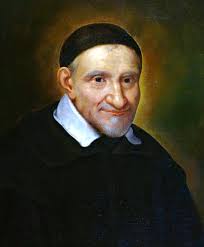
Today is the Feast Day of St. Vincent de Paul.

Vincent de Paul was born in April 1581 of a Gascon peasant family in Pouy in the south-east of France. He had four brothers and two sisters. At an early age, he showed a talent for reading and writing. At 15, his father sent him to school, managing to pay for it by selling the family’s oxen. A good ecclesiastical career, his father believed, would enable Vincent to be financially independent and to help support his family.

In 1596, he went to the University of Toulouse for theological studies, and there he was ordained priest in 1600. He remained in Toulouse until he went to Marseilles to collect an inheritance.

On his way back from Marseilles in 1605, there is a story he was taken seized by Turkish pirates and brought to Tunis where he was sold as a slave.  After being held in captivity for two years, he converted his ‘owner’ to Christianity, he was freed in 1607.  Some doubt the veracity of this event.

Vincent was ordained priest at the unusually early age of 19.  He began his priestly life as a court chaplain and was supported by the revenues of a commendatory abbey but his life changed following a false accusation of theft. In 1609 he was associated with Pierre (later Cardinal) de Berulle and became tutor to the children of the Gondi family.  In 1617 he was made parish priest of Chatillon-les-Dombes.  All during his life he combined an apostolate among the well-off upper classes combined with an utter devotion to the care of the poor and oppressed.  While chaplain with the Gondi family he gave help to prisoners condemned to work on galley ships and in 1622 preached missions to prisoners in Bordeaux.

Vincent is probably best known for the two religious congregations he founded: the Vincentians and the Daughters of Charity, both of which were designed to be contemplatives in action in the world. Both these congregations are still active today in many parts of the world.

In 1625 he set up a congregation of priests, the Vincentians.  They lived from a common fund and renounced all church honors.  They devoted themselves to serving people in the smaller towns and villages.  The purpose was to restore a more flexible apostolate among the diocesan clergy. In 1633 they were given care of the Paris priory church of Saint-Lazare.  From this church the congregation came to be known as ‘Lazarists’.  Because of their founder they are also known as Vincentians, although the official name is the Congregation of the Mission (CM).

Also in 1633 Vincent founded the Daughters of Charity (Filles de Charite).  They were the first congregation not to live in cloister so that they could devote themselves entirely to the poor and the sick. Vincent said that their cloister was the street. In this he realised the original idea of Francis de Sales, whose congregation had been made to follow a more traditional religious life by Rome. In this venture Vincent was aided by (St) Louise de Marillac, who was the first superior.  Together with Louise de Marillac, Vincent organised hospitals for the sick poor, founded institutions for abandoned children, opened soup kitchens, created job training programmes, taught young women to read, improved prison conditions, and organised countless local charities in the villages throughout France.

It is said that, even during his life, Vincent became a legend. Every level of society – clergy and laity, rich and poor, outcasts and convicts – all were won over by his charisma and selfless devotion.  Here was a man totally guided by his love for God and neighbour.

Rich women collected money and in other ways supported his countless good works. He gave alms for war-victims in Lorraine, sent his priests to Poland, Ireland, and Scotland (even the Hebrides).  From 1643, during the regency of Anne of Austria, who greatly admired him and valued his advice, he had considerable influence in her court.  The one exception was when he tried to persuade her to dismiss Cardinal Mazarin.

He died in September 1660 at the age of 79 and was canonized by Pope Clement XII in 1737. He was named by Pope Leo XIII patron of all charitable societies.  Among these is the lay movement called the Society of St. Vincent de Paul, which was founded in 1833 by Frederick Ozanam.

Sources:

Living Space
Catholic.org
Wikipedia

Posted in Uncategorized | Tagged , , , , , , , , , , | 4 Comments

Consciousness, the Mind and the Wonder of the Human Person

Sir John C. Eccles, Nobel Prize winning neuroscientist

Sir John C. Eccles, Nobel Prize winning neuroscientist

“There are two absolutely unpredictable happenings in the story of the cosmos. The first was the origin of life, the second the origin of the mind.”

— John C. Eccles, Nobel Prize, Medicine, 1963 “How the Self Controls Its Brain”, p. 167

For the past several years, I have been a member of a men’s group at my local parish. We follow a program called That Man is You! (TMIY), a Catholic lay program that focuses on developing husbands and fathers (The sponsor, Paradisus Dei sponsors separate women’s and youth programs). There are two aspects to the TMIY program. First, is the content, which harmonizes current social and medical science with the teachings of the Church, especially that of the Second Vatican Council and Pope John Paul II. Second, is the social aspect which allows men to share ideas and be vulnerable in a confidential setting. 

There is a core group of approximately 30 of us that meet every Wednesday morning at 5:45 a.m. for nine months of the year (summers off) so it is a fairly dedicated group. Most of us are either middle-aged and hitting the mid-age crisis (that would be me:-) or retired. It is a unique environment and it has done wonders for both my spiritual life and my relationships with my wife, children and broader community.

Yesterday, I attended the second session of the “Fall Semester” (I missed last week due to work travels) and the topic was human consciousness, a subject that fascinates me. Specifically, I am interested in the relationship between the mind and the brain. This is a very complex area that touches neuroscience and ontology but there are two broad camps:

  • The materialists who believe that nothing exists other than the physical universe. This group believes that mind and brain are the same thing. This position is exemplified by people like neurophilosopher Patricia Churchland in this interesting interview on NPR’s On Point.
  • The spiritualists who believe that the mind, or human consciousness, exists independently of the brain and that the brain is a transmitter between the spiritual mind and the material world. This position is exemplified by most major religions (yes, there are differences among the types of religious such as Buddhism which ascribe to an aspect of the nonself and Christianity which ascribe to a belief in an individual soul but those distinctions pale in comparison to the divine between the materialists and the spiritualists).

One of the leading neurologist philosophers of the spiritual school of the last several decades was Sir John C. Eccles. Set forth below is an abbreviated version of his biography from Wikipedia:

Eccles was born in Melbourne, Australia. At age 17, he was awarded a senior scholarship to study medicine at the University of Melbourne. As a medical undergraduate, he was never able to find a satisfactory explanation for the interaction of mind and body; he started to think about becoming a neuroscientist. He graduated (with first class honors) in 1925, and was awarded a Rhodes Scholarship to study under Charles Scott Sherrington at Magdalen College, Oxford University, where he received his Doctor of Philosophy in 1929. In the 1950s he researched the brain synapse, which work led to him winning the Nobel Prize for Medicine in 1963. In 1975 he retired to work on philosophy, specifically the mind-body problem. Eccles published until his death in 1997 at the age of 94. The summary of Eccles’ research is as follows:

“The essential feature … is that the mind and brain are independent entities … and that they interact by quantum physics … There is a frontier, and across this frontier there is interaction in both directions, which can be conceived as a flow of information, not of energy. Thus we have the extraordinary doctrine that the world of matter-energy is not completely sealed.” — John C. Eccles, How the Self Controls Its Brain, p. 9 Springer (1994) (cited in TMIY materials)

Other scientists and philosophers are continuing to study the relationship between the mind and brain. For example, neuroscientist Richard Davidson of University of Wisconsin has founded the Center for Investigating Healthy Minds which stems from his research on the brain scans of the Dalai Lama and other Buddhist monks who practice prolonged meditation.

My favorite research in the intersection between science and philosophy and what it means to be human is by Fr. Brendan Purcell who recently wrote the outstanding book: From Big Bang to Big Mystery: Human Origins in the Light of Creation and Evolution. This book, published in 2012, is the most comprehensive treatment of what it means to be human that I have read. I hope to do a book review on this in the future, but in the interim, here is a link to notes by Fr. Purcell for a presentation he gave in 2012 at the 50th International Eucharistic Congress in Dublin.

Aside from the core issue of consciousness, we learned other interesting facts about the human body from TMIY yesterday, all of which point to an organizing Mind behind the creation of the universe and humans, rather than the material world being a random collection of atoms and chemicals:

  • One thousand, million, million, million, million atoms combined into 75 trillion cells.
  • One billion neurons, stretching over one million miles, processing 38 thousand trillions bits per second.
  • 120 million rod cells and 6 million cone cells sending information down 1.2 million nerve fibers.
  • 20,000 hair cells sensitive to one billionth of an atmospheric pressure.
  • 100,000 heart beats, pumping 2000 gallons of blood through 60,000 miles of blood vessels every day.
  • 700 million alveoli containing 300,000 million capillaries, breathing 29,000 times per day.
Posted in Reason and Faith | Tagged , , , , , , , , , , , , , , , | 12 Comments

Life of Teilhard de Chardin: Discovery of Peking Man and Travels (1928-1940)

Statue of Peking Man

Statue of Peking Man

I am gradually building out the “Life of Teilhard de Chardin” posts. It has taken longer than usual as work and family preclude me from spending more time on the blog. However, here is the latest installment: Discovery of Peking Man and Travels (1928-1940) which can be read here.  Please forgive the link but I am converting Teilhard’s bio to an easier-to-find “Page” format rather than a “Post” format that the other ways were in (I am still new at WordPress).

Like all of the other posts in this series, it is a mish-mash from a variety of secondary sources, not all of which agree with each other. As such, there are bound to be errors and I welcome any and all corrections.

Posted in Uncategorized | Tagged , , , , , , , | 6 Comments