Pope Francis and Blessed Peter Faber, S.J.

Pope Francis is thoroughly Ignatian in his outlook

Pope Francis is thoroughly Ignatian in his outlook


Don’t worry, this is not yet another analysis of Pope Francis’ interview with Antonio Spadaro, S.J. which was translated by and published in America Magazine. That interview has been covered in-depth in a variety of news outlets and blogs.

One of the remarkable things about the election of Pope Francis is that he is the first Jesuit elected Pope, which was a huge surprise because I never thought that a Jesuit would be elected pope. I did not know what exactly the election of a Jesuit would mean for the Church but I knew that it would be interesting, which it certainly has been during the first six months. Although nothing has changed doctrinally and Pope Francis is in many ways more traditional than his predecessor, the perception of the Church in the mainstream media is certainly different.

One aspect of the interview that has received scant attention that has received little attention is his reference to Blessed Peter Faber, S.J. Here is that portion of the interview:

The Model: Peter Faber, ‘Reformed Priest’

I am wondering if there are figures among the Jesuits, from the origins of the Society to the present date, that have affected him in a particular way, so I ask the pope who they are and why. He begins by mentioning Ignatius Loyola [founder of the Jesuits] and Francis Xavier, but then focuses on a figure who is not as well known to the general public: Peter Faber (1506-46), from Savoy. He was one of the first companions of St. Ignatius, in fact the first, with whom he shared a room when the two were students at the University of Paris. The third roommate was Francis Xavier. Pius IX declared Faber blessed on Sept. 5, 1872, and the cause for his canonization is still open.

The pope cites an edition of Faber’s works, which he asked two Jesuit scholars, Miguel A. Fiorito and Jaime H. Amadeo, to edit and publish when he was provincial superior of the Jesuits in Argentina. An edition that he particularly likes is the one by Michel de Certeau. I ask the pope why he is so impressed by Faber.

“[His] dialogue with all,” the pope says, “even the most remote and even with his opponents; his simple piety, a certain naïveté perhaps, his being available straightaway, his careful interior discernment, the fact that he was a man capable of great and strong decisions but also capable of being so gentle and loving.”

Michel de Certeau characterized Faber simply as “the reformed priest,” for whom interior experience, dogmatic expression and structural reform are inseparable. The pope then continues with a reflection on the true face of the founder of the Society.

“Ignatius is a mystic, not an ascetic,” he says. “It irritates me when I hear that the Spiritual Exercises are ‘Ignatian’ only because they are done in silence. In fact, the Exercises can be perfectly Ignatian also in daily life and without the silence. An interpretation of the Spiritual Exercises that emphasizes asceticism, silence and penance is a distorted one that became widespread even in the Society, especially in the Society of Jesus in Spain. I am rather close to the mystical movement, that of Louis Lallement and Jean-Joseph Surin. And Faber was a mystic.” (emphasis added)

I previously wrote on Blessed Peter Faber, S.J. on his Feast day, August 2 and thought in light of the interview with Pope Francis it would be a great opportunity to highlight this great Jesuit. Attached here is a wonderful document on the life and spirituality of Peter Faber by Severin Leitner that was graciously provided by Claire Bangasser, of the great blog A Seat at the Table.

The article summarizes Peter Faber’s spiritual life and provides a clue into Pope Francis’ thinking. One passage particularly struck me as how Pope Francis, like other mystics such as Mother Teresa, use works and contemplative prayer together to deepen their relationship with God:

“I reflected on how to pray and work well, and how a genuine desire for prayer leads to good works and vice versa good works lead to a genuine desire for prayer I noticed and felt quite clearly, that a spiritual person who seeks God in his work finds him afterwards in prayer much better than a person who, as happens frequently, seeks Go d in prayer in order to find him afterwards in good deeds. So he w ho seeks and finds the spirit of God in good works makes more reliable pro gress than the one who only relies on prayer. To find God in the works compared to finding him in prayer is often like the actual execution compared to the mere desire.”

Posted in Ignatian Spirituality | Tagged , , , , , , , | 6 Comments

Teilhard de Chardin Quote of the Week (September 23, 2013): Never Give Up

Perseverance

“Never give up: try to attack it from another angle, the  correct angle—where success is in proportion not to the extension of the individual but to the constancy in the effort to make the world around God less harsh and more human.  If the pressure of events can induce you to make the mental sacrifice of every personal ambition in favor of a higher duty, I am convinced that you can reach a degree of emancipation and clearness of vision in relation to the external world, far greater than you imagine. One must contrive to preserve a real appetite for life and action whilst at the same time renouncing any desire for personal happiness. Therein lies the secret—and not illusion—of living in the “Divine Milieu.”

— Attributed to Pierre Teilhard de Chardin 

Posted in Teilhard Quote of the Week, Uncategorized | Tagged , , , , , , | 7 Comments

Sunday Sabbath: Tears in Heaven

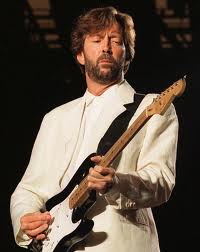
This is a follow up for the reflection for the 25th Sunday in Ordinary Time which talks about Eric Clapton and how he struggled through fame and self-destruction before surrendering his ego to have a relationship with God. What I failed to mention (as was reminded of by Julie, a blog reader and author of one of the most beautiful sites on the web) is that he also suffered deep personal tragedy in 1991 when his four-year-old son, Conor, fell through a window when he was playing in the 53rd floor of a New York apartment. Clapton wrote the beautiful song “Tears in Heaven” following that tragedy.

Posted in Uncategorized | Tagged , , , , | 6 Comments

Sunday Reflection, 25th Sunday in Ordinary Time (September 22, 2013): Eric Clapton and Surrendering to God

Eric Clapton is not Pretending about his relationship with God

Eric Clapton is not Pretending about his relationship with God

“I have a dogmatic certainty: God is in every person’s life.  God is in everyone’s life…Even if the life of a person has been a disaster, even if it is destroyed by vices, drugs or anything else—God is in this person’s life. You can, you must try to seek God in every human life.”  — Pope Francis

“You are never more of a mature adult than when you get down on your knees and bend humbly before something greater than yourself.” — Eric Clapton

Sunday is the 25th Sunday in Ordinary Time. You can find the weekly readings here. The theme is letting go of material wealth and surrendering one’s self to God.

I am not exactly in tune with popular culture. Yes, I am conversant in sports and current events but in other aspects I am sorely lacking. My experience with movies the past decade have largely revolved around Cars (I am thankful my oldest son is starting to like Percy Jackson:-), I have not watched Breaking Bad or any other mainstream television series and my musical knowledge ends approximately 1991 when I graduated college. As I sons enter their teenage years, it will be easy for them to classify me as an out-of-touch nerd.

However, I do enjoy music, especially classic rock and blues. As such, I have always been a fan of Eric Clapton‘s music. I knew a little bit about his professional career but I knew nothing about his personal life. However, when I started researching for the readings for this week I came across a fascinating homily by Fr. Ron Rolheiser that is available from St. Louis University.  The homily is a summary of Eric Clapton’s autobiography (Eric Clapton, The Autobiography, N.Y., Random House, 2007) and his journey from fame, self-destructive behavior using drugs, alcohol and casual sex to hide inner pain and then a surrender of the ego to have a relationship with God.  I encourage you to read the entire homily here, but set forth below is an extended summary:

“Clapton tells his story with a wonderful intelligence and disarming self-effacement. This isn’t a cheap celebrity, ego-trumpeting book, but a story of art, youth, restlessness, search, falling, near-disaster, and life-saving conversion. And its real interest lies exactly in that latter element since, as Heather King puts it, sin isn’t interesting but conversion is.

Clapton fans won’t be disappointed either at how seriously he takes his art. Throughout his whole career, however fuzzy his head may have been about other things, he was always clear and single-minded about his art, the blues, willingly sacrificing popularity and money for the sake of his craft. For him, art is pure, something near to God, and is meant always to remain pure. His words: “For me, the most trustworthy vehicle for spirituality had always proven to be music. It cannot be manipulated, or politicized, and when it is, that becomes immediately obvious.”

Those are the words of a good artist, but his real struggle was never with art but with his obsessions, addictions, ego, and sobriety.

Success came to him early and the world of rock-and-roll bathed him in a culture of alcohol, drugs, and irresponsibility. He was soon an addict, with everything in his life other than his music spinning out of control. Eventually grace intervened and, during a second trip to an alcoholic clinic, he found grace and sobriety. Here are his own words:

Nevertheless, I stumbled through my month in treatment much as I had done the first time, just ticking off the days, hoping that something would change in me without me having to do much about it. Then one day, as my visit was drawing to an end, a panic hit me, and I realized that in fact nothing had changed in me, and that I was going back out into the world again completely unprotected. The noise in my head was deafening, and drinking was in my thoughts all the time. It shocked me to realize that here I was in a treatment center, a supposedly safe environment, and I was in serious danger. I was absolutely terrified, in complete despair.

At that moment, almost of their own accord, my legs gave way and I fell to my knees. In the privacy of my room, I begged for help. I had no idea who I thought I was talking to, I just knew that I had come to the end of my tether, I had nothing left to fight with. Then I remembered what I had heard about surrender, something I thought I could never do, my pride just wouldn’t allow it, but I knew that on my own I wasn’t going to make it, so I asked for help, and getting down on my knees, I surrendered.

Within a few days I realized that something had happened for me. An atheist would probably say it was just a change of attitude, and to a certain extent that’s true, but there was much more to it than that. I had found a place to turn to, a place I’d always known was there but never really wanted, or needed, to believe in. From that day until this, I have never failed to pray in the morning, on my knees, asking for help, and at night to express my gratitude for my life and, most of all, for my sobriety. I choose to kneel because I feel I need to humble myself when I pray and with my ego, this is the most I can do.

If you are asking me why I do all of this, I will tell you … because it works, as simple as that. In all this time that I have been sober, I have never once seriously thought of taking a drink or a drug. …. In some way, in some form, my God was always there, but now I have learned to talk to him.

I read those words in a catechism book when I was a little boy and knew, already then, that they contained a truth that perennially needs to be asserted in the face of human pride. Pierre Teilhard de Chardin says something similar. At a certain time in your life, he says, you realize that you have only two choices: genuflect before something greater than yourself or begin to self-destruct.”

Resources:

Fr. Ronald Rolheiser Website
Fr. Rolheiser Reflection
Eric Clapton Article in Christianity Today

Posted in Sunday Reflections, Uncategorized | Tagged , , , , , , , , | 9 Comments

Feast of St. Matthew (September 21)

Caravaggio's painting of The Calling of St. Matthew

Caravaggio’s painting of The Calling of St. Matthew


“I often visited the Church of St. Louis of France, and I went there to contemplate the painting of ‘The Calling of St. Matthew,’ by Caravaggio. That finger of Jesus, pointing at Matthew. That’s me. I feel like him. Like Matthew. It is the gesture of Matthew that strikes me: he holds on to his money as if to say, ‘No, not me! No, this money is mine.’ Here, this is me, a sinner on whom the Lord has turned his gaze. And this is what I said when they asked me if I would accept my election as pontiff. I am a sinner, but I trust in the infinite mercy and patience of our Lord Jesus Christ, and I accept in a spirit of penance.” — Pope Francis, from his interview in America Magazine


I know this is a bit early, but for my readers in Australia and the Philippines, you can treat this as a Vigil :-).  September 21 is the Feast Day for St. Matthew, one of the twelve apostles. Interestingly, St. Matthew is the favorite apostle of my nine-year old son, primarily because he was the one with the money 🙂 (Yes, we have some work to do).

Matthew, who is called Levi by Mark and Luke, was a 1st-century Galilean (presumably born in Galilee, which was not part of Judea or the Roman Iudaea province) and the son of Alpheus. During the Roman occupation (which began in 63 BC with the conquest of Pompey), Matthew collected taxes from the Hebrew people for Herod Antipas, the tetrarch of Galilee. His tax office was located in Capernaum. However, as a tax collector he would have been literate in Aramaic and Greek.

Matthew likely became wealthy in his occupation as a tax collector. It is not surprising that Jews who did this work, taking money from Jews and giving it to the Roman colonizing power, were objects of contempt. After his call, Matthew invited Jesus home for a feast. On seeing this, the Scribes and the Pharisees criticized Jesus for eating with tax collectors and sinners. This prompted Jesus to answer, “I came not to call the righteous, but sinners” (Mark 2:17)

Matthew is spoken of five times in the New Testament; first in Matthew 9:9, when called by Jesus to follow Him, and then four times in the list of the Apostles, where he is mentioned in the seventh (Luke 6:15, and Mark 3:18), and again in the eighth place (Matthew 10:3, and Acts 1:13). As the account in the three Synoptics is identical, it is presumed that Matthew and Levi refer to the same person, although this is disputed. Levi could have been his original Jewish name. This is indicated by Matthew’s gospel referring to the tax collector as someone “named Matthew”. It was quite common for Jews to have two names. He is not mentioned in John’s gospel.

From very early times Matthew has been traditionally regarded as the author of one of the four gospels, to which both Irenaeus and Papias, early Christian writers, give witnesses. This gospel was written in late in the 1st century and, based on similarity of material, is presumed to be dependent on Mark which is believed to have been the first gospel to be written. It is a very Jewish work and is clearly directed to Jewish converts. The original is thought to have been written in Aramaic or Hebrew although we now only have the Greek version. Matthew’s gospel (in contrast with Mark) concentrates a good deal on the teaching of Jesus and for that reason was used widely in the Church for catechetical teaching.

Each of the four evangelists is represented by a symbol taken from the Old Testament. Matthew is represented as a man. This is because the genealogy he places at the beginning of his gospel speaks of the human ancestry of Jesus. One tradition says he went to Ethiopia and preached the Gospel there, confirming his teaching with many miracles. Because of one of his greatest miracles, that of bringing back to life the king’s daughter, the king and his wife together with the whole country became Christians. When the king died, his successor Hirtacus wished to marry Iphigenia, the daughter of the former king. But she had vowed her virginity to God and would not change. Because the vow had been taken through Matthew’s influence, Hirtacus had Matthew killed. It was believed that this happened on 21 September, hence the date of his feast. However, the Martyrology of Jerome says he died at Tarrium in Persia and others at Tarsuana, east of the Persian Gulf.

What are claimed to be his relics were brought to Salerno in Italy by Robert Guiscard from Finisterre in Brittany where it is said they had been originally brought from Ethiopia. Later, under Pope Gregory VII, they were transferred to the church dedicated to St. Matthew.

In art, Matthew is represented as either an evangelist or an apostle. As an evangelist he sits at a desk, writing his gospel with an angel guiding his hand or holding an inkwell. As an apostle he is shown with the emblem of martyrdom – a spear or sword or lance. He may also be shown holding a money-bag, representing his original profession. In the later Middle Ages he may even be shown wearing glasses, to help read his accounts!

Sources:

Sacred Space
Wikipedia

Posted in Uncategorized | Tagged , , , , , , , , , , | 6 Comments

The Higgs Boson and The Divine Milieu

Science and faith humor: this is why I am not a professional comedian :-)

Science and faith humor: this is why I am not a professional comedian 🙂

“In him we live and move and have our being.” — Acts 17:28, St. Paul speaking at the Areopagus
“The consistency of matter that enables it to act so decisively on the human body requires the existence of a universal principle that sustains materiality, and is as such non-material.” — David Grumett, summarizing Teilhard de Chardin views in “Teilhard de Chardin: Theology, Humanity and Cosmos“, p. 14

This is a follow-up to yesterday’s post on the Coursera video lectures on the Big Bang.  The lectures for the second week focused on the Higgs Boson, one of the most interesting scientific discoveries of the last two years.

According to the Standard Model of physics, the Higgs Boson is the last particle to be discovered that explains the Big Bang, which occurred approximately 13.7 billion years ago. The Standard Model describes the structure of matter and the forces that bind them together. The evolution of the universe from nothing is unravelled stage by stage by science. The discovery of the Higgs Boson traces what happened in this universe just a Pico second (10-12) after the Big Bang.

The Higgs Boson is part of the Higgs Field, which is an invisible field that exists throughout the universe. As particles pass through the Higgs Field they are slowed beyond the speed of light, much as an object passing through molasses will become slower, and thus are endowed with the property of mass. If the Higgs Field did not exist, particles would not have the mass required to attract one another, and would simply float around freely at light-speed (like photons do). The Higgs Boson is of such importance to the Standard Model that it is sometimes referred to as the “God particle”.

So, what is the theological significance of discovering the Higgs Boson? Fr. Dr. Mathew Chandrankunnel, founder of the Bangalore Forum for Science and Religion, wrote a brief paper on the theological implications of finding the Higgs Boson which is linked below.

Dr. Mathew Chandrankunnel Article on Higgs Boson

I encourage you to read the entire paper as it gives more detailed (but still non-technical) background on the Higgs Boson and the history of the relationship between science and faith. However, here are some key excerpts:

The relevance of this Higgs boson discovery is with respect to the confirmation of the Big Bang model about the origin of the universe. Thus, both scientific experiment and faith experience comes to a convergence about the creation from nothingness. In Christianity from its very inception, a convergence of rationality and faith has been established through the vision of Paul, Justin, Clement of Alexandria, Augustine and other intellectuals tried skilfully to interpret the Christian faith in terms of Greek rational philosophical categories. This positive outlook which has already been set in continued throughout the history. Nicholas of Cusa, Anselm, Aquinas etc., in the Middle Ages,  the Council of Trent, Luther, Calvin, Loyola in the beginning of modernity and the Vatican II Council in the twentieth century pioneered a revitalization and reinterpretation of the faith in terms of the constituent trends of those consecutive periods.

Dr. Chandrankunnel goes on to explain how the discovery of the Higgs Boson validates the vision of Teilhard de Chardin, the integration of science and faith in search of both the divine Creator of the Big Bang and the ultimate end of the Omega Point (or Cosmic Christ):

It was Teilhard de Chardin, as a palaeontologist and spiritualist who inspired the generations through his integrated vision of science, theology, philosophy and spirituality, who has with deep theological insights influenced the II Vatican Council. His Future of Man, Phenomenon of Man and the Divine Milieu proposes a holistic theological account of the origin of the universe from God and evolve in and through space and spearhead towards, God. For him, the beginning is A, which he interpreted as God and evolve towards Ω, the resurrected Christ,   guided by the principles of the complexity and consciousness, tangential and radial energy, through a process of cosmogenesis, biogenesis, noogenesis, socialization, planatization and omegalization. Science has actually no definite goal for its realization, but Chardin is proposing a final end from his theology and spirituality. According to him, there is continuity and even in the matter, life is latent and in life mind is latent. So by an integrated vision of science and Christian theology, Chardin proposes a converging Omega point where the matter, life and mind fuse into a supreme consciousness.

So what is the significance of this discovery for humanity? It may be similar to the discovery of electrons in the beginning of this century from which we have all the electronic gadgets. The quarks which are now discovered and the God particle may launch us into a new domain and new phenomena which can be manipulated into mind boggling technology such as down loading thoughts and three dimensional projection of matter in terms of quantum teleportation. And would be the plausible philosophical significance? Now these recent scientific experiments and the discovery of the Higgs Boson are drawing closer to the initial moments of the big bang event that happened 13.7 billion years ago while the religious experience pinpoints to a creation out of nothingness. The distinct religious experience and the scientific experiments are thus, converging towards the beginning of the universe. Science could not yet explain how the whole matter was confined into a tiny atom and it too explains the initial explosion as a mystery. Thus, as quantum relativistic cosmology points out, the universe began from a tiny atom, a quantum singularity as shown by the discovery of the God particle. It may also be pointed out in the long run that scientific experiments and religious experience can, thus one day converge towards a goal as described by Teilhard de Chardin towards a trans Cosmic Singularity, a Super-consciousness, describing the evolution of the universe from a quantum singularity towards a cosmic singularity incorporating science and its underpinning reason fused with religion and its foundational faith.

It is definitely an exciting time to be alive. It would be very interesting for someone who has a lot more time than I do (an aspiring Doctoral student?) to compare the science of the Higgs Boson with the concepts of The Divine Milieu and the divinization of matter as articulated by Teilhard de Chardin.  I am hoping that others continue the theological implications of the Higgs Boson and other recent scientific discoveries and integrating them into traditional Christian theology.

Resources:

Dr. Mathew Chandrankunnel Article on Higgs Boson
Coursera Big Bang Course
Dr. Mathew Chandrankunnel Site
Wikipedia

Posted in Reason and Faith | Tagged , , , , , , , , , , , , | 3 Comments

Continuing Education in Faith and Science: From Big Bang to Dark Energy

Depiction of the signature of the Higgs Boson

Depiction of the signature of the Higgs Boson

I am not a scientist. However, as a Christian I have an interest in science for several reasons. First, I am fascinated in the discoveries that science can tell us about our physical universe and ultimately about God the Creator of the physical universe.  Second, science is a sort of universal language that can break through artificial barriers that separate humanity and unite people across cultures and generations. Third, science is a fantastic tool for evangelization. As I mentioned previously, science can be a bridge for Christians to have honest discussions with non-believers over the existence of God and the meaning of life.

As Fr. Mathew Chandrankunnel said about the imperative to integrate science and faith:

Pope John Paul II expressed the desire for dynamic integration by illustrating the physicists urge to unify the four forces into a grand unified theory. The theory of Relativity proposes a physical continuum and genetics envisions a biological continuum. Thus, the scientific disciplines are increasingly unifying the cosmos and life through their explanatory theories. The Aristotelian division of the terrestrial and the celestial was eliminated by Galileo paving the way for this cosmic integration. So the Pope urges the scientists to continue the search for unity not only among scientific disciplines but integrating all forms of knowing processes.  In this aspect he exhorts the scientists and the theologians or science and religion to work toward a unity for the better of humanity. As Pratt correctly observed, often the warpath between faith and reason or religion and science is due to our misinterpretation. ‘The book of nature and the word of God emanate from the same infallible author, and therefore cannot be at variance. But man is a fallible interpreter, and by mistaking one or both of these divine records, he forces them too often into unnatural conflict.’ Pope John Paul II in the same vein, invited theologians to assimilate in their theological parlance the discoveries of science as the ancient Israelites integrated the cosmology of their neighboring cultures. A powerful clarion call is made by Pope John Paul II to both scientists and theologians in the following paragraph to interact and work together as a much needed ministry.

As part of my personal interest in science I have signed up for several Massive Open Online Courses (MOOC) through Coursera, an education company that partners with the top universities and organizations in the world to offer “courses” (or series of lectures) online for anyone to take, for free.  The first “course” I am taking is titled “From the Big Bang to Dark Energy“.  This course will cover various topics on the discoveries about how the Universe evolved in 13.7 billion years since the Big Bang.  From the course description:

We have learned a lot recently about how the Universe evolved in 13.7 billion years since the Big Bang.  More than 80% of matter in the Universe is mysterious Dark Matter, which made stars and galaxies to form.  The newly discovered Higgs-boson became frozen into the Universe a trillionth of a second after the Big Bang and brought order to the Universe.  Yet we still do not know how ordinary matter (atoms) survived against total annihilation by Anti-Matter.  The expansion of the Universe started acceleration about 7 billion years ago and the Universe is being ripped apart.  The culprit is Dark Energy, a mysterious energy multiplying in vacuum.  I will present evidence behind these startling discoveries and discuss what we may learn in the near future.

Hitoshi Murayama

Dr. Hitoshi Murayama: a big brain lies behind that boyish face

I have had my first two weeks of my Big Bang course and so far it has exceeded expectations. The lecturer, Dr. Hitoshi Murayama, is fantastic. Dr. Murayama is Director of the prestigious Institute for the Physics and Mathematics of the Universe (IPMU) in Tokyo, as well as professor at University of California Berkley (I do not envy his commute :-).  Dr. Murayama has a rare combination of being a very accomplished scientist who can explain difficult concepts in a way that non-scientists can understand. Plus, he has a great sense of humor. When I was researching for information on Dr. Murayama, I found this interesting article on his interaction with the Japanese royal family.

Tomorrow, I will have a summary of how the lectures from the first two weeks (specifically, the Higgs boson) have connected with my faith (specifically, Teilhard de Chardin’s Divine Milieu)


Posted in Reason and Faith | Tagged , , , , , , , , , , , , , | 7 Comments

Feast of St. Robert Bellarmine, S.J. (September 17)

St. Robert Bellarmine, S.J.

St. Robert Bellarmine, S.J.

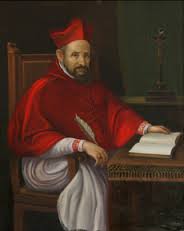
Today is a special day on the Church calendar as it is the feast day of two Doctors of the Church: St. Hildegard of Bingen and St. Robert Bellarmine, S.J.  You can find information on St. Hildegard of Bingen here.  This post is on Robert Bellarmine.

Robert Bellarmine was born on October 4, 1542 at Montepulciano in Tuscany, Italy, to a noble but impoverished family and was a nephew of Pope Marcellus II. As a boy he knew Virgil by heart and became adept at writing Latin verse. One of his hymns, on Mary Magdalen, is in the Breviary. He could play the violin and was good at debating. In 1560, at the age of 18, he entered the Jesuits and made his studies in Rome, Padua and Louvain. During his time of formation he also taught Latin and Green in Florence and Piedmont for a number of years. He was ordained priest at Ghent in 1570. Bellarmine obtained a reputation both as a professor and a preacher.

He was the first Jesuit to teach at the university, where the subject of his course was the Summa Theologica of St. Thomas Aquinas. His residence in Leuven lasted seven years. In poor health, in 1576 he made a journey to Italy. Here he remained, commissioned by Pope Gregory XIII to lecture on polemical theology in the new Roman College (now known as the Pontifical Gregorian University. These lectures would become the basis of his Disputationes de controversiis christianae fidei (Disputation on the Controversies of Christian Faith). This was a comprehensive presentation of Catholic teaching. It showed such erudition in Scripture, on the Fathers and Protestant theology that it was believed to be the work of several scholars. It met with immediate acclaim but was banned in England by the government. Robert was also involved in a revision of the Vulgate (the Latin translation of the Bible), the production of a famous catechism which would still be in use 300 years later.

Following the death of Henry III of France, Pope Sixtus V sent a legate to Paris to negotiate with the League, and chose Bellarmine as his theologian. Bellarmine was in the city during its siege by Henry of Navarre who would become king.

In the latter part of his life, one appointment followed another. In 1592 he was made Rector of the Jesuits’ Roman College. Two years later he became the Provincial of the Jesuit Province of Naples. In 1597 Pope Clement VIII made him his theological adviser and two years later named him to the College of Cardinals (as a Cardinal-Priest). These honors did nothing to change his austere lifestyle. He lived on a diet of bread and garlic and was known to have used the curtains of his apartment to clothe the poor. In 1602 he was made Archbishop of Capua and immediately was deeply involved in pastoral and welfare work. But he resigned his see after only three years when he was called back to Rome in 1605 by Pope Paul V to become Prefect of the Vatican Library as well as being active in several Vatican Congregations. His reservations about the temporal power of the Papacy are said to have put him out of favor with Pope Sixtus V  and even to have delayed his canonization. He was, however, vindicated by later theologians. In the famous controversy on the relationship of the sun to the earth, Bellarmine showed himself sympathetic to Galileo’s case but had urged the scientist to proceed more cautiously and to distinguish hypothesis from truth. In his old age he was allowed to return to his old home, Montepulciano, as its bishop for four years, after which he retired to the Jesuit college of St. Andrew in Rome. He received some votes in the conclaves which elected Popes Leo XI, Paul V, and Gregory XV, but only in the second case had he any prospect of election.

During his retirement, he wrote several short books intended to help ordinary people in their spiritual life: The Mind’s Ascent to God (1614), The Art of Dying Well (1619), and The Seven Words on the Cross. He died in Rome on 17 September 1621 at the age of 79. Though physically a small man, he was a giant in intellectual ability and personal warmth. He prayed every day for the Protestant theologians with whom he disagreed and never (as was often the case on both sides) made abusive attacks on them.

Although he was one of the most powerful men in Rome, Bellarmine lived an austere life. He gave most of his money to the poor. Once he gave the tapestries from his living quarters to the poor, saying that the walls wouldn’t catch cold. While he took little regard for his own comforts, he always saw to it that his servants and aides had everything they needed.

He was canonized in 1930 and named a Doctor of the Church in 1931. His remains, in a cardinal’s red robes, are displayed behind glass under a side altar in the Church of Saint Ignatius, the chapel of the Roman College, next to the body of his student, St. Aloysius Gonzaga, as he himself had wished.

Sources:

Living Space
Wikipedia
Ignatian Spirituality

Posted in Uncategorized | Tagged , , , , , , , , , | 2 Comments

Feast of St. Hildegard von Bingen (September 17)

St. Hildegard of Bingen

St. Hildegard of Bingen

Today is a special day on the Church calendar as it is the feast day of two Doctors of the Church: St. Hildegard of Bingen and St. Robert Bellarmine, S.J.  You can find information on St. Robert Bellarmine, S.J. here.  This post is on Hildegard of Bingen.

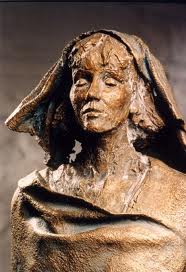
Hildegard of Bingen (1098-1179) is the newest Doctor of the Church, being named a Doctor in October 2012 by Pope Benedict XVI. She was a remarkable woman, a “first” in many fields. At a time when few women wrote, Hildegard, known as “Sybil of the Rhine”, produced major works of theology and visionary writings. When few women were accorded respect, she was consulted by and advised bishops, popes, and kings. She used the curative powers of natural objects for healing, and wrote treatises about natural history and medicinal uses of plants, animals, trees and stones. She is the first composer whose biography is known. She founded a vibrant convent, where her musical plays were performed. However, she was best known for her mystical visions and writings.

Hildegard was born in 1098 to Mechtilde and Hildebert of Bermersheim, a family of the free lower nobility in the service of the Counts of Sponheim. Sickly from birth, Hildegard is traditionally considered their youngest and tenth child, although there are records of seven older siblings. In her Vita, Hildegard states that from a very young age she had experienced visions, but soon realized she was unique in this ability and hid this gift for many years.

At age 8, the family sent Hildegard to an anchoress named Jutta to receive a religious education. Jutta was born into a wealthy and prominent family, and by all accounts was a young woman of great beauty. She spurned all worldly temptations and decided to dedicate her life to god. 

Jutta was also a visionary and thus attracted many followers who came to visit her at the enclosure. Hildegard also tells us that Jutta taught her to read and write, but that she was unlearned and therefore incapable of teaching Hildegard Biblical interpretation. Hildegard and Jutta most likely prayed, meditated, read scriptures such as the psalter, and did some sort of handwork during the hours of the Divine Office. This also might have been a time when Hildegard learned how to play the ten-stringed psaltery. Volmar, a frequent visitor, may have taught Hildegard simple psalm notation. The time she studied music could also have been the beginning of the compositions she would later create. After Jutta’s death, when Hildegard was 38 years of age, she was elected the head of the budding convent living within cramped walls of the anchorage.

During all these years Hildegard confided of her visions only to Jutta and another monk, named Volmar, who was to become her lifelong secretary. However, in 1141, Hildegard had a vision that changed the course of her life. A vision of God gave her instant understanding of the meaning of the religious texts, and commanded her to write down everything she would observe in her visions.

And it came to pass … when I was 42 years and 7 months old, that the heavens were opened and a blinding light of exceptional brilliance flowed through my entire brain. And so it kindled my whole heart and breast like a flame, not burning but warming… and suddenly I understood of the meaning of expositions of the books…

Yet Hildegard was also overwhelmed by feelings of inadequacy and hesitated to act.

But although I heard and saw these things, because of doubt and low opinion of myself and because of diverse sayings of men, I refused for a long time a call to write, not out of stubbornness but out of humility, until weighed down by a scourge of god, I fell onto a bed of sickness.

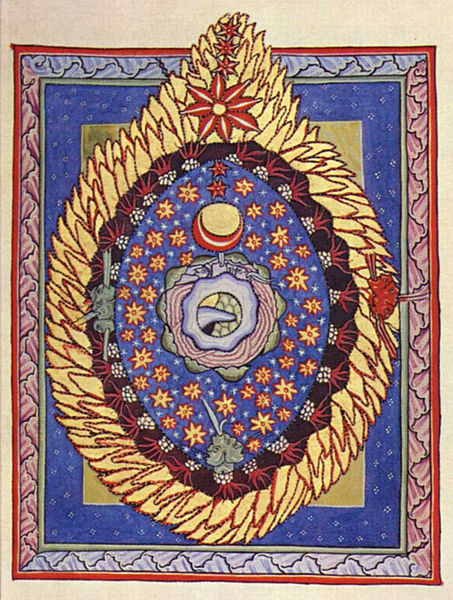
Illumination accompanying the third vision of Part I of Scivias

Illumination accompanying the third vision of Part I of Scivias

The 12th century was also the time of schisms and religious foment, when someone preaching any outlandish doctrine could instantly attract a large following. Hildegard was critical of schismatics, indeed her whole life she preached against them, especially the Cathars. She wanted her visions to be sanctioned, approved by the Catholic Church, though she herself never doubted the divine origins to her luminous visions. She wrote to St. Bernard, seeking his blessings. Though his answer to her was rather perfunctory, he did bring it to the attention of Pope Eugenius (1145-53), a rather enlightened individual who exhorted Hildegard to finish her writings. With papal imprimatur, Hildegard was able to finish her first visionary work Scivias (“Know the Ways of the Lord”) and her fame began to spread through Germany and beyond.

Her remaining years were very productive. She wrote music and texts to her songs. There is some evidence that her music and moral play Ordo Virtutum (“Play of Virtues”) were performed in her own convent. In addition to Scivias she wrote two other major works of visionary writing Liber vitae meritorum (1150-63) (Book of Life’s Merits) and Liber divinorum operum (1163) (“Book of Divine Works”), in which she further expounded on her theology of microcosm and macrocosm-man being the peak of god’s creation, man as a mirror through which the splendor of the macrocosm was reflected. Hildegard also authored Physica and Causae et Curae (1150), both works on natural history and curative powers of various natural objects, which are together known as Liber subtilatum (“The book of subtleties of the Diverse Nature of Things”). These works were uncharacteristic of Hildegard’s writings, including her correspondences, in that they were not presented in a visionary form and don’t contain any references to divine source or revelation. However, like her religious writings they reflected her religious philosophy-that the man was the peak of god’s creation and everything was put in the world for man to use.

Hildegard also wrote Physica, a text on the natural sciences, as well as Causae et Curae. Hildegard of Bingen was well known for her healing powers involving practical application of tinctures, herbs, and precious stones. In both texts Hildegard describes the natural world around her, including the cosmos, animals, plants, stones, and minerals. She is particularly interested in the healing properties of plants, animals, and stones, though she also questions God’s effect on man’s health. One example of her healing powers was curing the blind with the use of Rhine water.

Music was extremely important to Hildegard. She describes it as the means of recapturing the original joy and beauty of paradise. According to her before the Fall, Adam had a pure voice and joined angels in singing praises to god. After the fall, music was invented and musical instruments made in order to worship god appropriately. Perhaps this explains why her music most often sounds like what we imagine angels singing to be like.

On October 7 2012, Pope Benedict XVI named Hildegard a Doctor of the Church, the fourth woman of 35 saints given that title. He called her “perennially relevant” and “an authentic teacher of theology and a profound scholar of natural science and music.”

Sources:

Fordham University
Wikipedia
Pope Benedict XVI Statements on Hildegard von Bingen

Posted in Uncategorized | Tagged , , , , , , , , , , , , , | 7 Comments

Teilhard de Chardin Quote of the Week (September 16, 2013): Transubstantiation of the Universe

transubstantial

“Lord, do you now therefore, speaking through my lips, pronounce over this earthly travail your twofold efficacious word: the word without which all that our wisdom and our experience have built up must totter and crumble—the word through which all our most far-reaching speculations and our encounter with the universe are come together into a unity. Over every living thing which is to spring up, to grow, to flower, to ripen during this day say again the words: This is my Body. And over every death-force which waits in readiness to corrode, to  wither, to cut down, speak again your commanding words which express the supreme mystery of faith: This is my Blood.”

— Pierre Teilhard de Chardin, “Mass on the World

Posted in Teilhard Quote of the Week | Tagged , , , , , , , | 3 Comments