Teilhard de Chardin Quote of the Week (June 30, 2014): God Speaking Thorough “True Myths”


Destruction of Leviathan. 1865 engraving by Gustave Doré

Destruction of Leviathan. 1865 engraving by Gustave Doré

“Mythology and folklore . . . are filled with symbols and fables expressing the deeply rooted resolve of Earth to find its way to Heaven; from which it follows that we may in a perfectly legitimate sense accept the fact that a generalized, implicit faith of humanity in humanity is older than all civilization, and that it is this, finally, which constitutes the basic impulse forming all our past history.” — Teilhard de Chardin, The Future of Man, pp. 186-87

“[T]he story of Christ is simply a true myth: a myth working on us the same way as the others, but with this tremendous difference that it really happened: and one must be content to accept it in the same way, remembering that it is God’s myth where the others are men’s myths: i.e., the Pagan stories are God expressing Himself through the minds of poets, using such images as He found there, while Christianity is God expressing Himself through what we call ‘real things’.” — C.S. Lewis


Posted in Teilhard Quote of the Week | Tagged , , , , , , , , , | 2 Comments

Sunday Reflection, Solemnity of St. Peter and St. Paul (June 29, 2014): Unity in Diversity


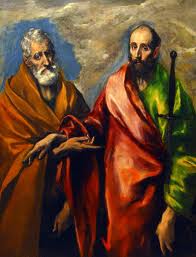
St. Peter and St. Paul

St. Peter and St. Paul

This year, Sunday falls on the Solemnity of St. Peter and St. Paul so we celebrate this great feast during the Mass this weekend.  The readings can be found here.

Both of these great Saints have other Feast days (The Chair of St. Peter is celebrated on February 22 and the Conversion of St. Paul is celebrated on January 25), but it is appropriate that their primary feast day is together.  Not only are St. Peter and St. Paul the pillars of early Christianity, but they represent a diversity of background and opinions that are crucial for the vibrancy of Christianity.

It is an example of God’s strong sense of humor that he picked St. Peter and St. Paul to build the foundations of the early Church.  No mere human would have picked such unlikely candidates.  St. Peter was an educated, peasant fisherman from a backwater Roman province who would go to the heart of Rome and become the first leader of a movement that is still the largest organization in the world 2,000 years later.  St. Paul was part of a strict sect of Judaism that insisted on following every letter of the Mosaic law who would eventually argue against the Church leadership to overturn much of the Mosaic law.  St. Peter was a man of action who had a history of backing out when things got tough prior to the Resurrection.  Tradition holds that St. Paul had a meek personality with a speech impediment but his ideas form a major part of the New Testament.  Christ certainly chose an odd couple of start his Church.

Peter represents that part of the Church which gives it stability: its traditions handed down in an unbroken way from the very beginning.  Peter is the rock, the structures which help to preserve and conserve those traditions, and the structure which also gives consistency and unity to the Church.

Paul represents the prophetic and missionary role of the Church.  It is that part of the Church which constantly works on the edge, pushing the boundaries of the Church further out, not only in a geographical sense but also pushing the concerns of the Church into neglected areas of social concern and creatively developing new ways of communicating the Christian message. This is the Church which needs to be constantly renewed.

St. Peter:  Leader and Man of Action

St. Peter, originally named Simon, was a native of Bethsaida, near Lake Tiberias.  Peter was the son of John, and worked, like his brother St. Andrew, as a fisherman on Lake Genesareth. Andrew introduced Peter to Jesus, and Christ called Peter to become a disciple. We know little else about Peter’s background, social class or education but like Jesus and many disciples, he was likely from a poor family with little formal education.  The Gospels portray Peter as being a very human figure, a man of action wanting to do the right thing, but frequently missing the message (criticizing Jesus for saying that he had to suffer) or lacking faith.  This dichotomy between wanting to be a bold man of courage to fleeing in the face of danger continued through the crucifixion, with his cutting off the ear of the slave of the high priest to Peter’s denying Jesus and fleeing at the end.

After seeing the risen Christ, Peter’s entire worldview changed.  Peter began to understand the meaning of Christ’s message and boldly assumed the leadership mantle that Jesus had given to him.  Tradition holds that Peter established the Church in Rome before suffering martyrdom.  The death of Peter is attested to by Tertullian at the end of the 2nd century, and by Origen in Eusebius, Church History III.  Origen wrote: “Peter was crucified at Rome with his head downwards, as he himself had desired to suffer.” This is why an upside down cross is generally accepted as a symbol of Peter, who would not have considered himself worthy enough to die the same way as his Savior.

St. Paul:  Intellectual and Mystic

Unlike St. Peter, St. Paul appears to have been well educated and very conversant in the Greek culture of the time.  St. Paul was likely born between the years of 5 BC and 5 AD. The Book of Acts implies that Paul was a Roman citizen by birth, more affirmatively describing his father as such, but some scholars have taken issue with the evidence presented by the text. He was part of devout Jewish family in the city of Tarsus—one of the largest trade centers on the Mediterranean coast. It had been in existence several hundred years prior to his birth. It was renowned for its university, one in which students could receive a superior education. During the time of Alexander the Great, Tarsus was the most influential city in Asia Minor.

Stoicism was the dominant philosophy there. In addition to his becoming steeped in Orthodox Pharisaic Judaism, his early life in Tarsus allowed him to learn “Classic Greek”, Greek philosophy, and Koine Greekwhich was the lingua franca of the Roman Empire, spoken by the common people.

Unlike St. Peter who was a close confidant of Jesus, St. Paul never met Christ prior to his Resurrection.  During Jesus’ life, Saul (Paul’s name prior to his conversion) was a devote Pharisee, who preached and practices devotion to the Mosaic law.  After Jesus’ death, Saul persecuted Christians as heretics who, in his way of thinking, were disobeying the law and blaspheming God. In a startling encounter, which ranks as one of the greatest turning points in human history, the Resurrected Christ appeared to Saul on his way to Damascus to persecute Christians there.  After this appearance, Paul led a new life as the Apostle to the Gentiles.

Paul was a visionary and a mystic.  Paul maintained the continuity between Christ and Abraham, Moses and the prophets.  He would rely heavily on the training he received concerning the law and the prophets, utilizing this knowledge to convince his Jewish countrymen of the unity of past Old Testament prophecy and covenants with the fulfilling of these in Jesus Christ. However, he also appreciated that God becoming Incarnate was the ultimate revelation that overturned many of the details of the Mosaic law.

Paul also drew on the language and thoughts of the Greek culture to effectively preach the Gospel.  In his letters, Paul reflected heavily from his knowledge of Stoic philosophy, using Stoic terms and metaphors to assist his new Gentile converts in their understanding of the revealed word of God. His wide spectrum of experiences and education gave the Paul the tools which he later would use to effectively spread the Gospel and to establish the church solidly in many parts of the Roman Empire.

Perhaps most profoundly, Paul was a deep mystic.  His first personal experience with Christ came after the Resurrection.  This personal experience, supplemented by a deep prayer life, provided Paul with the vision for the future Church.  For Paul, Christ was not only a peasant in Nazareth, he was the Omega of all creation.   Paul gave Christ a cosmic significance.  In his speech the Athenians as recorded in Acts, Paul stated that Christ was the one “in Him we live and move and have our being”.  In the first letter to the Corinthians, Paul described how all believers are part of the Body of Christ.  These concepts, as well as well as concepts from Johannian literature such as the Logos, were the scriptural basis for Teilhard de Chardin’s concept of the Divine Milieu.

Christian tradition holds that Paul was beheaded in Rome during the reign of Nero around the mid-60s.

Posted in Reason and Faith, Sunday Reflections | Tagged , , , , , , , , , , , , , , , , , , , , , , , | 4 Comments

Solemnity of St. John the Baptist (June 24)

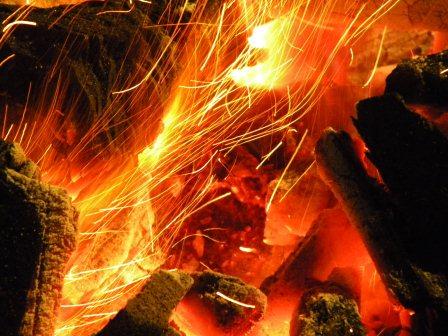
St. John the Baptist Bonfire

Today we celebrate the Feast of St. John the Baptist.  One of the things I really like about Christianity is its universality and its adaptability to different cultures.  Perhaps the best example of that is the date established for the celebration of Christmas.  Unlike the Crucifixion and Resurrection (for which we have strong evidence of their occurrence around the Jewish Passover), we have no evidence as to the time of year when Jesus was born.

In the first couple of centuries of Christianity, there was no established Feast Day for Christmas.  It was not until the fourth century that Christmas was fixed at December 25.  While the origins of this date are incomplete, many scholars believe this date was chosen as it was the date of a major Roman celebration of the Northern Hemisphere winter solstice, Sol Invictus (the Feast of the Unconquered Sun).  Christianity likely borrowed this pagan tradition and marked it as the birthday of Jesus.  It is entirely appropriate to celebrate the human incarnation of Christ at the winter solstice as the days are getting brighter and longer with His presence. As John Chrysostom said in the fourth century:

“they call it the ‘Birthday of the Unconquered’. Who indeed is so unconquered as Our Lord …? Or, if they say that it is the birthday of the Sun, He is the Sun of Justice.”

Similarly, we have no evidence as to when the birth of St. John the Baptist occurred.  However, the Church decided that the Feast Day of St. John the Baptist should fall around the Northern Hemisphere summer solstice.  June 24 is one of the oldest of the Church feasts and is sometimes called “summer Christmas.” On the eve of the feast, great bonfires were once lighted as a symbol of “the burning and brilliant” light, St. John, who pointed out Christ in this world of darkness.  The solstice fires had been pagan, but now they were blessed by the Church in St. John’s honor. There are actual blessings for the bonfire in the Roman liturgy. 

As we celebrate the Feast of St. John the Baptist, and as the days for those of us in the Northern Hemisphere start to get shorter, may we follow his example of being a light and pointing others to Christ.

Posted in Uncategorized | Tagged , , , , , , , | 3 Comments

Teilhard de Chardin Quote of the Week (June 23, 2014): Love, Matter and Spirit

sunset_heart

Love is the threshold of another universe. Beyond the vibrations with which we are familiar, the rainbow-like range of its colors is still in full growth. But, for all the fascination that the lower shades have for us, it is only towards the “ultra” that the creation of light advances. It is in these invisible and, we might almost say, immaterial zones that we can look for true initiation into unity. The depths we attribute to matter are no more than the reflection of the peaks of spirit. 

— “The Evolution of Chastity” (1934)

Posted in Teilhard Quote of the Week | Tagged , , , , , , , , | 1 Comment

Sunday Reflection, Corpus Christi (June 22, 2014): Teilhard, Pope Benedict and the Cosmos as a Living Host

cosmic_consciousness

This weekend is the Solemnity of the Most Holy Body and Blood of Christ, also known as Corpus Christi. The readings can be found here.

Teilhard de Chardin believed that the Eucharist was not only the central component of the Liturgy but that all of creation was divinized by the presence of God.  The most mystical description of this concept is described in Teilhard’s Mass on the World but he also discussed it frequently in his other writings.

This week’s reflections come from Teilhard de Chardin and Pope Benedict XVI who both beautifully point to this cosmic description of the Eucharist.  The first quote below is from Teilhard de Chardin:

“The greatest change, however, comes with mass and communion, when we realize the full depth and universality of their mystery. We now understand that when Christ descends sacramentally into each one of his faithful it is not simply in order to commune with him; it is in order to join him, physically, a little more closely to himself and to all the rest of the faithful in the growing unity of the world. When, through the priest, Christ says,’Hoc est corpus meum, ‘This is my body’, the words reach out infinitely far beyond the morsel of bread over which they are pronounced: they bring the entire mystical body into being. The priestly act extends beyond the transubstantiated Host to the cosmos itself, which, century after century, is gradually being transformed by the Incarnation, itself never complete. From age to age, there is but one single mass in the world: the true Host, the total Host, is the universe which is continually being more intimately penetrated and vivified by Christ. From the most distant origin of things until their unforeseeable consummation, through the countless convulsions of boundless space, the whole of nature is slowly and irresistibly undergoing the supreme consecration. Fundamentally—since all time and for ever-but one single thing is being made in creation: the body of Christ.”

Teilhard de Chardin, Pierre (2002-11-18). Christianity and Evolution (Harvest Book, Hb 276) (Kindle Locations 915-924). Houghton Mifflin Harcourt. Kindle Edition.

The Green Pope

The second quote below is from Pope Benedict XVI in 2009 in which he further elaborates on Teilhard’s vision:

Pope Benedict XVI said, “We ourselves, with our whole being, must be adoration and sacrifice, and by transforming our world, give it back to God. The role of the priesthood is to consecrate the world so that it may become a living host, a liturgy: so that the liturgy may not be something alongside the reality of the world, but that the world itself shall become a living host, a liturgy. This is also the great vision of Teilhard de Chardin: in the end we shall achieve a true cosmic liturgy, where the cosmos becomes a living host. And let us pray the Lord to help us become priests in this sense, to aid in the transformation of the world, in adoration of God, beginning with ourselves. That our lives may speak of God, that our lives may be a true liturgy, an announcement of God, a door through which the distant God may become the present God, and a true giving of ourselves to God.” (Homily, July 24, 2009).

Read More Here


Posted in Sunday Reflections | Tagged , , , , , , , , , , , , , , , , | 3 Comments

Charles Reid: We Can Do Better on the Intersection of Science and Theology

faith_science


Charles Reid, professor of law at St. Thomas University, has recently written an interesting piece in the Huffington Post titled “The Reconciliation of Science and Religion: We Can Do Better.”  The thrust of the article is Reid’s review of Amir Aczel’s book, “Why Science Does Not Disprove God.”:

The reconciliation of science and religion is one of the most compelling tasks confronting religious believers today. For we are truly faced with a pair of hostile, warring camps. Many religious believers have drifted into a kind of pietistic mistrust of science that seeks comfort in demonstrably false propositions like young earth creationism. On the other hand, we find a number of scientist who dismiss the possibility of a spiritual dimension to human existence. Some dismiss faith altogether as an outdated mode of explaining the inexplicable. Religion is superstition, they contend, and empiricism must finally triumph over the irrational.

Thus I picked up Amir Aczel’s book, “Why Science Does Not Disprove God,” with eager anticipation, hoping that he might make peace between these contending factions. Alas, I sighed, upon finishing the book, the chasm remains unbridged. Rather than grappling with the truly challenging, foundational questions, Aczel, I discovered, preferred to recite middle-brow explanations that might give consolation to people of faith but that never really come close to achieving a reconciliation of science and faith.

* * *

There are other thinkers, of course, who have attempted a sophisticated reconciliation of evolution and religion. Classically, there was Pierre Teilhard de Chardin (1881-1955). A world-class paleontologist as well as a Jesuit priest, Teilhard de Chardin relied on evolutionary theory and extended it to propose an ever-expanding “noosphere” — an inter-connected realm of cognition and consciouness that aims finally at the Omega Point, which constitutes ultimate knowledge of the universe, and of God.

Aczel mentions Teilhard de Chardin, but refuses to engage the complexity of his thought. He merely quotes Teilhard on the compatibility of religion and evolution and leaves it at that. Why? Why are evolution and religion compatible? One longs to have the “why” question answered. But Aczel does not venture a reply.

Read Full Article Here

I am a fan of Dr. Aczel as he is a preeminent scientist who can translate into common language. He can also be a bit of a sensationalist (in a good way), including when it comes to this blog’s namesake, Teilhard de Chardin, as evidenced by the book “The Jesuit and the Skull” which talks about the discovery by Teilhard de Chardin and his team of Peking Man.

While I agree with Dr. Reid that Dr. Aczel’s book falls short in some respects, I am not as critical as Reid is.  I believe the purpose of Dr. Aczel was to specifically counter the New Atheists and the book was written on the rudimentary level of their arguments. However, Dr. Reid’s broader point about the need to take up Teilhard de Chardin’s challenge of a broader synthesis of theology and science is accurate.  I encourage Dr. Reid to take up his challenge and write such a book as he seems to have both the desire and the academic pedigree to do so :-).

In the interim, I highly recommend Brendan Purcell’s book “From Big Bang to Big Mystery: Human Origins in the Light of Creation and Evolution“.  Purcell’s book is comprehensive, yet readable and is the best book on the symbiotic relationship between theology and science that I have read.


Posted in Reason and Faith | Tagged , , , , , , , , , , , , , , , , , , | 6 Comments

Teilhard de Chardin Quote of the Week (June 16, 2014): Charity and Progress


love_peace

“Christian detachment subsists wholly in this wider attitude of mind: but instead of “leaving behind” it leads on; instead of cutting off, it raises. It is no longer a breakaway but a way through; no longer a withdrawal but an act of emerging. Without ceasing to be itself, Charity spreads like an ascending force, like a common essence at the heart of all forms of human activity, whose diversity is finally synthesized in the rich totality of a single operation. Like Christ Himself, and in His image, it is universalized, it acquires a dynamic and is humanized by the fact of doing so.”

– Pierre Teilhard de Chardin, The Future of Man, p. 88


Posted in Teilhard Quote of the Week | Tagged , , , , , , , , | 1 Comment

Sunday Reflection, Feast of the Holy Trinity (June 15, 2014): The God of Love

Mystery of the Trinity

Mystery of the Trinity

This Sunday is the Feast of the Holy Trinity.  The readings can be found here.

Today’s reflection comes from Fr. Michael Campbell-Johnston, SJ, a former provincial of the British Jesuits.  You can read the entire reflection here, but set forth below is an extended summary:

“The dogma of the Holy Trinity is a mystery we can never fully understand, at least in this life. How can there be only one God yet three separate persons each with their own nature and equal to each other? But it does teach us one very clear truth, crucially important and with practical consequences. The very essence of God’s nature is not a mystery of isolation or individualism but of sharing, of mutual outpouring, of giving and receiving. The exchange of love between Father and Son is what Jesus called the Holy Spirit, the spirit of love.

This is why, apart from the philosophical definition given to Moses in the Bible “I am who am”, the only true definition we have of God as a person is that given us by St John “God is love”. And it is because of this love that you, me and everything else exists. We were created by love in order to love. And this is where the practical consequences come in. Our whole purpose in life is to learn what love is or, better put, to learn how to love.

* * *

This is explained very clearly by Pope John Paul II in a letter he wrote to families. “God created man in his own image and likeness: calling him to existence through love. He called him at the same time for love. God is love and in himself He lives a mystery of personal loving communion. Creating the human race in his own image and continually keeping it in being, God inscribed in the humanity of man and woman the vocation, and thus the capacity and responsibility, of love and communion. Love is therefore the fundamental and innate vocation of every human being.”

The great Jesuit palaeontologist Teilhard de Chardin also saw this very clearly and declared that love is the fundamental law of the universe, the prime and indispensable motor of its progress. “Love has always been carefully eliminated from the realist and positivist concepts of the world, but sooner or later we will have to acknowledge that it is the fundamental impulse of life or, if you prefer, the one natural medium in which the rising course of evolution can proceed. With love omitted, there is truly nothing ahead of us except the forbidding prospect of standardisation and enslavement; the doom of ants and termites. It is through love and within love that we must look for the deepening of our deepest self, in the life-giving coming together of humankind.”

There is however a fly in the ointment. God’s love consists in a total gift of self and we can only share in this, the purpose of our existence, when we too are able to give ourselves totally. Yet we are all born with a love that is selfish, turned in on self. And it is no easy task to rid ourselves of the selfishness or egoism we all have. In fact the whole of our life can be considered as a long gradual struggle to achieve a love that is ever more selfless, more geared towards the other. And the extraordinary thing is, the more we give and go out to others, the more we ourselves receive and the richer our life becomes.  As Jesus taught, if we die to ourselves, we become alive in others and in God. Let us make an effort today, the celebrate this feast of the Holy Trinity, to perform one act that makes our love less centered on self, more unselfish, more open to another.”

Read Entire Reflection

Posted in Sunday Reflections | Tagged , , , , , , , , , , , , , , , , | 3 Comments

The Noosphere in Wisconsin

The Noosphere in Wisconsin

The Noosphere in Wisconsin

I saw the above plate indicating the Noosphere driving from Milwaukee to Madison and had to take a picture :-).  I would love to find the owner.

Posted in Uncategorized | Tagged , , | 5 Comments

A God Too Small

I pray that the Fire of the Holy Spirit will burn in me

I pray that the Fire of the Holy Spirit will burn in me

I am continuing to find excellent Pentecost reflections on the web.  The latest gem is from Fr. René Camilleri in the Times of Malta.  You can find Fr. Camilleri’s entire article here but set forth below is an extended excerpt:

“The task of all those who claim to believe in God is to make God visible, tangible, and available on this earth. It’s no use preaching an infinite and changeless Being who is beyond the range of our inhumanity. The whole point of our religion is tragically missed if in religion we continue to speak of a personal transformation that does not lead to social transformation.

The incarnate God has a face and feelings and emotions. Yet our dualistic thinking about heaven and earth creates division where God has unified. We need a mental and heart revision, like the one the Apostles and first disciples went through, in order to receive truly the spirit that dispels the insecurity that engulfs our faith and gives the right vision that will invigorate the Church in a world that needs this new spiritual energy that religion is failing to generate.

The spirit is given to us to arouse within us the passion for the possible, to enable in us the vision of a transformation of the world we live in begun in the resurrection.

Teilhard de Chardin was a Jesuit paleontologist and theologian whose vision of a consecration of the world shows how the most intense moment of communion with the divine involves also intense moments of communion with the earth.

He speaks marvelously of the Eucharist on the world: “The sacramental species are formed by the totality of the world, and the duration of the creation is the time needed for its consecration”.”

Read Entire Article Here


Posted in Uncategorized | Tagged , , , , , , , , , , | Leave a comment