Escaping the Ego: St. John of the Cross and an Anatomy of the Self

maryeholste's avatarA Wider Sunrise

st-john-of-the-cross1The most brilliant and illuminating discussion of the human self that I have ever read is in a a book by Denys Turner, The Darkness of God:Negativity in Christian Mysticism.* He draws from Aristotle and adds a bit of his own humor to explain St. John of the Cross on the subject. I want to share highlights of that discussion here.

We begin the spiritual life by building up our “ascetical self.” The beginner works hard at fasting, keeping vigil, works of charity, and all his various labors for Christ. This is a necessary step. He learns self-control, self-denial, and gains strength of will. But this is not the end of the journey. As the beginner builds up his ascetic self, he is still unable to conquer the ego. He creates an ever more spiritual egoism, but can not overcome pride through his ascetic labors. He is caught: trapped…

View original post 753 more words

Posted in Uncategorized | 9 Comments

Flannery O’Connor on Teilhard de Chardin

Flannery O'Connor

Flannery O’Connor


“It is doubtful if any Christian of this century can be fully aware of his religion until he has seen it in the cosmic light which Teilhard has cast upon it.” Flannery O’Connor – The Presence of Grace.

Posted in Uncategorized | Tagged , , , | 8 Comments

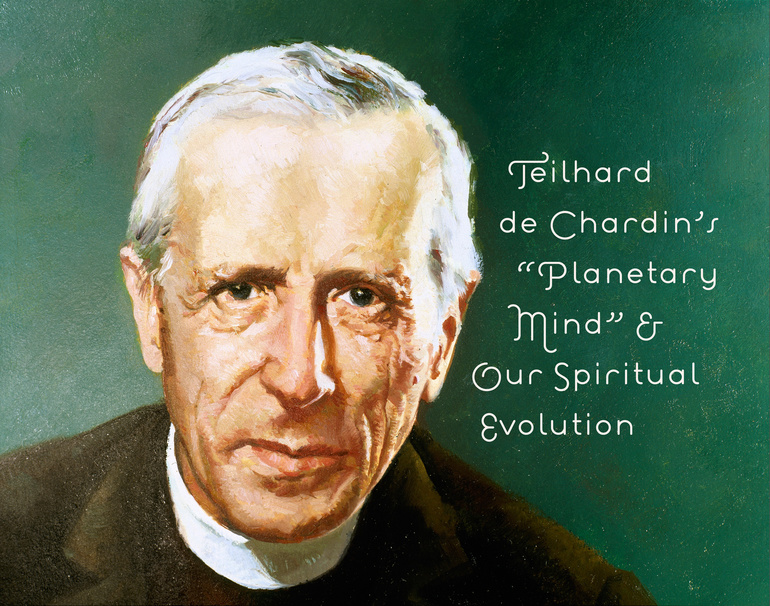
Thinking Faith and Teilhard de Chardin

teilhard5


To commemorate the 200th anniversary of the restoration of the Society of Jesus by Pope Pius VII, the Jesuits in Britain have produced a special calendar for 2014. The calendar features illustrations of 12 Jesuits from across the world who have been active in various ministries over the past 200 years.

The first of these Jesuit to be featured is Teilhard de Chardin.  Fr. Chris Corbally, SJ of the Vatican Observatory wrote an outstanding piece on the legacy of Teilhard de Chardin as part of the calendar.  You can read the entire article here but set forth below is an extended excerpt:

The account of the universe that modern astronomy unfolds, from the initial, unimaginably intense radiation in the Big Bang to the emergence of primordial hydrogen and helium, and thence via nuclear synthesis in stars to all the elements we find around us on Earth, makes a fascinating story of how our bodies are literally made up of ‘stardust’. Our bodies do borrow, partialiter, from the product of the universe. (Partialiter = partly, and totaliter = totally, are Latin technical terms, familiar to Teilhard from the works of St Thomas Aquinas.) It is a ‘borrowing’ since our bodies undergo a complete change of their individual atoms every seven years. We and the Universe are truly one…and yet Teilhard understood that there is so much more to us than seeing ourselves as just a mass of atoms. Everything, including the very ‘mass’ of our bodies, is a shining forth, or diaphany, of spirit, and wondrously of that same Spirit through which the Body of Christ shines forth in the celebration of every ‘Mass’.

* * *

Evolution is not confined to the discipline of astronomy. It includes all the aspects that make up the Big History of the Universe: geology, biology, palaeontology, anthropology, environmental studies, economics, etc., as well as standard history. Teilhard himself took part in the discovery of Peking Man, an example of Homo erectus, dating roughly to ¾ million years ago. H. erectus was well on the way to understanding and mastering his environment. He was fully bipedal and an excellent big game hunter. Later members of the genus Homo, including our own species, Homo sapiens, are now believed to have evolved in Africa, and not directly from H. erectus. For the beginnings of what we call human sentience, that is, the ability to feel and perceive in a human way, archaeologists have returned to Africa and to the Middle Stone Age to discover the first remnants of religion, art, and even greater mastery of their environment among hominins who were closer than H. erectus to a direct line to modern man.

Our human sentience clearly has evolved, and will continue to do so. As it does, we come to reflect more critically on the interconnectedness of everything within the universe.

* * *

Teilhard would recognise that with the growing sense of the interdependence of all life forms comes a responsibility. It is a responsibility not just for human progress, but for the progress of the entire ecosystem in which we exist, which sustains us, and which shares in the full evolutionary story, the Big History. While Teilhard served as a stretcher-bearer during the First World War, he experienced in the trenches the camaraderie that a common cause will bring. A similar, intense camaraderie is needed today to tackle environmental destruction and the abuse of the world’s limited resources. Teilhard’s vision of the energy and unity of all ‘matter’ is something that could be most helpful to achieve the level of commitment needed by everyone, not just the current, ecologically-sensitive few.

Read Full Article by Fr. Chris Corbally, SJ

Posted in Uncategorized | Tagged , , , , , , , , , , , , | 1 Comment

Teilhard de Chardin Quote of the Week (January 27, 2014): Love Embracing the Earth

love_earth

Courtesy of Pat Taylor and her blog Journey of a Former Nun

“All we need is to imagine our ability to love developing until it embraces the totality
of the people of the Earth.” 

Posted in Teilhard Quote of the Week | Tagged , , , , , , , , , , | 3 Comments

SERMON: A Christmas Sermon On Peace, by Martin Luther King, Jr.

thevalueofsparrows's avatarThe Value of Sparrows

PEACE ON EARTH

This Christmas season finds us a rather bewildered human race.  We have neither peace within nor peace without.  Everywhere paralyzing fears harrow people by day and haunt them by night.  Our world is sick with war; everywhere we turn we see its ominous possibilities.  And yet, my friends, the Christmas hope for peace and goodwill toward all men can no longer be dismissed as a kind of pious dream of some utopian.  If we don’t have goodwill toward men in this world, we will destroy ourselves by the misuse of our own instruments and our own power.  Wisdom born of experience should tell us that war is obsolete.  There may have been a time when war served as a negative good by preventing the spread and growth of an evil force, but the very destructive power of modern weapons of warfare eliminates even the possibility that war…

View original post 2,867 more words

Posted in Uncategorized | Leave a comment

Sunday Reflection: Third Sunday in Ordinary Time (January 26, 2014): Unity in Diversity

unity_church
I urge you, brothers and sisters, in the name of our Lord Jesus Christ, that all of you agree in what you say, and that there be no divisions among you, but that you be united in the same mind and in the same purpose. — 1 Cor. 1:10

This weekend is the Third Sunday in Ordinary Time.  The weekly readings can be found here.  The theme is calling together all of humanity in Unity in Christ.  This is a fitting theme as we end the Week of Prayer for Christian Unity and the celebration of Martin Luther King, Jr. in the United States.

This week’s reflection is from Fr. James Predmore, S.J.  You can find the entire reflection here, but set forth below is an extended summary:

“In Matthew’s Gospel, immediately after Jesus begins to preach, he calls two sets of brothers in the fishing trade, Simon and Andrew, and James and John, to join his mission. They leave their professions and follow him in this great enterprise. The Jesus movement begins in earnest. Other disciples were later added as they taught and cured every disease and illness among the people. While in Corinth, Paul stresses unity among the believers, that they be of the same mind and in the same purpose. He points out the rivalries that set in and urges believers to forget their factions and to unify under Christ. In fact, if you listen to the prayerful words in the mass, you will find the Church stresses unity above all other concerns.

We are a church filled with diverse cultures and interests. Our goal is to be unified in common mind and purpose even though we represent different traditions, experiences, races, and backgrounds. You can bet that the disciples of Jesus had natural animosities to one another. Simon, a zealot does not make easy peace with a compromiser; Matthew, a traitorous collaborating tax collector is his natural enemy. Simon is chosen over his brother; James and John and their mother vie for power and anger the other ten. Judas controls the purse strings because he is trusted to act with integrity. The diverse interests and opinions of the Twelve and their many followers conflicted many times, but they had one thing in common: they agreed to follow the promise of Jesus and this settled all other matters.

Our local church community has to let go of the simple-minded ways we approach service to the larger community. We have to put the community before ourselves. In any church across the world we will find these types of people: the untrained musician who will not give up her style of playing guitar despite the protests of the community because her pride will be hurt if others find out she does not have foundational musical skills (The great secret is very public anyways); the unbending person who takes up the weekly offertory in his own peculiar way because it is one aspect of life where he can contribute and exert control; the organizer of socials who demands that others cannot eat or have fun at a party until the game she wants everyone to play is finished; the reader who makes the same mistakes every week because he will not listen to proper protocol.

These peculiar behaviors are numerous and hold the community back from coming together as one body. However, despite their fierce resistance, the church will move forward because the church is larger-minded. Small-minded people stay in their place and are therefore left behind; large-hearted people move forward and see the possibilities for growth. The most helpful question a person can ask their priest is this: I would like to be generous in offering my service to the church. What is the best way the church can use my gifts? Believe me, every good gift will be used for God’s greater glory and the generous person will find a place where he or she can thrive and be very happy. Being a “person with and for others” brings exponential happiness.

I’ll read a quote from the early deliberations that started the Jesuits way back in 1540. Knowing that their dedication to serve the Church and Christ, the Lord, would undoubtedly separate them from one another, the first companions discerned if they should somehow bind themselves to one another. Here is their response.

In the end, we established the affirmative side of the question, that is, that in as much as our most kind and affectionate Lord had deigned to gather us together and unite us, men so spiritually weak and from such diverse geographical and cultural backgrounds, we ought not split apart what God has gathered and united; on the contrary, we ought day by day to strengthen and stabilize our union, rendering ourselves one body with special concern for each other, in order to effect the greater spiritual good of our fellow men. For united spiritual strength is more robust and braver in any arduous enterprise than it would be if segmented.

The disciples of Jesus may have disagreed on many topics, just as this community of faith does. The purpose is not to change the other person, but to offer freedom and to respect what God is doing. God brings us together. God gathers and unites. We have to step out of ourselves, sometimes out of our small-minded ways, to strengthen and stabilize our union, and show special care for one another. This is for our spiritual good. Help God in his enterprise. Get out of your own way and build up one another in freedom and genuine care and service. May our prayer be that of Jesus: that we may be one, as you and I are one.”

Resources:

Fr. James Predmore, S.J. Reflection
Living Space Reflection
Creighton Online Ministries Reflection

Posted in Sunday Reflections | Tagged , , , , , , , , , , , , , , , | Leave a comment

Encore Presentation of On Being’s Show on Teilhard de Chardin

lead_teilharddechardin

NPR is broadcasting an encore presentation of a 2012 radio show on Pierre Teilhard de Chardin.  This show is an excellent overview of some of the ideas of Teilhard de Chardin and his relevance today.  It contains interviews with Ursula King, David Sloan Wilson and Andrew Revkin.  Please check on the links below for copies of transcripts, podcasts and radio stations airing the show.

On Being Teilhard de Chardin Main Page
Podcast of Show
Transcript of Show
Interview with Ursula King
Interview with David Sloan Wilson
Interview with Andrew Revkin
NPR Stations and Broadcast Times


Posted in Uncategorized | Tagged , , , , , , , , , , , , , | 7 Comments

Teilhard de Chardin: Life is worth living

Thanks to Michael Kinney for finding this. The Patience Prayer by Teilhard de Chardin is on my refrigerator as I am in constant need of this grace.

Posted in Ignatian Spirituality | Tagged , , , , , | 1 Comment

Teilhard de Chardin Quote of the Week (January 20, 2014): Death of the Ego and Rebirth in Christ

phoenix

Courtesy of Michael Kenney at Journey Towards Easter:

“Christ consumes with his glance my entire being. And with that same glance, that same presence, he enters into those who are around me and whom I love. Thanks to him therefore I am united with them, as in a divine milieu, through their inmost selves, and I can act upon them with all the resources of my being…

 …Once a man has resolved to live generously in love with God and his fellow-men, he realises that so far he has achieved nothing by the generous renunciations he has made in order to perfect his own inner unity. This unity in its turn must, if it is to be born anew in Christ, suffer an eclipse which will seem to annihilate it. For in truth those will be saved who dare to set the center of their being outside themselves, who dare to love Another more than themselves, and in some sense become this Other: which is to say, who dare to pass through death to find life. Si quis vult animam suam salvam facere, perdet eam…

 …The salvation of the soul must be bought at the price of a great risk incurred and accepted: we have, without reservation, to stake earth against heaven; we have to give up the secure and tangible unity of the egocentric life and risk everything on God. ‘If the grain of wheat does not fall into the ground and die, it remains just a grain.”

Hymn of the Universe (1965), pp.119-121, Harper Collins.

Posted in Teilhard Quote of the Week | Tagged , , , , , , , , , , , | 14 Comments

Martin Luther King, St. Augustine and Catholic Moral Law

Martin_Luther_king

In the United States, we celebrate the life and ideals of Martin Luther King, Jr. today.  I am too young to remember King or the civil rights movement. However, as a began my journey back to Christianity, I came across the life and writings of King.  I was incredibly impressed with his deep Christian faith and his use of Catholic moral law to support his nonviolent actions to promote civil rights.  Perhaps the most prominent example of this combination is King’s actions in 1963 in Birmingham and the related Letters from a Birmingham Jail.

According to Wikipedia, The Birmingham Campaign began on April 3, 1963, with coordinated marches and sit-ins against racism and racial segregation in Birmingham, Alabama. The non-violent campaign was coordinated by Alabama Christian Movement for Human Rights and King’s Southern Christian Leadership Conference. On April 10, Circuit Judge W. A. Jenkins issued a blanket injunction against “parading, demonstrating, boycotting, trespassing and picketing”. Leaders of the campaign announced they would disobey the ruling. On April 12, King was roughly arrested and put in jail.

King met with unusually harsh conditions in the Birmingham jail. An ally smuggled in a newspaper from April 12, which contained “A Call for Unity”: a statement made by eight white Alabama clergymen against King and his methods. The letter provoked King and he began to write a response on the newspaper itself. King writes in Why We Can’t Wait: “Begun on the margins of the newspaper in which the statement appeared while I was in jail, the letter was continued on scraps of writing paper supplied by a friendly black trusty, and concluded on a pad my attorneys were eventually permitted to leave me.”

King responded to his fellow clergy in a tone and spirit of brotherly love.  However, he was also very clear in his advocacy of the righteousness of his position. The brilliance of King’s letter is that his response was grounded in the core of Christian faith without belittling his opponents. The full text of the letter can be found here but set forth below is a key excerpt which highlights the Catholic moral law as the foundation for his actions:

[T]here are two types of laws: there are just laws, and there are unjust laws. I would agree with St. Augustine that “An unjust law is no law at all.” Now, what is the difference between the two? How does one determine when a law is just or unjust? A just law is a man-made code that squares with the moral law, or the law of God. An unjust law is a code that is out of harmony with the moral law. To put it in the terms of St. Thomas Aquinas, an unjust law is a human law that is not rooted in eternal and natural law. Any law that uplifts human personality is just. Any law that degrades human personality is unjust. All segregation statutes are unjust because segregation distorts the soul and damages the personality. It gives the segregator a false sense of superiority and the segregated a false sense of inferiority. To use the words of Martin Buber, the great Jewish philosopher, segregation substitutes an “I – it” relationship for the “I – thou” relationship and ends up relegating persons to the status of things. So segregation is not only politically, economically, and sociologically unsound, but it is morally wrong and sinful. Paul Tillich has said that sin is separation. Isn’t segregation an existential expression of man’s tragic separation, an expression of his awful estrangement, his terrible sinfulness?”

Last year, in honor of the 50th anniversary of Letters From a Birmingham Jail, Christian Churches Together in the U.S.A., a broad coalition of Christian churches (including Catholic, Orthodox, mainline protestant, evangelical protestant) issued a response. The response is equal to Dr. King’s in its commitment to the Christian ideal and social justice.  The full text can be found here but set forth is an excerpt:

As church leaders, we confess we have tended to emphasize our responsibility to obey the law while neglecting our equal moral obligation to change laws that are unjust in their substance or application. All too often, the political involvement of Christians has been guided by the pursuit of personal or group advantage rather than a biblically grounded moral compass. We confess it is too easy for those of us who are privileged to counsel others simply to “wait”—or to pass judgment that they deserve no better than what they already have.

We confess that we are slow to listen and give legitimacy to those whose experience of race relations and social privilege in America is different than our own. We keep the “other” at arm’s length to avoid hearing the call to sacrifice on their behalf. Our reluctance to embrace our “inescapable network of mutuality” underscores Dr. King’s observation that privileged groups seldom give up their advantages voluntarily. For example, it is difficult to persuade most suburban Christians to demand that they strive for the same quality of education in our cities that they take for granted in their own schools. To the extent that we do not listen in love, our influence in society is limited to “a weak, ineffectual voice with an uncertain sound.”

We confess that we often prefer stability to upheaval, even when upheaval is the necessary precondition for the establishment of justice. We confess that we often avoid the fiscal, emotional, and spiritual costs of changing our beloved institutions—even when called to do so by our Lord and Savior. Our churches and denominational structures thus fail in critical ways to model the “creative psalm of brotherhood” invoked by Dr. King.  Recent efforts in the Christian community toward “racial reconciliation,” though laudable in intent, tend to stop short of Dr. King’s vision of true justice and fellowship. Sunday morning remains the most segregated time in our nation.”

Dr. King and Christian Churches Together set a high standard for all of us to follow.  I pray today that I may have the wisdom and courage to follow their example.

Resources:

Letters From a Birmingham Jail
Christian Churches Together Response to Letters from a Birmingham Jail
U.S. Catholic Bishops Resources on the “Response”

Posted in Uncategorized | Tagged , , , , , , , , , , , , , , , , , , | 4 Comments