Feast of St. Mary Magdalene, the Apostle to the Apostles

St. Mary Magdalene

St. Mary Magdalene

Our July celebration of Hall of Fame of Saints continues today with the Feast of St. Mary Magdalene.  St. Mary Magdalene holds a special place both in Christian and world history. According to three of the four Gospels, she was the first eyewitness to the most important historical event in the history of the world; the Risen Christ first appeared to her.  Mary Magdalene then spread this news to the eleven apostles and other disciples of Jesus and is known as the “Apostle to the Apostles”.

While accurate historical information on Mary Magdalene is limited, we do know that she was a close disciple of Jesus.  In his apostolic letter Mulieris Dignitatem from August 1988, Blessed John Paul II praised Mary Magdalene’s special role as being the first witness to the Resurrection:

The women are the first at the tomb. They are the first to find it empty. They are the first to hear ‘He is not here. He has risen, as he said.’ They are the first to embrace his feet. The women are also the first to be called to announce this truth to the Apostles. The Gospel of John (cf. also Mk 16:9) emphasizes the “special role of Mary Magdalene”. She is the first to meet the Risen Christ. […] Hence she came to be called “the apostle of the Apostles”. Mary Magdalene was the first eyewitness of the Risen Christ, and for this reason she was also the first to bear witness to him before the Apostles. — Blessed John Paul II

St. Mary Magdalene has seen a resurgence in popular culture in recent decades, primarily due to sensationalist but historically inaccurate novels like The Da Vinci Code.  There are also myths of Mary Magdalene that were passed on by Church authorities.  For example, the popular myth of her being a repentant prostitute is likely not accurate.   Mary Magdalene has long been confused with other women also named Mary and some anonymous women whose stories were mistakenly fused into one sensual young sinner. This conflation merging several women into one composite has incorrectly linked the Magdalene with the unnamed sinner (commonly thought to have been a prostitute) in Luke 7:36-50. Though St. Mary Magdalene is named in each of the four gospels in the New Testament, not once does it say that she was a prostitute or a sinner. Nothing in the New Testament even hints of her as a prostitute.  Contemporary scholarship is said to have restored the understanding of Mary Magdalene as an important early Christian leader.  In 1969, Pope Paul IV clearly separated Luke’s sinful woman, Mary of Bethany, and Mary Magdalene via the Roman Missal.

Other legends, too, were added to the Gospel account. For instance, Mary Magdalen was said to have gone to Ephesus with Jesus’ Mother and St. John the Apostle. She was even said to have been the fiancée of John, until Jesus called him. There was even a claim that her tomb had been seen in Ephesus in the 8th century.

The town of Vezelay, in France, was claiming to have her relics from the 11th century and there was even a story that she, her sister Martha and Lazarus had spread the Gospel in Provence. Mary Magdalen was said to have lived as a hermit in the Maritime Alps before dying at Saint Maximin. These stories were widely believed but get little credence from modern scholars. 

In art Mary Magdalene is usually represented with the emblem of a pot of ointment, or shown in scenes of the Crucifixion and Resurrection. In England there were 187 churches dedicated to her and both Oxford and Cambridge universities have colleges named after her. Mary Magdalen is patron both of repentant sinners and of the contemplative life. Together with her close relationship to Jesus this explains her great popularity over the centuries. 
Sources:
Sacred Space
Wikipedia
Posted in Uncategorized | Tagged , , , , , , , | 4 Comments

Sunday Reflection: 16th Sunday in Ordinary Time (July 21, 2013) (Contemplatives in Action)


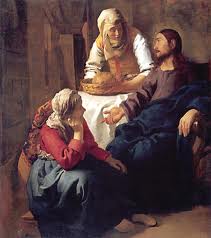
Mary and Martha: Contemplative and Action

Mary and Martha: Contemplative and Action

Today is the 16th Sunday in Ordinary Time and today’s Gospel is the fascinating story of Mary and Martha from the Gospel of Luke.

“Jesus entered a village
where a woman whose name was Martha welcomed him.
She had a sister named Mary
who sat beside the Lord at his feet listening to him speak.
Martha, burdened with much serving, came to him and said,
“Lord, do you not care
that my sister has left me by myself to do the serving?
Tell her to help me.”
The Lord said to her in reply,
“Martha, Martha, you are anxious and worried about many things.
There is need of only one thing.
Mary has chosen the better part
and it will not be taken from her.”

This story deeply troubled me when I was a child and well into my adulthood.  Growing up in a middle class family in the United States, a strong work ethic was ingrained into my being as long as I can remember.  As such, I very much sympathized with Martha in the story as the one who is doing all of the work; cleaning, preparing the meal and serving it, while lazy Mary isn’t doing anything to help out.  I was taken aback by Jesus’ rebuke of Martha; it seems so unfair to criticize Martha, the one putting food on the table rather telling Mary to help out.

It was only recently that I have begun to understand the true message of Jesus’ message. He is not necessarily criticizing Martha, but he was praising Mary in an effort to emphasize the balance between contemplation and action.  As St. Theresa of Avila writes:

“It is a great favor which the Lord grants to these souls, for it unites the active life with the contemplative. At such times they serve the Lord in both these ways at once; the will, while in contemplation, is working without knowing how it does so; the other two faculties are serving Him as Martha did. Thus Martha and Mary work together.” — St. Teresa of Avila, Way of Perfection, Chapter 31

Ignatian Spirituality places a strong emphasis on being a “contemplative in action”. These two concepts are deeply intertwined but as today’s Gospel points out, the order is important.  The first step in being a contemplative in action is the contemplative Mary.  This means stopping our activities and reflecting and listening to God.  Without this pause to deepen our relationship with God and understand his will, there is a risk that our activities become aimless as opposed to furthering the will of God.  This contemplation phase is important, which is why I believe it is important for everyone to take time to spend with God, not only in daily prayer, but also with extended retreats.

The way in which activity and contemplation will be balanced depends on a person’s given vocation and personality.  There are, however, certain practices that can help cultivate a contemplative disposition.  These practices will vary by individual makeup but they could include silently watching a sunrise, daily Mass, Eucharistic adoration, meditating with eyes closed or gazing at a sleeping infant.   All of these practices help us quiet our minds and opening ourselves to let God speak to us.

After drawing closer to God during contemplation and discerning God’s will, the next phase is action.  During the action phase we carry out the will of God within our daily vocations, whether it be a parent, religious life, firefighter, farmer, doctor, attorney, factor worker or whatever vocation we are called to do at that point in our lives.  The important thing to recognize is that our action phase is not an end in itself, but as part of God’s overall plan for us.  The cycle of contemplation and action inform each other and give us greater zest for life.  As Andy Otto writes:

“Contemplation allows us to renew our active lives (work, play, relationships) so that all we do does not become mindless action but rather glorifies God. Then the cycle repeats. Your activity leads you again into a time of stopping, resting, reflecting, and then returning to activity with greater zeal and purpose. Being a contemplative in action means that your active life feeds your contemplative life and your contemplative life informs your active life. That is what contemplation in action means, and the cycle never ends.” 

Ultimately, the synthesis of contemplation and contemplation is perpetuating the love of God to others.  During contemplation, we remove our distractions and open ourselves up and allow God to speak to our innermost desires and deepen our relationship with him.  Action is the manifestation of God’s love as we work to bring about the Kingdom of God by serving our neighbor in whatever activity we are doing at that moment.

Posted in Ignatian Spirituality, Sunday Reflections | Tagged , , , , , , , , , | 3 Comments

Ignatian Spirituality: Learning to Live Reverently

starry-sky1

July is a special month for Ignatian Spirituality as July 31 is the Feast Day for St. Ignatius of Loyola, founder of the Society of Jesus, also known as the Jesuits.  This year, the outstanding site Ignatian Spirituality is having a “31 Days with St. Ignatius” countdown with a different reflection each day.

I am only a week off of a silent retreat focused on Ignatian spirituality but the memories of that wonderful experience are already starting to fade as I am getting immersed back into my hectic daily life.  However, one of the reflections from the “31 Days” really harkened to my retreat.  One of the principles of Ignatian Spirituality is to develop a reverence and awe for the grandeur of God and then enter into a deep and personal relationship with God.  By doing this, we will be able to experience God moving and acting in our everyday life.  An initial step in this journey is to learn to live reverently.  The “31 Day” reflection for tomorrow (yes, I know I am jumping ahead but I will be traveling so consider this a preview:-) is an outstanding reflection on learning to live reverently by Gerald M. Fagin, S.J.  Below is an excerpt:

“Reverence is a virtue to be cultivated and practiced. It is a disposition of heart that leads us to the good in all things and draws us closer to God. Reverence brings us closer to other people and to the world around us. The reverent person notices and responds to the mystery of life and the sacredness of all things. Reverence is an attitude of dependence and humility, an appreciation of the splendor and beauty of all reality, and a longing for something greater. Reverence is a self-effacing virtue, but it implies as well a reverence for oneself as a person created and loved and chosen by God. Reverence gives voice to our desire for God, our desire to find fulfillment beyond ourselves in the mystery that embraces us.

* * *

We feel such things often—in the countless number of stars on a clear night, before a work of art, at the birth of a child, at the moment of dying of a loved one. These contemplative experiences draw us closer to God even as we feel small and unworthy. They are sacred moments that expand the landscapes of our hearts. Ignatius knew reverence when he prayed at night under the stars, but he knew it as well in the business of each day. He hoped to elicit that experience throughout the Exercises.

Ignatius believed that anyone who prayerfully considers the basic truth that we are created out of love by a transcendent God of holiness will grow in a sense of reverence. We will have a deepened sense of the sacredness of all things if we think of everything as continually being called and sustained in being by God. We will stand in awe not just before sunsets and mountains, flowers and trees, but also, and especially, before every person we meet. Reverence is a disposition of a heart that allows us to live before the beauty and goodness of every creature and the God who made them. In Ignatian terminology, reverence will enable us to find God in all things.”

I encourage you to read the entire post here.

Posted in Ignatian Spirituality | Tagged , , , , , , | 2 Comments

Teilhard de Chardin Quote of the Week (July 15, 2013): Collective Consciousness and the Consummated Christ

collective_consciousness

“Without biological evolution which produced the brain, there would be no sanctified souls; similarly, without the evolution of collective thought which alone can realize on earth the fullness of human consciousness, could there be a consummated Christ?” — Pierre Teilhard de Chardin (from Note sur le Progres, quoted in Robert Speaight, “The Life of Teilhard de Chardin“, p. 112)

Posted in Teilhard Quote of the Week | Tagged , , , , | 3 Comments

Life of Teilhard de Chardin: First China Trip and Mass on the World (1923-1924)

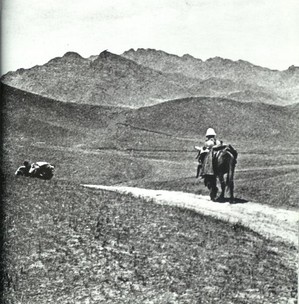
Teilhard de Chardin on the Mongolian plateau in 1924. It was around this time he wrote "The Mass on the World".

Teilhard de Chardin on the Mongolian plateau in 1924. It was around this time he wrote “The Mass on the World”.

Teilhard de Chardin set sail for his first trip to China in Spring 1923.  He landed at Shanghai and proceeded to travel by train to Tientsin, a coastal city some eighty miles from Peking where Emile Licent, S.J., had built his museum and housed the fossils he had collected in China since his arrival in 1914.

The two French Jesuits were both outstanding scientists and developed a solid working relationship.  However, Teilhard and Licent never became close friends due to differences in social, spiritual and intellectual temperments.  Licent, a northerner, knew the Chinese country and language very well and was a skilled negotiator with the locals.  Licent was very independent in his work. He was primarily interested in collecting fossils rather than interpreting their significance.   Moreover, he was a spiritual stranger to mystical intuitions.  Teilhard, on the other hand, was more outgoing; he enjoyed conversational society in which he could relate his geological knowledge to a wider scientific and theological sphere.  Teilhard was a deep mystic who felt compelled to translate his experiences in an intellectual manner.

Almost immediately after his arrival Teilhard de Chardin made himself familiar with Licent’s collection and, at the latter’s urging, gave a report to the Geological Society of China. In June 1923 Teilhard and Licent undertook an expedition into the Ordos desert west of Peking near the border with Inner Mongolia.  The journey was an arduous one, with rough physical conditions and a harsh summer climate.  It was during this journey that Teilhard de Chardin completed is famous “Mass on the World“, which is a mystical masterpiece.  The opening lines from Mass on the World capture the heart of Teilhard’s Christian devotion:

“Since once again, Lord — though this time not in the forests of the Aisne but in the steppes of Asia — I have neither bread, nor wine, nor altar, I will raise myself beyond these symbols, up to the pure majesty of the real itself; I, your priest, will make the whole earth my altar and on it will offer you all the labors and sufferings of the world.

Over there, on the horizon, the sun has just touched with light the outermost fringe of the eastern sky. Once again, beneath this moving sheet of fire, the living surface of the earth wakes and trembles, and once again begins its fearful travail. I will place on my paten, O God, the harvest to be won by this renewal of labour. Into my chalice I shall pour all the sap which is to be pressed out this day from the earth’s fruits.

My paten and my chalice are the depths of a soul laid widely open to all the forces which in a moment will rise up from every corner of the earth and converge upon the Spirit. Grant me the remembrance and the mystic presence of all those whom the light is now awakening to the new day.

One by one, Lord, I see and I love all those whom you have given me to sustain and charm my life. One by one also I number all those who make up that other beloved family which has gradually surrounded me, its unity fashioned out of the most disparate elements, with affinities of the heart, of scientific research and of thought. And again one by one — more vaguely it is true, yet all-inclusively — I call before me the whole vast anonymous army of living humanity; those who surround me and support me though I do not know them; those who come, and those who go; above all, those who in office, laboratory and factory, through their vision of truth or despite their error, truly believe in the progress of earthly reality and who today will take up again their impassioned pursuit of the light.

This restless multitude, confused or orderly, the immensity of which terrifies us; this ocean of humanity whose slow, monotonous wave-flows trouble the hearts even of those whose faith is most firm: it is to this deep that I thus desire all the fibres of my being should respond. All the things in the world to which this day will bring increase; all those that will diminish; all those too that will die: all of them, Lord, I try to gather into my arms, so as to hold them out to you in offering. This is the material of my sacrifice; the only material you desire.

Once upon a time men took into your temple the first fruits of their harvests, the flower of their flocks. But the offering you really want, the offering you mysteriously need every day to appease your hunger, to slake your thirst is nothing less than the growth of the world borne ever onwards in the stream of universal becoming.

Receive, O Lord, this all-embracing host which your whole creation, moved by your magnetism, offers you at this dawn of a new day.

This bread, our toil, is of itself, I know, but an immense fragmentation; this wine, our pain, is no more, I know, than a draught that dissolves. Yet in the very depths of this formless mass you have implanted — and this I am sure of, for I sense it — a desire, irresistible, hallowing, which makes us cry out, believer and unbeliever alike:

‘Lord, make us one.’”

In March 1924, Teilhard de Chardin wrote an essay “Mon Universe” which expands on his vision of the Eucharistic Presence:

“We must say that the initial Body of Christ, his primary body, is confined to the species of bread and wine.  Can Christ, however, remain contained in this primary Body? Clearly, he cannot.  Since he is above all the Omega, that is, the universal ‘form’ of the world, he can obtain his organic balance and plenitude only by mystically assimilating . . . all that surrounds him.  The Host is like a blazing hearth from which flames spread their radiance.  Just as the spark that falls into the heather is soon surrounded by a wide circle of fire, so, in the course of centuries, the sacramental host — for there is but one Host, ever growing greater in the hands of a long succession of priests — the Host of bread, I mean, is continually being encircled more closely by another, infinitely larger, Host, which is nothing but the universe itself — the universe gradually being absorbed by the universal element. . . The matter of the sacrament is the world, through which there spreads, so to complete itself, the superhuman presence of the universal Christ. The world is the final, and the real, Host into which Christ gradually descends, until his time is fulfilled. . . Nothing is at work in creation except in order to assist, from near at hand or from afar, in the consecration of the universe.”

These sentiments would eventually become incorporated as part of mainstream Catholic theology through the writings of Pope Benedict XVI and other leading theologians. 

In April 1924, Teilhard de Chardin and Licent set out for their second expedition to Gobi,  north of the Ordos.  This expedition was not as successful with either new essays or new fossils as was the earlier one.  In September 1924, Teilhard was able to visit his sister’s grave in Shanghai and from there return to Paris.  Little did he know that he would run into his first major confrontation with the Church hierarchy over Teilhard’s ideas on original sin.

Robert Speaight, “The Life of Teilhard de Chardin
Thomas M. King, S.J., “Teilhard’s Mass”
Pierre Teilhard de Chardin, “The Making of a Mind; Letters From a Soldier Priest”
JimDo public website
American Teilhard Association
Wikipedia
Posted in Uncategorized | Tagged , , , , , , , | 3 Comments

Scientific Potpourri: July 16, 2013

Milky_Way

Here are some of the leading science stories from astronomy, cosmology and evolutionary biology from the past week:

Space-Time is Not the Same for Everyone.  From Science Daily:  Before the Big Bang, space-time as we know it did not exist. So how was it born? The process of creating normal space-time from an earlier state dominated by quantum gravity has been studied for years by theorists at the Faculty of Physics, University of Warsaw. Recent analyses suggest a surprising conclusion: not all elementary particles are subject to the same space-time.

How Early Earth Kept Warm Enough to Support Life.  From Science Daily: Solving the “faint young sun paradox” — explaining how early Earth was warm and habitable for life beginning more than 3 billion years ago even though the sun was 20 percent dimmer than today — may not be as difficult as believed, says a new University of Colorado Boulder study.  The short answer:  a lot more carbon dioxide in the atmosphere.

Nature’s Unruly Complexity.   From NPR’s blog 13.7:  According to reductionism, every system, no matter how complex, can be understood in terms of the behavior of its basic constituents. The focus is on the bottom layer of the material chain: matter is made of molecules; molecules of atoms; atoms of electrons, protons, and neutrons; protons and neutrons of quarks; we don’t know if the buck stops here or not.  At the biological level, organisms are composed of organs; organs of cells; cells of organic macromolecules; those of many atoms, etc.  In practice, reductionists know (or should know) that this extrapolation is impossible: studying how quarks and electrons behave won’t help us understand how a uranium nucleus behaves, and much less genetic reproduction or how the brain works.

UK Team Plans ET Search.  From NPR Science Friday Podcast: A group of British academic researchers has announced plans to band together in a search for extraterrestrial intelligence. Alan Penney, the coordinator of the newly-formed UK SETI Research Network, describes the group’s strategy for looking for signals from the stars.

Scientists Confirm Status of Homo Floresiensis as a New Hominoid Species. From Science Daily:  New scientific analysis points to the “hobbit” remains first found ten years ago is a distinct, extinct hominoid species rather than a deformed homo erectus.

Evolution Too Slow to Keep Up With Climate Change.  From Science Daily: Many vertebrate species would have to evolve about 10,000 times faster than they have in the past to adapt to the rapid climate change expected in the next 100 years, a study led by a University of Arizona ecologist has found.  [Editor’s Note:  We know the Earth has suffered significant climate changes over short periods bad results for many species.   This is the first time it was brought about by humans.]

Spacecraft Images the Heliotail, Revealing and Unexpected Structure.  From Science Daily:  NASA’s Interstellar Boundary Explorer (IBEX) spacecraft recently provided the first complete pictures of the solar system’s downwind region, revealing a unique and unexpected structure.  “We’re seeing a heliotail that’s much flatter and broader than expected, with a slight tilt”.

Posted in Reason and Faith, Uncategorized | Tagged , , , , , , , , , , | 2 Comments

Feast of St. Bonaventure, July 15, 2013

St. Bonaventure

St. Bonaventure

July is a great month for Saints as many intellectual and spiritual giants of the Church have their Feast days this month.  Today we honor St. Bonaventure, another Doctor of the Church.  

St. Bonaventure was born at Bagnoregio in Latium, not far from Viterbo, then part of the Papal States. Almost nothing is known of his childhood, other than the names of his parents, Giovanni di Fidanza and Maria Ritella.

He entered the Franciscan Order in 1243 and studied at the University of Paris, possibly under Alexander of Hales, and certainly under Alexander’s successor, John of Rochelle. In 1253 he held the Franciscan chair at Paris. Unfortunately for Bonaventure, a dispute between seculars and mendicants delayed his reception as Master until 1257, where his degree was taken in company with Thomas Aquinas. Three years earlier his fame had earned him the position of lecturer on the The Four Books of Sentences—a book of theology written by Peter Lombard in the twelfth century—and in 1255 he received the degree of master, the medieval equivalent of doctor.

As a theologian he is regarded as being more in the line of St Augustine in contrast to his more Aristotelian contemporary, the Dominican Thomas Aquinas. He emphasized a more wholistic approach than a purely rational one in speaking of divine mysteries. His main theological teaching is contained in his commentary on the Sententiae of Peter the Lombard. One point on which he differed with Aquinas was his assertion that the creation of the world in time could be shown by human reason. He also wrote important treatises on mystical theology. His Itinerarium mentis ad Deum (The journey of the mind to God) became an enduring classic.

In 1257, after having successfully defended his order against the reproaches of the anti-mendicant party, he was elected Minister General of the Franciscan Order at the age of 36.  He has been called, with some justice, its second founder. The Franciscans were coming under criticism at the time as a result of a huge increase in numbers, poor organisation attributed to Francis of Assisi with the resulting divisions into factions, with each one claiming to be faithful to the Founder. While strongly defending the ideals of Francis, Bonaventure insisted on the need for study and an intellectual path to God. He approved of the Friars studying and teaching in universities. He saw the Franciscan role as complementing the work of the diocesan clergy through preaching and spiritual direction. The clergy of the day were often poorly educated and lacking in spirituality.  In November 1265, he was selected for the post of Archbishop of York; however, he was never consecrated and resigned the appointment in October 1266. 

Bonaventure was instrumental in procuring the election of Pope Gregory X.  In 1273 he was made Cardinal-Bishop of Albano.  When the papal messengers called on him, he was washing dishes in the Mugello friary (near Florence). He asked them to wait until he had finished.

Bonaventure attended the Council of Lyon in 1274. There, after his significant contributions led to a temporary union of the Greek and Latin churches, Bonaventure died suddenly and in suspicious circumstances at the age of 52. The Catholic Encyclopedia has citations which suggest he was poisoned.

Bonaventure steered the Franciscans on a moderate and intellectual course that made them the most prominent order in the Catholic Church until the coming of the Jesuits. His theology was marked by an attempt completely to integrate faith and reason. He thought of Christ as the “one true master” who offers humans knowledge that begins in faith, is developed through rational understanding, and is perfected by mystical union with God. His achievements in theology and administration should not allow one to forget dominant traits noted by his contemporaries: a gentle courtesy, compassion, and accessibility.

Bonaventure was canonised by Pope Sixtus IV in 1482 and declared a Doctor of the Church in 1588. He is often called the Seraphic Doctor.

Posted in Uncategorized | Tagged , , , , , , | 4 Comments

Sunday Reflection; 15th Sunday of Ordinary Time (July 14, 2013) (Golden Rule: The Moral Law and the Existence of God)

A Universal Moral Law That Points to the Existence of God

A Universal Moral Law That Points to the Existence of God

Today is the 15th Sunday in Ordinary Time. In today’s readings we have the famous Golden Rule:

You shall love the Lord, your God,
with all your heart,
with all your being,
with all your strength,
and with all your mind,
and your neighbor as yourself.”

This statement is the bedrock of Christian thought and morality. As easy as it is to say, it is incredibly difficult to follow. While Christianity may have the most extremely form of the positive Golden Rule, it is far from unique in promoting the Golden Rule. Every major ancient culture including the Babylonians, Egyptians, Indians, Chinese, Greeks and Romans had a form of the Golden Rule. Moreover, all major world religions, including Islam, Judaism, Buddhism, Hinduism, Confucianism, Taoism, Janism, Native American spirituality and even the New Atheists have a form of the Golden Rule. There is a universality to its acceptance as a model of ethical behavior (ignoring quasi-popular philosophies such as Ayn Rand’s objectivism who people may aspouse to but never propose implementing to its logical conclusion).

This in and of itself is striking. It is likely that over 99% of the humans who lived in the last 5,000 years adhered to some form of the Golden Rule. Despite attempts for an explanation, I do not believe there is convincing basis in evolutionary biology why I should be nice to my neighbor or treat her the way I want to be treated (see Patrick Kerns’ rebuttal in the comments below for an opposing view). In a “survival of the fittest” world without any objective morality, I should solely look out for my self-interest without regard to how it affects others. It is a perplexing question.

In today’s reflection, we answer this conundrum by turning to an outstanding podcast by Fr. Robert Barron of Word on Fire ministries (Fr. Barron’s weekly homilies are a rich source of the Christian faith and I encourage you to visit there often). Fr. Barron cites C. S. Lewis’ Mere Christianity which used the universality of the Golden Rule as evidence for the existence of God. Lewis calls the Golden Rule the “Law of Human Nature” and asserts that everyone knows it almost instinctively.

Lewis then makes a second observation. While people everywhere have a notion that they should behave in these ways, they do not do so themselves. He says, “They know the Law of Human Nature; they break it. These two facts, are the foundation of all clear thinking about ourselves and the universe in which we live.”

Lewis reasons that just as the laws of physics or mathematics are real, this Law of Human Nature must also be real. It must have been created as part of a universal truth, and not by societal convention. In other words, the Law of Human Nature is embedded in the ontological nature of reality.

Lewis says, “I find that I do not exist on my own, that I am under a law. Something that is directing the universe, and appears in me as a law urging me to do right and making me feel responsible and uncomfortable when I do wrong.” Other cultures have treated this Law of Human Nature as a real but impersonal force. Greeks used the term logos and the Chinese used to the term tao to reflect this eternal order or path to eternal order.

Lewis reasons from a monotheistic perspective that there must be a “perfect goodness” behind the universe that is interested in what we do. “I think we have to assume,” he says, “it is more like a mind than it is like anything else we know.” Perhaps that is because it has rules. To Lewis, that perfect goodness, the Law of Human Nature, that Being, is what we call God.

What makes Christianity unique among monotheistic religions (all other world religions) is the belief that God (logos, tao, Law of Human Nature, perfect goodness) so loved creation in general and humanity in particular that God became human to enter into a more intimate relationship with humanity in general and each person in particular. Our very being is hard-wired to seek out our creator (and hence the universality of the Golden Rule).

That is why a rich prayer and spiritual life is so enriching (love God with all your heart, being, strength and mind). Moreover, when we spread that love to others (love your neighbor as yourself), we are connecting us with our Creator, our fellow humans and our truest selves in sharing this divine order. Lord, this week help me to love you and all of my neighbors more deeply.

Posted in Reason and Faith, Sunday Reflections | Tagged , , , , , | 5 Comments

Teilhard de Chardin Quote of the Week (July 8, 2013): God is a Choice

god_choice“God is a choice; a very simple choice; the choice between a Yes and a No, between the sign + and the sign -.  None of us can avoid making this choice, and it is extremely difficult to make the wrong one.” — Pierre Teilhard de Chardin (quoted in Robert Speaight, “The Life of Teilhard de Chardin“)

Posted in Teilhard Quote of the Week | Tagged , , | 1 Comment

Feast of St. Benedict, Patron Saint of Europe

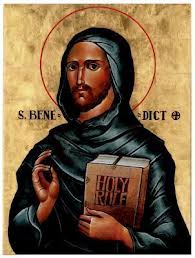
St. Benedict of Nursia

St. Benedict of Nursia

Today is the Feast of St. Benedict of Nursia, one of the Patron Saints of Europe.  Below is a description of St. Benedict from the Irish Jesuits:

Benedict of Nursia (c. 480 – c. 547) known as the Father of Western monasticism had a huge influence in his own time and in succeeding centuries. His monks were a source of stability in the highly disordered state of Europe following the collapse of the Roman Empire and the invasions of the northern tribes (Vandals, Huns, etc.) and laid the ground for the emergence of the cultural wealth of the Renaissance from the 12th century onwards.

Benedict was born about 480, the son of a Roman noble from Nursia (modern Norcia, in Umbria) and it is believed he was a twin of St Scholastica. Little certain is known about his life as the only source is the Second book of Gregory’s Dialogues. It has been described as “the biography of the greatest monk, written by the greatest Pope, himself also a monk”. It is more a spiritual portrait than a factual biography.

Benedict began studies in Rome but left before completing them to become a hermit in Subiaco. Over a period of three years in solitude, Benedict matured both in mind and character, in knowledge of himself and of his fellow-man. At the same time he became deeply respected by people in the neighborhood, so that when the abbot of a nearby monastery died, the monks begged him to be their abbot. Although he did not agree with their lifestyle, he finally accepted. However, it did not work, so much so that the monks tried to poison him and he went back to his hermit’s cave. The legend is that they tried to poison his drink but, when he blessed the cup, it shattered. They then tried to kill him with poisoned bread but, when he blessed it, a raven came and snatched it away. Many other miracles were attributed to him and many people came to him for direction. So he built 12 monasteries each with a superior and 12 monks. He himself lived in a 13th with some whom he thought were more promising. Benedict, however, was the father or abbot of all the groups.

Benedict later for Monte Cassino, near Naples, where he drew up the final version of his Rule. This contained much of the traditional monastic teaching of earlier monks like Cassian, Basil and probably also the so-called Rule of the Master, though much modified by Benedict. His vision was a life characterized by prudence and moderation rather than severe asceticism and lived within a framework of authority, obedience, stability, and community life. ‘Stability’ meant that a monk would generally stay permanently in the monastery which he had joined. It was a way of life which was complete, well-ordered and practical. The monk’s day was taken up with liturgical prayer, complemented by sacred reading and manual work of various kinds which took care of the community’s needs.

Benedict was not a priest and there is no evidence that he intended to found a religious order.  His principal goal and achievement was to write a Rule or way of life. Today’s Order of St Benedict (OSB) is of later origin and not a “religious order”” as commonly understood but rather a confederation of congregations into which the traditionally independent Benedictine abbeys have affiliated themselves for the purpose of representing their mutual interests, without however losing any of their autonomy. Benedict’s own personality is reflected in his description of the kind of person the abbot should be: wise, discreet, flexible, learned in the law of God, but also a spiritual father to his community. Gregory’s Dialogues spoke of him as having second sight and miraculous powers.

Because of its inner qualities and the endorsement it received from secular rulers and other founders of religious institutes, Benedict’s Rule became the standard monastic code in the early Middle Ages. Because of it flexibility, it could be adapted to the different needs of society in different places. In a world of civil turmoil with the break-up of the Roman Empire, it was the monasteries which became centres of learning, agriculture, hospitality, and medicine in a way which Benedict himself could never have imagined.

The best known symbols connected with Benedict are a broken cup (containing poison) and a raven.

Benedict spent the rest of his life realising the ideal of monasticism contained in his rule. He died at Monte Cassino, Italy, according to tradition, on 21 March 547.

He was named patron protector of Europe by Pope Paul VI in 1964. His feast day, previously 21 March, was moved in 1969 to 11 July, a date on which his feast had been celebrated in several places.  Together with Saints Cyril and Methodius, Catherine of Siena, Bridget of Sweden, and Teresa Benedicta of the Cross (Edith Stein) Benedict was declared a Patron of Europe by Pope John Paul II in 1999).

Posted in Uncategorized | Tagged , , , | 2 Comments