The Lord’s Prayer: A Challenging and Dangerous Prayer

lord_prayer

Today’s readings contain the version of the Lord’s Prayer found in the Gospel of Matthew. I learned this prayer as a child and pray it almost every day. It has become so routine that I often lose the power of the words contained in that simple prayer. Today, I would like to borrow extensively from an analysis of the “Our Father” from the Irish Jesuits:

“The prayer in this form (Luke has a shorter version) contains seven petitions. Seven is a favorite number for Matthew. In listing the genealogy of Jesus he divides it into three lists of seven (chap. 1); there were probably seven Beatitudes in the original text (chap. 5); there are seven parables of the Kingdom (chap. 13) and forgiveness is to be offered not seven times but 77 times (chap. 18); there are seven ‘Alas’ when denouncing the Pharisees (chap. 23). Finally, the gospel itself is divided into seven main sections (Infancy, five discourses, passion).

The text of the Lord’s Prayer should not be seen as just a formula for vocal recitation. It is, rather, a series of statements and petitions in which we affirm our relationship with God, with the people around us and with the world in general. It is a statement of faith and it is, as we shall see, a highly challenging and, therefore, even rather dangerous prayer.

Let us take a brief look at the petitions one by one.

1. Our Father:

The challenge and the danger begin right in the first two words. We address God as Father, the source of life and of everything that we have; we have nothing purely of our own. But God is not just ‘Father’; he is ‘our‘ Father. And that ‘our’ includes every single person who lives or has ever lived on this earth; not a single person can be excluded. As St. Cyprian said in a treatise that as part of the Office of Readings on Tuesday: “We do not say ‘My Father, who art in heaven,’ nor ‘Give me this day my daily bread.’ . . . We pray in public as a community, and not for one individual but for all. For the people of God are all one.”

In addressing God as ‘our Father’ we are acknowledging that every human person, including myself, is a child of God and therefore that we all belong to one huge family where we are all, in a very real way, brothers and sisters to each other. There is no room here for rejection, or hatred, or prejudice or contempt of any kind based on race, nationality, colour of skin, gender, sexual orientation, social class, religion… If I am not prepared to accept every single person as a brother or sister, I will have problems even beginning to say this prayer.

2. May your name be held holy:

Other forms are ‘Hallowed be thy name’ or ‘Holy be your name’. Of course, God’s name is holy no matter what we say or think. We make this prayer for our sake more than for his. Here we are praying that God’s name be held in the deepest respect by people everywhere. That is not the case: some people despise his name and others do not even know it. We pray that the whole world will know God’s name, which is to say, to know and recognise God as their God and Lord, their Creator and Conserver and the final end of their lives on this earth. It is, in fact, another form of the next petition.

3. Your kingdom come:

We have already spoken about the nature of the kingdom. It might be more accurate to say, ‘Your kingship come’. In other words, we pray that every person in our world may put themselves consciously and willingly under the kingship and lordship and the love of God. We do this, above all, by our working together to make this world the kind of place that God wants it to be – a place of truth and love, of justice and peace, of sharing and caring. In one sense, of course, God is Lord irrespective of our relationship to him. But it is clearly his will that people, on their part, should accept that loving lordship as the centre of their lives. And that is the work of the Church and of every single Christian, indeed of every person anywhere – to help people recognise the kingship and lordship of God and to accept it as the key to their present and future happiness.

4. Your will be done on earth – as in heaven:

This, in a way, is simply another way of saying what we have already asked for in the previous two petitions. For that is the will of God that people everywhere recognise the holiness of his name and submit themselves gladly to his kingship and lordship in our world. We do that most effectively by identifying totally with the mission and work of Jesus to bring life, healing and wholeness to our world. To do the will of God is not simply to throw aside what we want and accept God’s will even when it is totally contrary to our own. We are only fully doing God’s will when we can see clearly that what he wants is always what is the very best for us. And we are only fully doing his will when we fully want what he wants, when our will and his will are in perfect harmony. Then we do what he wants and we do what we want. We are praying here to reach that level of oneness.

5. Give us today our daily bread:

It does not look like it but this also is a highly dangerous prayer for us to make. First of all, we are only asking for what we need now. Later in the Sermon on the Mount Jesus will tell us not to be anxious about the future. We are asking for what we need today; tomorrow is another day. We take care of one day at a time.

But there is one little word here that is highly dangerous. It is the word ‘us’. Who is that ‘us’? Just me and my immediate family? or my parish? or my neighbourhood or my town or my country? Surely it is the same as that ‘our’ in the first petition – it includes every single person. I am praying, therefore, that every single person have bread to eat today. We know, of course, that there are millions of people (some of them in rich countries) who do not have enough to eat or who suffer from malnutrition and poorly balanced diets. In praying that all of ‘us’ have our daily bread, are we expecting God to drop manna from the skies or are we not reminding ourselves that the feeding of brothers and sisters is our responsibility? If people are hungry or badly fed, it is not God’s doing; human beings are responsible in most cases (outside of natural disasters).

This petition prayer can also include the Bread of the Eucharist. But in sharing that Bread together we are saying sacramentally that we are a sharing people and we will share our goods and blessings with others, especially those in need. Otherwise our Eucharist becomes a kind of sacrilege.

6. And forgive us our debts, as we have forgiven those who are in debt to us.

Again is this not another dangerous prayer to make? We are asking that God’s forgiveness to us be conditional on our readiness to forgive those we perceived to have hurt us in some way. That is a daring thing to do. And forgiveness does not simply mean uttering a few words. Forgiveness in the Scripture always includes reconciliation between offender and offended. In fact, I would go even further and say that the fully Christian person is never offended, cannot be offended. The true Christian has a rock solid sense of their own security and their own inner worth which no other person can take away. When such a person is the recipient of some attack, be it verbal or physical, their first response is to reach out to the attacker with concern and sympathy. It is the attacker who has the problem, not the one attacked. Most of us have a long way to go to reach that level of inner peace. ‘If what you say about me is true, I accept it; if it is false, then it is false. Why should I take offence?’

7. And do not put us to the test, but save us from the evil one (orfrom evil).

In the end, we acknowledge our weaknesses and our total dependence on God’s help. We pray that we will not find ourselves in a situation where we fall seriously. We ask to be protected from the powers of evil with which we are surrounded.

Some texts conclude with “For yours is the kingdom and the power and the glory for ever. Amen”, which is used by many Christian denominations and is now included in the Catholic Eucharist after the Lord’s Prayer but separated by a prayer for peace. It is believed that this conclusion, not found in most manuscripts, was introduced for liturgical reasons.

Finally, in addition to simply reciting this prayer in the rapid way we normally do, we could sometimes take it very slowly, one petition at a time and let its meaning sink in. Or we could just take one petition which is particularly meaningful to us at any time and just stay with it until it really becomes part of us.”

Posted in Uncategorized | Tagged , , | 4 Comments

Life of Teilhard de Chardin: The Early Years (1881-1899)

Pierre Teilhard de Chardin at age 12

Pierre Teilhard de Chardin at age 12

Pierre Teilhard de Chardin was born on May 1st, 1881 at the family estate in Sarcenat, France, to an upper class, land holding family of devout Catholics. Sarcenat is near the twin cities of Clermont-Ferrand in the ancient province of Auvergne. His parents were Emmanuel and Berthe-Adele Teilhard de Chardin. His mother was the great grandniece of Voltaire. Teilhard was the fourth of the couple’s eleven children.

It has been said that Pierre Teilhard de Chardin received his love of science from his father and his love of God from his mother.  Emmanuel Teilhard de Chardin was a tall and impressive figure who spoke seldom but was always to the point.  He was at once an antiquarian, an ornithologist, amateur geologist and a gentleman farmer.  He supervised the education of their children prior to entering school. His study on the first floor was his ultimate man-cave; no one was allowed to enter it uninvited.  Here he would sit writing for hours with the quill pens he insisted on making himself.

Berthe Teilhard de Chardin was a woman of deep Catholic piety.  She instilled in Teilhard a devotion to the Sacred Heart of Jesus, which was to be the radiating center of Teilhard’s own spirituality and theology.  Berthe rose early and walked to Mass every day before dawn so that she might be at home to breakfast with the family.  Berthe gave much of her time to charity.  Teilhard’s reflections on his mother’s influence is striking, he writes: “A spark had to fall upon me, to make the fire blaze out. And, without a doubt, it was through my mother that it came to me, sprung from the stream of Christian mysticism, to light up and kindle my childish soul. It was through that spark that `My universe,’ still but half-personalized, was to become amorised, and so achieve its full centration.”

Pierre and the other children of Emmanuel and Berthe rose at 7:30 for breakfast, had lunch at 11:00 and dinner at 6:00.  At 8:30 p.m., the household gathered for evening prayers.  Emmanuel would lead the Our Father, Hail Mary, Creed and the Litany of Our Lady.  On Sundays the family attended Mass in the morning, often followed by an extended family gathering with the cousins.  After Vespers, the children would play charades or roller-skating while the adults would visit in the salon.

Largely influenced by his mother, Pierre was called to the religious life at an early age.  He attended the Jesuit high school of Notre Dame de Mongre near Villefranche-sur-Saone, thirty miles north of Lyons, at twelve years of age.  Near the time of his graduation he wrote his parents indicating that he wanted to become a Jesuit in his pursuit of the Truth.

“As far as I can go back in my childhood, nothing seems to me more characteristic or familiar in my inner disposition than the taste or irresistible need for some ‘one and only sufficiing and necessary’ thing: in order to be fully at ease, to be completely happy, the knowledge that ‘some essential thing’ does really exist, to which everything else is no more than an accessory or, maybe, an embellishment. To know that, and unceasingly to rejoice in the consciousness of its existance . …” From Teilhard’s essays in The Heart of the Matter.

I have found contradictory information on the siblings of Pierre Teilhard de Chardin, but here is the best information I could piece together from the books I have in my library and the internet.  Any updates or corrections would be greatly appreciated. 

Father: Alexandre-Victor Emmanuel Teilhard de Chardin (b. 1844, d. 1932)
Mother: Berthe-Adèle de Dompierre d’Hornoy (b. 1853, m. 18-May-1875, d. 1936)
Brother: Albéric (naval officer, b. 1875, d. 1902. died of TB)
Sister: Marielle (b. ????, d. ????, died in infancy).
Sister: Françoise (nun, b. 1879, d. 1911. Mother Superior of Little Sisters of the Poor in China, died of smallpox).
Sister: Marguerite Teillard-Chambon (b. 1880, d. 1959; contracted incurable illness in 1902).
Sister: Marie-Louise (b. 1891, d. 1904.  Died of meningitis).
Sister: Marguerite-Marie (b. 1883, d. 1936).
Brother: Gabriel (b. 1885, d. 1941).
Brother: Olivier (b. 1887, d. 1918. Killed in action during WWI).
Brother: Joseph (b. 1889, d. 1978).
Brother: Gonzague (b. 1893, d. 1914. Killed in action during WWI).
Brother: Victor (d. 1934)

Sources:
Robert Speaight, “The Life of Teilhard de Chardin
JimDo public website
American Teilhard Association
Wikipedia

Posted in Uncategorized | Tagged | Leave a comment

You Want Me to Love and Pray for My Enemies?

Easy to say; hard to do

Easy to say; hard to do

Today’s Gospel reading is especially challenging for me: “But I say to you, love your enemies and pray for those who persecute you.” (Mt. 5:44).

My initial reaction is the same as the daily reflection from the Magis Center for Faith and Reason:

“Say that again, Lord?  You want me to love and pray for whom?

Love your enemies and pray for those who persecute you.

Can’t I just believe in the fact that you were Incarnate of the Virgin Mary, suffered death, were crucified, died, and were buried, and that you rose from the dead and are seated at the Father’s right hand in glory, judging the living and the dead? 

Somehow, assenting in Faith to the creedal dogmas of the Paschal Mystery is worlds easier than loving our enemies in the here and now.  One has to do with me and God, me and Eternity, me and my Hopeful, promised Destiny, me and the Alpha and Omega of my life.  Or, rather, we and God, we and our Hopeful, promised Destiny, and so on.  But, the other part – – the part about loving my enemy: Why is that such a difficult teaching of Jesus to swallow, to live?

The Irish Jesuits respond to this question by answering that, God’s ways may strike us as strange at first, but upon further reflection, they really are the best way to live:

“If we would only reflect a little, the advice of Jesus makes a great deal of sense and, in fact, is really the only way to go for our own happiness and peace. Otherwise, as Jesus says, his listeners were no different from ‘tax collectors’, a group who, because they worked for the occupying power, were held in special contempt, or pagans, that is, people who lived God-less lives.

To understand what Jesus is saying we need to clarify two words, ‘love’ and ‘enemies’.

Who are our enemies? They can either be the people that we are hostile towards or the people who are hostile to us. The practising Christian who takes on board the teaching of Jesus will want to have positive attitudes to people in general and will not marginalise anyone on the basis of race, nationality, colour, class, gender or whatever. Such a person will not want to act in a way unnecessarily to create hostility in others. However, simply because we try to look and act positively towards others is no guarantee that they will act in the same way towards us. Through no objective fault of our own, we may become the object of their dislike, resentment, hatred, jealousy, anger and even violence. These are our enemies. And we are to love them.

What does ‘love’ mean here? The word that the gospel uses is a verb from the noun agape.  Agape is a unilateral way of loving by which, irrespective of the actions or attitudes of another person, I desire their well-being. It is the love which God extends to every one of his creatures, irrespective of how they respond to him. In this it is quite different from the love which involves sharing, intimacy, affection and a strong element of mutual giving.

We are not being asked to love our enemies with the love of affection, to be in love with them or to be fond of them. That would not make sense and they would not want it. But we are asked to reach out and desire their well-being. This can be done when we focus our attention and our concern more on them than on ourselves.

When we are the objects of other people’s hostility we tend to go on the defensive and to generate negative attitudes towards the other. Our inner security (or insecurity) is under attack. Jesus is asking us rather to respond to the real situation rather than to react to spontaneous feelings.

When someone hates me, attacks me, is angry with me for no reason that I can think of, instead of feeling sorry for myself, I will reach out and ask, “What is wrong with that person? Why is that person acting in that way? What is bothering that person? Is there any way I can help to dissolve this person’s negative behavior which is probably a sign of some inner self-hating or insecurity on their part?”

And certainly when I begin to think in this way, it becomes perfectly natural to pray for that person, to pray for their inner healing, for a restoration of peace and inner security. To hate someone who hates me, to be violent with someone who is violent with me, simply means that there are twice as many problems as there were at the beginning. By responding in the way that Jesus suggests, we end up with no problem at all!

And Jesus gives us another motive for acting in this way: it is the way God himself acts. He causes the hot, merciless sun to shine on the good as well as the bad; the cool, refreshing rain falls equally on the bad as well as the good. What Jesus is saying is that God’s love, his agape, reaches out indiscriminately to every single person, irrespective of their behaviour.

“You must therefore be perfect just as your heavenly Father is perfect.” Perfection here refers to that unconditional agape that God extends to every single person. If we are to grow into the likeness of God and give witness to his presence in the world, we need to act in exactly the same way. And wouldn’t it be a wonderful world if people followed Jesus’ advice? Far from being impractical, it is the only way to go.”

Posted in Uncategorized | Tagged | Leave a comment

Teilhard de Chardin Quote of the Week (June 17, 2013)

cosmic11

“The great cosmic attributes of Christ, those which (particularly in St John and St Paul) accord him a universal and final primacy over creation, these attributes… only assume their full dimension in the setting of an evolution… that is both spiritual and convergent.”

(Catholicism and Science, 1946, IX, 189)
Posted in Reason and Faith, Teilhard Quote of the Week | Tagged , , | Leave a comment

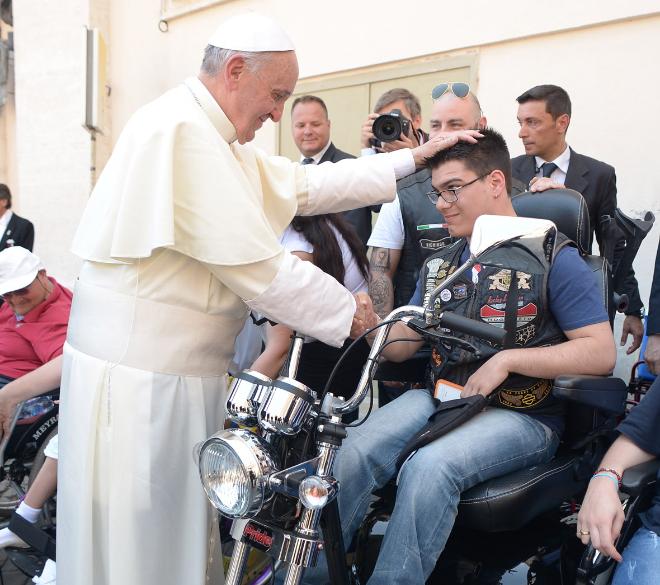
Hundreds of Harley riders revved up as Pope Francis blesses bikes

Pope Francis blesses a man at the end of Mass Sunday in St. Peter’s Square at the Vatican. The pope blessed Harley-Davidson bikes and bikers as the Wisconsin motorcycle manufacturer celebrated its 110th anniversary with a parade and plenty of leather.

Pope Francis blesses a man at the end of Mass Sunday in St. Peter’s Square at the Vatican. The pope blessed Harley-Davidson bikes and bikers as the Wisconsin motorcycle manufacturer celebrated its 110th anniversary with a parade and plenty of leather.

I am certainly not immune from the foibles of hometown proud.  Being in Wisconsin, USA, one of the international claims to fame we have is the iconic Harley-Davidson motorcycle.  This morning’s Milwaukee Journal Sentinel newspaper has a great article on Pope Francis blessing and celebrating mass with a group of motorcycle riders in Rome to celebrate Harley-Davidson’s 110th anniversary.

Rome — Several hundred Harley-Davidson motorcycle owners can add a papal blessing to their list of bragging rights about their Hog.

Before celebrating Mass on Sunday, Pope Francis blessed bikes and bikers from his popemobile as Harleys lined Via della Conciliazione, the street from St. Peter’s Basilica to the Tiber River. The blessing concluded a weekend of events on the Rome leg of the Milwaukee-based motorcycle manufacturer’s celebration of its 110th anniversary.

Paolo Forbicini’s Harley-Davidson Fat Boy was one of the bikes blessed by Pope Francis. Forbicini, a Catholic from Milan, said he was proud to have the pontiff’s blessing bestowed on his ride.

After the blessing, leather-clad bikers sat alongside nuns and other worshippers for a traditional Catholic Mass. Forbicini said celebrating his first Mass in St. Peter’s Square was even more special with all his fellow bikers . . . Read the entire article here.

Posted in Uncategorized | Tagged , , , | Leave a comment

Scientific Potpourri

earth

Here are some of the top scientific stories of the week from cosmology and evolution:

Humans are Related to All Life on Earth.  In a recent article in the journal NatureDouglas Theobald of Brandeis University concluded that there was less than a 1 in 102,860 chance that all life did not arise from a common ancestor.  102,860 is 1 followed by 2,860 zeros, an incomprehensibly large number.  Big Think discusses the implications for human health.  In my opinion, the theological implications of this connection are even more interesting.

New Physics Complication Lend Support to Multiverse Hypothesis?  An article in Scientific American discusses why the Higgs Boson has significantly less mass than predicted.  Speculations include the multiverse and other theories.  It is a fascinating article, even though it confuses science with metaphysics.  Unless the multiverse theory can be experimentally tested, it is in the realm of metaphysics.

World Population Could Be Nearly 11 Billion by 2100.  A new statistical analysis shows the world population could reach nearly 11 billion by the end of the century, according to a United Nations report issued June 13. That’s about 800 million, or about 8 percent, more than the previous projection of 10.1 billion, issued in 2011.

Context Crucial When It Comes to Mutations in Genetic Evolution.  According to the traditional view among biologists, a central tenet of evolutionary biology has been that the evolutionary fates of new mutations depend on whether their effects are good, bad or inconsequential with respect to reproductive success. Central to this view is that “good” mutations are always good and lead to reproductive success, while “bad” mutations are always bad and will be quickly weeded out of the gene pool. However, new research led by evolutionary biologist Jay Storz of the University of Nebraska-Lincoln has found that whether a given mutation is good or bad is often determined by other mutations associated with it. In other words, genetic evolution is context-dependent.

Discovery of New Material State Counterintuitive to Laws of Physics.  At the suburban Chicago laboratory, a group of scientists has seemingly defied the laws of physics and found a way to apply pressure to make a material expand instead of compress/contract.  “It’s like squeezing a stone and forming a giant sponge,” said Karena Chapman, a chemist at the U.S. Department of Energy laboratory. “Materials are supposed to become denser and more compact under pressure. We are seeing the exact opposite. The pressure-treated material has half the density of the original state. This is counterintuitive to the laws of physics.”

 Simple Theory May Explain Dark Matter.  From Science Daily:  Most of the matter in the universe may be made out of particles that possess an unusual, donut-shaped electromagnetic field called an anapole.  This proposal, which endows dark matter particles with a rare form of electromagnetism, has been strengthened by a detailed analysis performed by a pair of theoretical physicists at Vanderbilt University.  An article about the research was published online last month by the journal Physics Letters B

Posted in Reason and Faith | Tagged , , , , | 2 Comments

Father’s Day Prayer: In Gratitude for my Father

fathers_day

From Creighton’s Online Ministries

In gratitude for my Father

Dear God, the Father of us all, I thank you for my father. Along with my mother, through the marvel of your creation, my father gave me the gift of life itself. He was such a good teacher and mentor, such a wonderful example of how to live a life of faith. Please take care of him now and be generous with him as you prepare him for the rewards of eternal life you have prepared for him.

Posted in Uncategorized | Tagged | Leave a comment

Sunday Reflection: Actions Speak Louder Than Words

st_anthony

This week’s readings for the Eleventh Sunday in Ordinary Time include fascinating stories on hypocrisy, sin, repenting and forgiveness.  The first reading is an excerpt from the famous story of King David and his adultery with Bathsheba.  The Gospel includes a story only found in Luke where a “sinful woman” who crashed a dinner where a Pharisee was hosting Jesus.  The focus on these two readings are that (i) God will forgive any sin as long as we repent and (ii) actions speak louder than words.

For today’s reflection, I would like to go back to Thursday of this week, which was the Feast of St. Anthony of Padua.  St. Anthony was born 1195 and initially joined the Cannons Regular Order of priests.  At the age of twenty-five, Anthony’s life took an exciting turn. He met some Franciscans and was impressed by their simple, evangelical lifestyle. Anthony received permission to transfer from the Cannons Order to the Franciscan Order, which was very new.  St. Anthony eventually developed an outstanding reputation for his preaching ability and was named a Doctor of the Church in 1946.

This week’s reflection is a sermon by St. Anthony of Padua from the Office of the Readings for the Feast of St. Anthony:

Second reading
From a sermon by Saint Anthony of Padua, priest
Actions speak louder than words

“The man who is filled with the Holy Spirit speaks in different languages. These different languages are different ways of witnessing to Christ, such as humility, poverty, patience and obedience; we speak in those languages when we reveal in ourselves these virtues to others. Actions speak louder than words; let your words teach and your actions speak. We are full of words but empty of actions, and therefore are cursed by the Lord, since he himself cursed the fig tree when he found no fruit but only leaves. Gregory says: “A law is laid upon the preacher to practice what he preaches.” It is useless for a man to flaunt his knowledge of the law if he undermines its teaching by his actions.

But the apostles spoke as the Spirit gave them the gift of speech. Happy the man whose words issue from the Holy Spirit and not from himself! For some men speak as their own character dictates, but steal the words of others and present them as their own and claim the credit for them. The Lord refers to such men and others like them in Jeremiah: So, then, I have a quarrel with the prophets that steal my words from each other. I have a quarrel with the prophets, says the Lord, who have only to move their tongues to utter oracles. I have a quarrel with the prophets who make prophecies out of lying dreams, who recount them and lead my people astray with their lies and their pretensions. I certainly never sent them or commissioned them, and they serve no good purpose for this people, says the Lord.

We should speak, then, as the Holy Spirit gives us the gift of speech. Our humble and sincere request to the Spirit for ourselves should be that we may bring the day of Pentecost to fulfillment, insofar as he infuses us with his grace, by using our bodily senses in a perfect manner and by keeping the commandments. Likewise we shall request that we may be filled with a keen sense of sorrow and with fiery tongues for confessing the faith, so that our deserved reward may be to stand in the blazing splendor of the saints and to look upon the triune God.”

Posted in Sunday Reflections | Tagged , , | Leave a comment

Teilhard de Chardin Quote of the Week: June 10, 2013 (Big Christianity)

cosmic_christ3

“Under the constant flood of being that science lets loose, a certain small-scale academic Christ is swept away; and instead the great Christ of tradition and mysticism is revealed and must be accepted; and it is to this Christ that we must turn.”

— Pierre Teilhard de Chardin, Science and Christ.

Posted in Teilhard Quote of the Week | Tagged , | Leave a comment

Report: ‘Catholic McCarthyism’ Threatens U.S. Bishops’ Anti-Poverty Mission

CCHD

One of the challenging items about being a Catholic in the United States is that there is an unhealthy degree of factionalization within the Church that, unfortunately, are often motivated by political and electoral agendas rather than authentic Church teaching.  I am personally troubled, not only for the Unity of the Church, but because I feel like a young child who has a Mother and Father than I deeply love and it pains me to see them violently arguing with each other over trivial matters.  As a result, you will not see this blog engaging in U.S. electoral politics or the Catholic in-fighting.

When I first saw a report from Faith in Public Life (a solid faith-filled organization but one that has a strong political agenda)  with “McCarthyism” in the title, I disregarded it as a political grenade.  However, when I flipped to page 2 of the report and saw the list of endorsing organizations and individuals, I decided to read further.

First, some background.  In 1969, the U.S. Conference of Catholic Bishops (USCBB) created the Catholic Campaign for Human Development (CCHD), which according to USCCB website, is “is an instrument of the Catholic Church working to carry out the mission of Jesus Christ, ‘… to bring good news to the poor   … release to captives    … sight to the blind, and let the oppressed go free.'” (Luke 4:18) . . . CCHD provides funding to groups whose activities reflect Catholic moral and social teaching on human life and dignity. CCHD-funded groups work to change social structures and policies which undermine life and dignity, especially for the poor and powerless.” (emphasis added).   Over the last 44 years, the CCHD has used the resources of the Church to raise funds and organize in support of this objective.  The CCHD has been hailed by Blessed John Paul II and Pope Emeritus Benedict “removing the causes of poverty and not merely the evil effects of injustice.”

The agencies receiving funds from the CCHD face exacting scrutiny for consistency with Catholic teaching.  According to the website of the USCCB, the CCHD:

“As the official anti-poverty agency of the Catholic bishops in the United States, CCHD is accountable to them and operates at the highest levels of fidelity to Church teaching, integrity and transparency in its mission to provide critical support to poor persons. CCHD monitors grant recipients through an exacting reporting process in cooperation with the local diocese. Only groups that have received formal approval from the local bishop may receive a CCHD grant.

CCHD requires of each grantee the highest standards of accountability and conformity with the moral teaching of the Catholic Church. If a group commits offenses against Catholic moral teaching, or undermines the Church’s defense of the unborn or her promotion of the family, a grant qualification is rescinded.”

Sounds like fairly standard stuff:  The CCHD is the official vehicle of the U.S. Bishops to support the Gospel message of reducing poverty and systemic injustice.  Fairly non-controversial stuff, right?

Fast-forward to this week, when Faith in Public Life issued a report claiming that “a small, but well-financed network has emerged as a relentless opponent of the bishops’ social justice Campaign (CCHD), which has long been recognized as one of the most influential funders of grassroots community organizing.”  The thing that caught by attention on the report it that it is endorsed by two former Presidents of the USCBB and no less than 10 current or former Bishops and other Church leaders, as well as numerous current and former employees of the CCHD.  When I saw the endorsers, I decided to read further.

The report makes claims, back up by extensive footnotes and examples, of well-funded Catholic fringe groups that have been critical of the CCHD for partnering with non-Catholics or those who do not share Catholic social teaching.  It is noteworthy that these fringe groups are not claiming that the CCHD’s mission is consistent with the Christian Gospel, only that the CCHD should not fulfill its mission of reducing poverty buy partnering with organizations who differ with the CCHD on other issues.  The report was striking in its rebuke on those organizations critiquing the CCHD:

“Is there anything Christian about this? Jesus drew rebukes from pious religious leaders of his time for eating with prostitutes, befriending outcasts and challenging the high priests who zealously guarded the letter of the law while ignoring its spirit. Groups like the American Life League might have good intentions. But in their doggedness to defend the faith they are losing sight of the liberating message of the Gospel and tarnishing the Catholic justice tradition.”

The USCCB is also fed up with fringe groups attacking the bishops and the CCHD.  As Bishop Stephen Blaire, chairman of the USCCB Committee on Domestic Justice and Human Development, and Bishop Jaime Soto, chairman of the USCCB Subcommittee on CCHD have noted:

“Despite significant progress, some things don’t change. The American Life League (ALL) continues to attack CCHD and the USCCB. ALL continue[s] to recycle allegations that CCHD funds many organizations that are in conflict with Catholic teaching. They simply do not agree with CCHD’s mission and how we apply our guidelines and requirements.”

I disagree with some of the rhetoric used by in the report.  I do not believe that charges of McCarthyism are conducive to building bridges.  However, I strongly support the aim of the report and the activities of the USCCB and the CCHD in furtherance of the goals of the USCCB and the Gospels to reduce poverty and try to solve the root of systemic injustices in the U.S.

Posted in Uncategorized | Tagged , | Leave a comment