Solemnity of St. Peter and St. Paul: Unity in Diversity

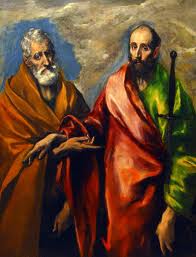
St. Peter and St. Paul

St. Peter and St. Paul

Today is the Solemnity of St. Peter and St. Paul.  Both of these great Saints have other Feast days (The Chair of St. Peter is celebrated on February 22 and the Conversion of St. Paul is celebrated on January 25), but it is appropriate that their primary feast day is together.  Not only are St. Peter and St. Paul the pillars of early Christianity, but they represent a diversity of background and opinions that are crucial for the vibrancy of Christianity.

It is an example of God’s strong sense of humor that he picked St. Peter and St. Paul to build the foundations of the early Church.  No mere human would have picked such unlikely candidates.  St. Peter was an educated, peasant fisherman from a backwater Roman province who would go to the heart of Rome and become the first leader of a movement that is still the largest organization in the world 2,000 years later.  St. Paul was part of a strict sect of Judaism that insisted on following every letter of the Mosaic law who would eventually argue against the Church leadership to overturn much of the Mosaic law.  St. Peter was a man of action who had a history of backing out when things got tough prior to the Resurrection.  Tradition holds that St. Paul had a meek personality with a speech impediment but his ideas form a major part of the New Testament.  Christ certainly chose an odd couple of start his Church.

Peter represents that part of the Church which gives it stability: its traditions handed down in an unbroken way from the very beginning.  Peter is the rock, the structures which help to preserve and conserve those traditions, and the structure which also gives consistency and unity to the Church.

Paul represents the prophetic and missionary role of the Church.  It is that part of the Church which constantly works on the edge, pushing the boundaries of the Church further out, not only in a geographical sense but also pushing the concerns of the Church into neglected areas of social concern and creatively developing new ways of communicating the Christian message. This is the Church which needs to be constantly renewed.

St. Peter:  Leader and Man of Action

St. Peter, originally named Simon, was a native of Bethsaida, near Lake Tiberias.  Peter was the son of John, and worked, like his brother St. Andrew, as a fisherman on Lake Genesareth. Andrew introduced Peter to Jesus, and Christ called Peter to become a disciple. We know little else about Peter’s background, social class or education but like Jesus and many disciples, he was likely from a poor family with little formal education.  The Gospels portray Peter as being a very human figure, a man of action wanting to do the right thing, but frequently missing the message (criticizing Jesus for saying that he had to suffer) or lacking faith.  This dichotomy between wanting to be a bold man of courage to fleeing in the face of danger continued through the crucifixion, with his cutting off the ear of the slave of the high priest to Peter’s denying Jesus and fleeing at the end.

After seeing the risen Christ, Peter’s entire worldview changed.  Peter began to understand the meaning of Christ’s message and boldly assumed the leadership mantle that Jesus had given to him.  Tradition holds that Peter established the Church in Rome before suffering martyrdom.  The death of Peter is attested to by Tertullian at the end of the 2nd century, and by Origen in Eusebius, Church History III.  Origen wrote: “Peter was crucified at Rome with his head downwards, as he himself had desired to suffer.” This is why an upside down cross is generally accepted as a symbol of Peter, who would not have considered himself worthy enough to die the same way as his Savior.

St. Paul:  Intellectual and Mystic

Unlike St. Peter, St. Paul appears to have been well educated and very conversant in the Greek culture of the time.  St. Paul was likely born between the years of 5 BC and 5 AD. The Book of Acts implies that Paul was a Roman citizen by birth, more affirmatively describing his father as such, but some scholars have taken issue with the evidence presented by the text. He was part of devout Jewish family in the city of Tarsus—one of the largest trade centers on the Mediterranean coast. It had been in existence several hundred years prior to his birth. It was renowned for its university, one in which students could receive a superior education. During the time of Alexander the Great, Tarsus was the most influential city in Asia Minor.

Stoicism was the dominant philosophy there. In addition to his becoming steeped in Orthodox Pharisaic Judaism, his early life in Tarsus allowed him to learn “Classic Greek”, Greek philosophy, and Koine Greekwhich was the lingua franca of the Roman Empire, spoken by the common people.

Unlike St. Peter who was a close confidant of Jesus, St. Paul never met Christ prior to his Resurrection.  During Jesus’ life, Saul (Paul’s name prior to his conversion) was a devote Pharisee, who preached and practices devotion to the Mosaic law.  After Jesus’ death, Saul persecuted Christians as heretics who, in his way of thinking, were disobeying the law and blaspheming God. In a startling encounter, which ranks as one of the greatest turning points in human history, the Resurrected Christ appeared to Saul on his way to Damascus to persecute Christians there.  After this appearance, Paul led a new life as the Apostle to the Gentiles.

Paul was a visionary and a mystic.  Paul maintained the continuity between Christ and Abraham, Moses and the prophets.  He would rely heavily on the training he received concerning the law and the prophets, utilizing this knowledge to convince his Jewish countrymen of the unity of past Old Testament prophecy and covenants with the fulfilling of these in Jesus Christ. However, he also appreciated that God becoming Incarnate was the ultimate revelation that overturned many of the details of the Mosaic law.

Paul also drew on the language and thoughts of the Greek culture to effectively preach the Gospel.  In his letters, Paul reflected heavily from his knowledge of Stoic philosophy, using Stoic terms and metaphors to assist his new Gentile converts in their understanding of the revealed word of God. His wide spectrum of experiences and education gave the Paul the tools which he later would use to effectively spread the Gospel and to establish the church solidly in many parts of the Roman Empire.

Perhaps most profoundly, Paul was a deep mystic.  His first personal experience with Christ came after the Resurrection.  This personal experience, supplemented by a deep prayer life, provided Paul with the vision for the future Church.  For Paul, Christ was not only a peasant in Nazareth, he was the Omega of all creation.   Paul gave Christ a cosmic significance.  In his speech the Athenians as recorded in Acts, Paul stated that Christ was the one “in Him we live and move and have our being”.  In the first letter to the Corinthians, Paul described how all believers are part of the Body of Christ.  These concepts, as well as well as concepts from Johannian literature such as the Logos, were the scriptural basis for Teilhard de Chardin’s concept of the Divine Milieu.

Christian tradition holds that Paul was beheaded in Rome during the reign of Nero around the mid-60s.
 

Posted in Uncategorized | Tagged , | 2 Comments

St. Irenaeus and Teilhard de Chardin

St. Irenaeus

St. Irenaeus

“The glory of God is humanity fully alive.” — St. Irenaeus

Today is the Feast Day of St. Irenaeus (Orthodox Church celebrates St. Irenaeus on August 23).  St. Irenaeus was Bishop of Lugdunum in Gaul, then a part of the Roman Empire (now Lyons, France), the area where Teilhard de Chardin spent many of his formative years.  St. Irenaeus was an early Church Father and apologist, and his writings were formative in the early development of Christian theology. He was a student of St. Polycarp, who in turn was traditionally a disciple of St. John the Evangelist.

St. Irenaeus’ best-known book, Adversus Haereses or Against Heresies (c. 180) is a detailed attack on Gnosticism, which was then a serious threat to the Church, and especially on the system of the Gnostic Valentinus. As one of the first great Christian theologians, he emphasized the traditional elements in the Church, especially the episcopate, Scripture, and tradition. Against the Gnostics, who said that they possessed a secret oral tradition from Jesus himself, Irenaeus maintained that the bishops in different cities are known as far back as the Apostles—and none of them was a Gnostic—and that the bishops provided the only safe guide to the interpretation of Scripture. His writings, with those of St. Clement and St. Ignatius of Antioch, are taken as among the earliest signs of the developing doctrine of the primacy of Rome. St. Irenaeus is the earliest witness to recognition of the canonical character of all four gospels.

Irenaeus’ writings had a significant influence on the thinking of Teilhard de Chardin. Irenaeus repeatedly insists that God began the world and has been overseeing it ever since this creative act; everything that has happened is part of his plan for humanity. The essence of this plan is a process of maturation: Irenaeus believes that humanity was created immature, and God intended his creatures to take a long time to grow into or assume the divine likeness. Thus, Adam and Eve were created as children. Their Fall was thus not a full-blown rebellion but rather a childish spat, a desire to grow up before their time and have everything with immediacy.

Everything that has happened since has therefore been planned by God to help humanity overcome this initial mishap and achieve spiritual maturity. The world has been intentionally designed by God as a difficult place, where human beings are forced to make moral decisions, as only in this way can they mature as moral agents. Irenaeus likens death to the big fish that swallowed Jonah: it was only in the depths of the whale’s belly that Jonah could turn to God and act according to the divine will. Similarly, death and suffering appear as evils, but without them we could never come to know God.

According to Irenaeus, the high point in salvation history is the advent of Jesus. Irenaeus believed that Christ would always have been sent, even if humanity had never sinned; but the fact that they did sin determines his role as a savior. He sees Christ as the new Adam, who systematically undoes what Adam did.

Teilhard de Chardin took the core ideas of Irenaeus and expanded upon them in light of the the understandings from 20th century cosmology and evolutionary biology.  The core similarities of St. Irenaeus and Teilhard de Chardin are as follows:

  • Matter is created by God as good (as opposed to the gnostics that view matter as evil).
  • God is continuing to create in the Universe.
  • Humanity and all of creation are evolving as part of God’s plan to draw humans closer to himself.
  • Christ is an integral part of the Universe, both in the human incarnation as Jesus of Nazareth and as the Cosmic Christ.
  • Suffering and death help humans grow in our moral evolution, both in empathy and selflessness, bringing humans closer to God.


Posted in Uncategorized | Tagged | 3 Comments

Life of Teilhard de Chardin: Intellectual Foundations and Paleontology Beginnings (1908 – 1914)

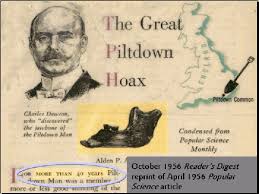
Piltdown Hoax

From Cairo, Pierre returned to England to complete his theological studies at Ore Place in Hastings. During the years 1908 to 1912 Teilhard lived the rigorously disciplined life of a Jesuit scholastic.  It was here that his scientific and theological ideas continued to develop. Two different but interrelated developments occurred during this period which significantly affected the future course of Teilhard’s life. These are the reading of Teilhard’s continued intellectual and theological formation at Ore Place, the anti-Modernist attack by Pope Pius X, and his discovery of a fossil tooth in the region of Hastings.

Teilhard’s Continued Intellectual Formation

The intellectual climate in Europe and within the Catholic Church continued to be divisive.  In 1903 while Teilhard was in Egypt, Pius X succeeded Leo XIII as Pope. The curia under Pope Pius X had a different theological emphasis, retreating from the modern world (partly due to the hostility by many European governments) and attacking a diverse spectrum of ideas labelled “modernism” in the encyclical Pascendi Dominici Gregis (1907) and the decrees of Lamentabili (1907).  These underlying intellectual currents continued to last during Teilhard’s lifetime (and echos of them continue today).  Despite the fact that the modernism contained in the official writings of Pope Pius X was aimed primarily at the anti-Catholic atheistic philosophies and governments of Europe, the term “modernism” took on a much broader label that some theologians used as a club against their opponents without regard to the ideas of such persons.  Unfortunately, Teilhard would be a victim of these unfair charges both during his lifetime and after his death.

Robert Speaight accurately described the problems of modernism as defined by Pope Pius X and Teilhard’s pushback against Modernism:

“The tendency of Modernism is to diminish the trancendent stature of Christ: Teilhard’s concern was to enlarge it to cosmic proportions.  So far from inventing a Christ to fit his own ideas, Teilhard had already found him in St. Paul.  It was ‘He in whom all things consist’, ‘He who fills all things’, ‘the Christ who is all in all’, and ‘has ascended high above all the heavens to fill all things with his presence’.  it was the Christus pantocrator of Byzantium, and more particularly the Christ of the Sacred Heart, freed from its popular iconography. Where the Modernist tends to imprison Christ in history at the same time as he questions the historicity of the Gospels which gave him to us, Teilhard adores him when he is transfigured on the mountain, rises from the tomb or is lost in the clouds above the heads of the Apostles. Whatever certain neo-modernists may pretend to the contrary, the opposition could not be more clear.” 

The core of these ideas took their shape at Ore Place as Teilhard continued his quest for the synthesis of a Big Christ, supported by the findings of science.  Teilhard understand the universe, created by God, in evolution and that this evolution had a cosmic and spiritual significance.  Quickly, the germs of a future synthesis of Matter, Life and Energy, all created by the triune God, had acquired the “organic dignity of a Cosmogenesis”.

Teilhard was ordained a priest on August 24, 1911 at the chapel at Ore Place.  He said his first Mass the next morning, the feast of St. Louis, served by two of his brothers, Gabriel and Joseph.  Two other brothers, Victor and Gonzague were also present.  Having his siblings present at his Ordination must have triggered feelings for his eldest sister Francoise, who had died prematurely of smallpox only two months earlier while in China.  This sister, who was the only other family member in religious life, had become a Little Sister of the Poor and worked among the impoverished of Shanghai. For Teilhard her death was particularly poignant because of the selfless dedication of her life.

Paleontology and “Piltdown Man” 

From 1912 to 1914, Teilhard worked in the paleontology laboratory of the Musée National d’Histoire Naturelle, in Paris, studying the mammals of the middle Tertiary period. In June 1912 he formed part of the original digging team, with Arthur Smith Woodward and Charles Dawson, to perform follow-up investigations at the Piltdown site, after the discovery of the first fragments of the (fraudulent) “Piltdown Man”.  The Piltdown Man was one of the most famous paleoanthropological hoaxes ever to have been perpetrated.  Animal bone fragments were presented as the fossilized remains of a previously unknown early human.  The likely identity of the forger was Charles Dawson.  However, long after he died, Teilhard was suspected as a co-conspirator by Stephen Jay Gould.  Gould, while a famous paleontologist and writer, certainly had some questionable forgeries himself.  Teilhard was eventually exonerated, but it is ironic that accusations against a man of impeccable character (Teilhard) by a man with suspicious character (Gould) were ever taken seriously.

During this time, Teilhard has a more fruitful encounter with Professor Marcellin Boule, a specialist in Neanderthal studies.  Boule, as early as 1915, astutely recognised the non-hominid origins of the Piltdown finds and gradually guided Teilhard towards human paleontology.  It was an interesting pairing; Boule a short, stout and plebeian atheist and Teilhard a tall, thin and aristocratic Catholic priest but by all accounts got along well.  While there was a strong mutual respect for their scientific prowess, Teilhard later expressed frustration for Boule’s opposition to religious faith in his scientific work:

“What [Boule] defends with a justifiable energy (perhaps with more energy than has now become necessary) is that the human species appeared on Earth in obedience to the same fundamental laws as every other species.  hence its past and present structure.  What he did not unfortunately see as clearly (the fault is perhaps the fault of his generation) is that this similarity in ’embryogenesis’ does not prevent man — rather than contrary — from representing an exception in nature (an exception of eminence and emergence, and not of anomaly) without which the Tree of Life is meaningless, even from a scientific point of view” (emphasis added) (quoted in Robert Speaight, “The Life of Teilhard de Chardin“, p. 49

Apart from his geological excursions, Teilhard’s life was fairly routine.  After saying Mass at 6:00 a.m. and having breakfast with the Jesuits, he worked at the Museum until late afternoon.  During this period, he met new people such as Abbe Henri Breuil, who would have a lasting impact on his life and deepened friendships with previous acquaintances such as his cousin Marguerite.  The intellectually active and safe life of the Museum would soon give way to the bloody trenches of World War I.   

Posted in Uncategorized | Tagged , , | Leave a comment

Teilhard de Chardin Quote of the Week (June 24, 2013): Christ and Science

Science helps lead us to the Divine

Science helps lead us to the Divine

“Science alone cannot discover Christ, but Christ fulfills the desires which spring up in our hearts from the teachings of science.”

— From Science and Christ (quoted in Robert Speaight, the “The Life of Teilhard de Chardin“).

Posted in Reason and Faith, Teilhard Quote of the Week | Tagged , | Leave a comment

Life of Teilhard de Chardin: Early Jesuit Formation (1899 – 1908)

Teilhard de Chardin in Jersey approximately 1902

Teilhard de Chardin in Jersey approximately 1902

Teilhard de Chardin entered the Jesuit novitiate in France in March 1899.   Teilhard’s training as a Jesuit provided him with the thoughtful stimulation to continue his devotion both to scientific investigation of the earth and to cultivation of a life of prayer.  Here he further developed the ascetic piety that he had learned in his reading at home.  Teilhard entered the Jesuits at a time of high conflict between the Catholic Church and the government of the French Third Republic.  According to Robert Speaight: “Every religious institution in France was at this time a redoubt of orthodoxy and, almost necessarily, of political reaction.  Militant atheism was not only in the air, but in the government.”  The French government passed the 1901 Law on Associations, which resulted in many hardships for Catholic institutions.  Tens of thousands of clerics, including the Jesuits, choose to leave France for the English island of Jersey.

However, prior to leaving France, Teilhard took his first vows as a Jesuit in March 1901.  He wrote to his parents:

“At last I’m a Jesuit . . . if you only knew the joy I feel now that I have at least given myself completely and forever to the Society, particularly at a time when it is being persecuted.”

Teilhard was remain faithful to his vows to the Society of Jesus and the Catholic Church, sometimes at great personal cost.

Around this time Teilhard’s family suffered a series of tragedies.   In September 1902, his eldest brother, Albéric, a naval officer, died of tuberculosis.  Around this time, his younger sister Marguerite-Marie (also known as Guigite) became permanently bedridden after an attack of pleurisy.  Two years later his sister Louise died of meningitis at the age of 12.  During this period of tragedy, Teilhard momentarily turned his gaze away from the world towards the meaning of life and suffering.  Teilhard indicates that but for Paul Trossard, his former novice master who encouraged him to follow science as a legitimate way to God, he would have discontinued those studies in favor of theology.

Teilhard spent the next three years (1905-1908) teaching physics and chemistry at the Jesuit college of St. Francis in Cairo, Egypt.  Teilhard’s naturalist inclinations were developed through prolonged forays into the countryside near Cairo studying the existing flora and fauna and also the fossils of Egypt’s past.  While Teilhard carried on his teaching assignments assiduously he also made time for extensive collecting of fossils and for correspondence with naturalists in Egypt and France. His collected Letters from Egypt reveal a person with keen observational powers. In 1907 Teilhard published his first article, “A Week in Fayoum.” He also learned in 1907 that due to his finds of shark teeth in Fayoum and in the quarries around Cairo a new species named Teilhardia and three new varieties of shark had been presented to the Geological Society of France by his French correspondent, Monseur Prieur.

From Teilhard’s letters during his period in Egypt, suggest that Teilhard was starting his intellectual and spiritual synthesis of science and revealed truth.  According to Robert Speaight:

“If Teilhard thought about these matters, he does not say so.  His piety finds an unforced expression in devotion to the Blessed Virgin and the Sacred Heart.  Although he is sometimes called upon for a sermon, he would rather teach than preach.  The impression throughout is of a searching eye and sympathetic heart rather than a questing mind.  But these appearances were deceptive. Behind the world of physics he felt the essential matter of his childish dreams and now, in the spring of his vocation, he vowed that he would ‘force the secret of its mysterious gravity.’ “

These ideas would begin to germinate when Teilhard returned to England to continue his theological studies.

Sources:
Robert Speaight, “The Life of Teilhard de Chardin
JimDo public website
American Teilhard Association
Wikipedia
Posted in Uncategorized | Tagged , | Leave a comment

Solemnity of St. John the Baptist

St. John the Baptist Bonfire

St. John the Baptist Bonfire

Today we celebrate the Feast of St. John the Baptist.  One of the things I really like about Christianity is its universality and its adaptability to different cultures.  Perhaps the best example of that is the date established for the celebration of Christmas.  Unlike the Crucifixion and Resurrection (for which we have strong evidence of their occurrence around the Jewish Passover), we have no evidence as to the time of year when Jesus was born.

In the first couple of centuries of Christianity, there was no established Feast Day for Christmas.  It was not until the fourth century that Christmas was fixed at December 25.  While the origins of this date are incomplete, many scholars believe this date was chosen as it was the date of a major Roman celebration of the Northern Hemisphere winter solstice, Sol Invictus (the Feast of the Unconquered Sun).  Christianity likely borrowed this pagan tradition and marked it as the birthday of Jesus.  It is entirely appropriate to celebrate the human incarnation of Christ at the winter solstice as the days are getting brighter and longer with His presence. As John Chrysostom said in the fourth century:

“they call it the ‘Birthday of the Unconquered’. Who indeed is so unconquered as Our Lord …? Or, if they say that it is the birthday of the Sun, He is the Sun of Justice.”

Similarly, we have no evidence as to when the birth of St. John the Baptist occurred.  However, the Church decided that the Feast Day of St. John the Baptist should fall around the Northern Hemisphere summer solstice.  June 24 is one of the oldest of the Church feasts and is sometimes called “summer Christmas.” On the eve of the feast, great bonfires were once lighted as a symbol of “the burning and brilliant” light, St. John, who pointed out Christ in this world of darkness.  The solstice fires had been pagan, but now they were blessed by the Church in St. John’s honor. There are actual blessings for the bonfire in the Roman liturgy. 

As we celebrate the Feast of St. John the Baptist, and as the days for those of us in the Northern Hemisphere start to get shorter, may we follow his example of being a light and pointing others to Christ.

Posted in Uncategorized | Tagged , , , , | 1 Comment

Scientific Potpourri

Early Mars with oxygen?

Early Mars with oxygen?

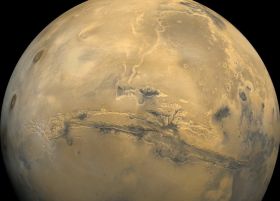
Researchers Say Mars Had Oxygen-Rich Atmosphere 4 Billion Years Ago.  From Physics.org: Differences between Martian meteorites and rocks examined by a NASA rover can be explained if Mars had an oxygen-rich atmosphere 4000 million years ago—well before the rise of atmospheric oxygen on Earth 2500 million years ago.

Two Collider Research Teams Find Evidence of New Quark Particle.  From Physics.org: Two research teams working independently at two different particle accelerators have found evidence of what appears to be a four-quark particle that has come to be called Zc(3900). Both teams are made up of a large number of researchers affiliated with institutions from around the world and both have published their findings in separate papers in the journal Physical Review Letters.

Dusty Surprise Around Giant Black Hole.  From Physics.org: ESO’s Very Large Telescope Interferometer has gathered the most detailed observations ever of the dust around the huge black hole at the centre of an active galaxy. Rather than finding all of the dust in a doughnut-shaped torus around the black hole, astronomers find that much of it is located above and below the torus. These observations show that dust is being pushed away from the black hole as a cool wind—a surprising finding.

Uncovering Quantum Secret in Photosynthesis.  From Science Daily:  The efficient conversion of sunlight into useful energy is one of the challenges which stand in the way of meeting the world’s increasing energy demand in a clean, sustainable way without relying on fossil fuels. Photosynthetic organisms, such as plants and some bacteria, have mastered this process: In less than a couple of trillionths of a second, 95 percent of the sunlight they absorb is whisked away to drive the metabolic reactions that provide them with energy. The efficiency of photovoltaic cells currently on the market is around 20 percent.

Can We Resolve Quantum Paradoxes by Stepping Out of Space and Time? From Scientific American: In the June issue of Scientific American, physicist and writer Hans Christian von Baeyer describes the current state of “deep confusion about the meaning of quantum theory” and discusses one proposal—a denial that the theory describes anything objectively real—for rendering some of the quantum perplexities “less troubling.” Von Baeyer also lists several other possible interpretations, but leaves out what I think is the most promising approach: Transactional Interpretation.  [Editor’s Note:  The concepts are beyond my understanding but I am able to grasp just enough to find it interesting].

Posted in Reason and Faith | Tagged , , , | 3 Comments

Sunday Reflection; 12th Sunday of Ordinary Time (June 23, 2013) (One in Christ)

galatians

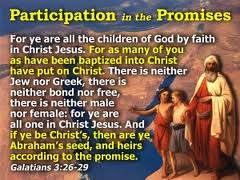
This week we have a rich series of readings.  We read from Psalm 63 with its poetic longing for unity with God: “My soul is thirsting for you, O Lord my God”.  We have an insightful reading from St. Paul’s letter to the Galatians emphasizing that all of humanity is one in Christ.  We have a beautiful Gospel from Luke where Peter identifies Jesus as the Christ (Messiah) and Jesus goes on to describe a suffering Messiah, which is a much different expectation than the disciples had of the savior of the Israeli people.

This week’s reflection comes from Fr. John Predmore, S.J., a pastor for the English speaking diocese of Jerusalem in Amman Jordan.  Fr. Predmore’s blog is a rich resource for Ignatian spirituality and one of my daily reads.  Here is an excerpt of Fr. Predmore’s reflections for this Sunday.  You can read the full blog here.

“Because of the extraordinary Christ event, some of us only focus upon his nature as one who is victorious over life and death and sin and despair. He is the strong One whose protection is all we need. This is the happy Jesus to whom we sing songs of gratefulness and praise, but it is not complete. The work of Jesus is not yet done. Seeing the suffering of the Cosmic Christ and the personal Christ requires that we be vulnerable to his grief and mourning and he invites us to make this personal. This sadness impels us to act to bring about a world more inline with Christ’s values.

 Let’s look at the issues where Jesus must still endure great suffering. Make it a prayerful exercise to ask Jesus about these areas of society that present challenging problems to a faithful Christian. Ask him about the ways he is suffering today because we cannot live out the ideals that our faith sets forth. Have him show you where these ideals have broken down and have caused many to despair. Let him reveal the ways we are to respond to the brokenness of these spheres of life.”

Fr. Predmore then lists a number of current problems including family, life, community, economic, national and world that Christians are called to address.  He then proceeds:  

“The task of a Christian is daunting, but as Jesus illustrates in the Gospel, everything begins with our personal response to him. The old saying “All politics is local” can be applied to faith. We can be just in dealing with others, respect all life and work for the dignity of others, learn how to be forgiven and to forgive, solve problems without violence, educate ourselves and inform our conscience, pray for unity and peace, enact our penances humbly, and to continually respond to the question of Jesus, “Who do you say I am?” Our response will deepen our commitment to him and he might ask us to do a few things that make us uncomfortable. Christianity is not easy, but the personal friendship with Jesus will help us be free in our response to him.”

Posted in Sunday Reflections | Tagged , , , , , | Leave a comment

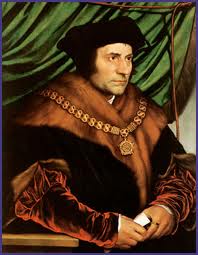
Feast of St. Thomas More

St. Thomas More

St. Thomas More

St. Thomas More was an English lawyer, philosopher, author and statesman.  As a practicing corporate attorney, More is the patron saint of my profession.  Many Catholic diocese’s have a local St. Thomas More Society, that is dedicated to better integrate the ideals of the legal profession and the Christian faith.

During More’s lifetime he earned a reputation as a leading humanist scholar and occupied many public offices, including that of Lord Chancellor from 1529 to 1532. He is recognized as having a major influence on developing equity as an additional legal system in English law. He was fluent in Greek and Latin, authored Utopia, his most famous writing, followed by History of King Richard III, Defense of the Seven Sacraments, and many more scholarly and literary works.

St. Thomas More was involved in the very early stages of the Reformation in England.  He opposed the King Henry VIII separation from the Roman Catholic Church and refused to accept him as Supreme Head of the Church of England, a title which had been given by parliament through the Act of Supremacy of 1534. He was imprisoned in 1534 for his refusal to take the oath required by the First Succession Act, because the act disparaged Papal Authority and Henry’s marriage to Catherine of Aragon. In 1535, he was tried for treason, convicted on perjured testimony, and beheaded.  Intellectuals and statesmen across Europe were stunned by More’s execution.   Desiderius Erasmus saluted him as one “whose soul was more pure than any snow, whose genius was such that England never had and never again will have its like”.   

There was a more controversial side to More’s life, because he advocated the persecution and execution of Protestants who refused to recant their faith. However, the judgement of history has been largely willing to forgive this in light of the times he lived in and his martyrdom in the Roman Catholic cause. Two centuries later Jonathan Swift said More was “the person of the greatest virtue this kingdom ever produced”, a sentiment with which Samuel Johnson agreed. Historian Hugh Trevor-Roper said in 1977 that More was “the first great Englishman whom we feel that we know, the most saintly of humanists, the most human of saints, the universal man of our cool northern renaissance.”

As a very positive sign that the intra-Christian rivalries of the Reformation era are largely over, St. Thomas More is also recognized as a Saint by the Anglican Church.


Posted in Uncategorized | Tagged , , , | Leave a comment

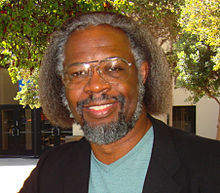
Superstring Theoretical Physicist on the Codes of Reality

S. James Gates, Jr.

S. James Gates, Jr.

One of the shows on my iTunes podcast feed is NPR’s On Being with Krista Tippett. It is a refreshing rarity of a relatively mainstream radio show that offers significant substance on topics relating to religion, philosophy, science and the meaning of life. Last week, On Being aired the replay of an interview with S. James Gates, Jr., a theoretical physicist at the University of Maryland known for his work on supersymmetry, supergravity and superstring theory. Gates is distinguished in his field, winning the prestigious National Medal of Science in 2013 and serving on President Obama’s Council of Advisors on Science and Technology.

Now, I am not a scientist, and I do not pretend to be able to discuss these concepts in significant depth. My knowledge on these subjects is limited to the general audience books I have read on these subjects (primarily from Brian Greene and Stephen Hawking). That is why I appreciate listening to people like Professor Gates who have the ability to take complex theoretical physics and “dumb it down” for non-scientists like me so that we can grasp the main points he is making.

My prior exposure to Professor Gates was limited to Gates’ appearances on NOVA’s series “The Elegant Universe” and a few assorted appearances on History Channel, Science Channel and the like. I was not previously exposed to an in-depth view of Professor Gates’ thoughts so I had no preconceived notions. However, as I was listening to the On Being interview with Professor Gates, I became fascinating with both his scientific work but more importantly, his articulation of the relationship between science and philosophy.

You can find links to the podcast, transcript and background material here. However, I would like to summarize three points from the interview.

The Code of Reality?

The Code of Reality?

Adinkras and the Nature of Reality.

One of Professor Gates’ major work in recent years is a paper on adinkras, which was published in Physics World in June 2010. Adinkras are geometric objects that encode mathematical relationships between supersymmetric particles.

“we were led first to a graphical technology, something we called the adinkras. This is a word that comes from traditional West Africa languages. But we found these mathematical objects which sit inside of the equations with the property of supersymmetry.

Then secondly, even more shocking for us, when we analyzed these objects very carefully, we found out that they have attributes of ones and zeros in precisely the same way that computers use ones and zeros to send digital information. And in particular, the kinds of codes we found, which was the most shocking thing for us, is that there’s a class of codes that allow your browsers to work in an accurate way. They’re called error-correcting codes. We found a role for error correcting codes in the equations of supersymmetry, and this was just stunning for us.

In fact, it was so stunning that it was at least eight months before any of us would sort of admit how bizarre it was.”

To provide a very brief summary, when searching for the mathematics to reconcile the standard model with supersymmetry, Professor Gates found a class of codes that may explain the standard model. In the words of Professor Gates:

“Could it be that codes, in some deep and fundamental way, control the structure of our reality?”

Theological Implications of Adinkras

The theological implications of the potential existence of adinkras are obvious: if there are computer-like codes embedded in the very nature of supersymmetry, they are additional evidence of a Creator. This subject was briefly mentioned in the On Point interview with reference to “a religious blogger, also a scientifically literate person,” who was discussing this subject. I do not know who the blogger is but I strongly suspect it is Catholic Commentary, a UK blog who published an article on this topic shortly after the Physics World came out. As Professor Gates said in the interview:

“About the adinkras and the codes. This blogger, who, to this day, I don’t know this young man, read the article and he raised the question that, if the equations of fundamental physics are based on information theory and essentially information theory is at the very center of string theory, how did it get there? And his implication is that indeed this is something for theologians to contemplate. You know, that was, again, for me a stunning assertion and it still has yet to be fully studied. But it probably will not be studied by physicists [laugh].

Relationship Between Science and Theology

The other item that struck me in Professor Gates’ interview was that he understood and clearly articulated the symbiotic relationship between science and theology. The interview did not go into Gates’ own beliefs (or lack thereof), nor was I able to find much on his personal beliefs on the internet. However, a 2009 article from the Cornell Daily Sun summarized a speech by Professor Gates:

“Gates said instances like the Big Bang and human evolution tend to affirm matters spiritual — an origin of the universe, and the common link of all humans, no matter their race. But in most instances, Gates believes science is mute on matters spiritual — science neither affirms nor denies spirituality. . . Science, which Gates said is defined as the study of reproducible observations, has no laboratory experiment that can deal with spiritual matters. As such, science was “mute” on religion, and thus had no ability to refute spirituality or the existence of God. “

Further, although I was unable to find out whether Professor Gates has any religious beliefs (in the extended On Being podcast he says he grew up Anglican and won an award in high school for being able to memorize the Bible), the language he uses certainly suggests he does. Further, Professor Gates has a deep respect for Christianity. In describing James Maxwell, a leading 19th century theoretical physicist, Gates emphasizes his strong Christian beliefs:

“Maxwell is a hero to Gates — both being theoretical physicists with a firm faith in God. Gates expressed disappointment in how few people know of the man.

‘Most people have never heard of James Clerk Maxwell, which is rather odd,’ Gates said, ‘since many fields would not exist in the form they do today without him.’

Gates described how Maxwell, in addition to being devoted to theoretical physics, memorized verses from the Bible. ‘This is one of the three greatest physicists who ever lived, and he was a devout, traditional Christian,’ Gates said. ‘He did not see a wall between the two.’ “

In summary, it was a fantastic interview with Professor Gates and I encourage you to listen to it. I am sure I messed up some of the science description, but perhaps some of this blog’s readers on these subjects, especially those who are more knowledgeable in science than I am (e.g. Professor Erik Andrulis who runs a great blog who pushes my ability to understand the science).

Posted in Reason and Faith | Tagged , , | Leave a comment