Orthodoxy of Teilhard de Chardin (Part I): Pope Benedict and Spirit of the Liturgy

Pope Emeritus Benedict Endorses Teilhard de Chardin

Pope Emeritus Benedict Endorses Teilhard de Chardin

Teilhard_Christ

__________

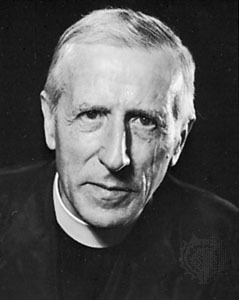
I was hoping to save this post and series until later, when I could have had a more comprehensive assessment.  However, as I am becoming more immersed into the blogosphere, I am starting to realize how controversial a figure Teilhard de Chardin is in some circles.  I knew that Teilhard was a lightening rod among some schismatic heretics such as SSPX.  I also knew that certain non-Christian spiritual authors had taken a stale, watered-down, non-Christian version of Teilhard de Chardin in their spiritualities.  However, I was absolutely shocked that even mainstream Catholics are still skeptical of the orthodoxy of Teilhard de Chardin.  This post is the first of a series which will hopefully put these notions to rest.

The misconception of non-orthodoxy on Teilhard de Chardin comes from two sources.  First, Teilhard was prohibited from publishing his theological writings during his lifetime.  Teilhard was allowed to publish scientific papers arising out of his work as a paleontologist.   Second, many of Teilhard’s writings were published after his death.  The pre-Vatican II Church issued a warning on Teilhard’s writings (but notably did not put any of Teilhard’s works on the Prohibited Index, which existed until 1966).  The primary concern about Teilhard’s orthodoxy was over his explanation of original sin.  I will not get into the debate on whether the warning was issued under misformed pretenses or dissect its meaning but you can read the full warning here.

What I will focus on in this series is how Teilhard de Chardin’s vision was incorporated into Catholic theology by leading theologian of the last 50 years.  There are many outstanding contemporary theologians (e.g. John Haught and Ilia Delio) who have taken Teilhard’s core ideas and expanded them in a more coherent theology.  However, some Catholic critics of Teilhard de Chardin are unlikely to be convinced by non-hierarchical current theologians, much less a lay person in rural Wisconsin:-).

Hence, in this initial series on the orthodoxy of Teilhard de Chardin, we will focus on three outstanding theologians who also speak for the Church:  Pope Emeritus Benedict, Cardinal Henri de Lubac and Archbishop Józef Życiński.    

During the first week of this series, we will focus on one of the most influential theologians during my spiritual journey, Pope Emeritus Benedict.  Benedict was known for many things.  But perhaps he was best known for embracing the liturgy as the focal point of Christian worship.  In 2000, Pope Emeritus Benedict (then Joseph Ratzinger) published “The Spirit of the Liturgy“, which was described as follows:  ”In this beautiful treatment of the “great prayer of the Church,” Pope Benedict XVI offers his insights on many areas of the Liturgy to help readers rediscover the spiritual wealth and grandeur of the Liturgy as the very center of our Christian life.”

In Chapter 2 of this book, Benedict describes how Teilhard’s theological vision of Christ is central to the Christian liturgical and Eucharistic experience:

“And so we can now say that the goal of worship and the goal of creation as a whole are one and the same—divinization, a world of freedom and love. But this means that the historical makes its appearance in the cosmic. The cosmos is not a kind of closed building, a stationary container in which history may by chance take place. It is itself movement, from its one beginning to its one end. In a sense, creation is history. Against the background of the modern evolutionary world view, Teilhard de Chardin depicted the cosmos as a process of ascent, a series of unions. From very simple beginnings the path leads to ever greater and more complex unities, in which multiplicity is not abolished but merged into a growing synthesis, leading to the “Noosphere”, in which spirit and its understanding embrace the whole and are blended into a kind of living organism. Invoking the epistles to the Ephesians and Colossians, Teilhard looks on Christ as the energy that strives toward the Noosphere and finally incorporates everything in its “fullness’. From here Teilhard went on to give a new meaning to Christian worship: the transubstantiated Host is the anticipation of the transformation and divinization of matter in the christological “fullness”. In his view, the Eucharist provides the movement of the cosmos with its direction; it anticipates its goal and at the same time urges it on.” (emphasis added)

– Ratzinger, Joseph Cardinal; Pope Benedict XVI (2009-06-11). The Spirit of the Liturgy (Kindle Locations 260-270). Ignatius Press. Kindle Edition.

Tomorrow, we will continue our discussion of how Pope Benedict Emeritus incorporates the vision of Teilhard de Chardin’s cosmic host into Christian theology and concern for the environment.

Posted in Orthodoxy of Teilhard de Chardin | Tagged , , | Leave a comment

Teilhard de Chardin Quote of the Week (May 20): In the Beginning . . .

big_bang2

“In the beginning was Power, intelligent, loving, energizing. In the beginning was the Word, supremely capable of mastering and moulding whatever might come into being in the world of matter. In the beginning there were not coldness and darkness: there was the Fire. This is the truth.

So, far from light emerging gradually out of the womb of our darkness, it is the Light, existing before all else was made which, patiently, surely, eliminates our darkness. As for us creatures, of ourselves we are but emptiness and obscurity. But you, my God, are the inmost depths, the stability of that eternal milieu, without duration or space, in which our cosmos emerges gradually into being and grows gradually to its final completeness, as it loses those boundaries which to our eyes seem so immense. Everything is being; everywhere there is being and nothing but being, save in the fragmentation of creatures and the clash of their atoms.”

– From Mass on the World

Posted in Teilhard Quote of the Week | Tagged , | Leave a comment

Pentecost: Go Light Your World

I love this song and thought it is a wonderful theme for Pentecost

Posted in Uncategorized | Leave a comment

Sunday Reflection: Pentecost (Unleashing Hearts on Fire)

pentecost

Echoing biblical stories such as Moses and the burning bush, Teilhard de Chardin frequently uses the imagery of fire to describe the presence of God.  On Pentecost, the Church has multiple options for the Second Reading and the Gospel.  Today’s reflection goes back over a decade, which was written in 2000 by Patricia Datchuck Sánchez.  You can read the full reflection here, but it begins:

“The day will come,” said Teilhard de Chardin, “when, after harnessing space, the winds, the tides and gravitation, we shall harness for God the energies of love. And on that day, for the second time in the history of the world, we shall have discovered fire.” In a sense the annual feast of Pentecost is another opportunity, placed in the path of the believer, for discovering and participating in the ever-present fire which is God’s love. Pentecost rounds out and climaxes the Easter event. All that we have remembered and celebrated, viz., Jesus’ saving death, his resurrection and ascension to glory, all of these sacred events took place so that the Holy Spirit might be unleashed upon the world.”

Following up on this outstanding quote by Ms. Sánchez, here is a reflection by the Irish Jesuits at Sacred Space

“A message for all

Immediately, the apostles go out and begin to speak to the crowds of people.  Jerusalem is filled with Jewish and convert visitors from all over the Mediterranean, from Asia Minor, Egypt and North Africa, even Rome, to celebrate the feast.  These people are amazed to hear men, who are clearly relatively unlettered people from the province of Galilee, speaking to them in so many languages.

The meaning is clear.  What the apostles are preaching is a message destined for the whole world and not just for one people.  A long time ago, as described in the book of Genesis, men tried to build a tower right up to heaven.  For such arrogance they were punished by having to speak in a myriad of languages unintelligible to others.  Humanity became deeply divided.

Today, Babel is reversed.  All are speaking and hearing the message with full understanding; people are being brought together in unity under God.”

The message from Pentecost could not be more clear.  Once he have had the holy fire of the Spirit touch our hearts, we have an obligation to live the Gospel.  I am reminded of the words of St. Francis of Assisi: “Preach the Gospel at all times, and when necessary, use words.”

Twenty-first century Western Culture can be very cynical.  Detractors of religious institutions have, often justifiably, been critical of the sometimes wide gap between what religious people profess to believe in and their actions.  Christianity in the U.S. has lost the power of its message due to this hypocrisy.

I was talking to a friend of mine this week who is a very spiritual and giving person.  I have witnessed her care for her elderly Mother for years and more recently care for her husband who is a quadriplegic due to a freak accident.  Further, she is a spiritual person in the sense that she is not a scientific, materialistic reductionist.  She recently went to a talk by the Dalai Lama and she was talking about his message of peace, compassion and the interconnectiveness of humanity and God’s creation that the Dalai Lama had.  It was interesting in how the Dalai Lama was incorporating the Gospel message into his speech, but what really struck me was that my friend was inspired by this message and viewed it as someone novel in individualistic, materialistic U.S. culture.  It was a message that resonated with my friend, but despite living her whole life in a supposedly Christian nation, she did not associate the Gospel message with Christianity.  This is a stunning indictment of Christianity (and of me as she has known me over almost a decade).

Dear Almighty God:  On Pentecost, the birthday of the Church, please grant me the grace to live the Gospel through my actions.  Lord, help me to find the fire of inner joy with you and to spread your joy to others through my actions.

Your humble servant.

Posted in Sunday Reflections | Tagged , | Leave a comment

I believe in the Holy Spirit... and other annoyances

Reblogged from There Will Be Bread:

Click to visit the original post
  • Click to visit the original post
  • Click to visit the original post
  • Click to visit the original post

"I believe in the Holy Spirit..." The words are right there in the Nicene Creed:

I believe in the Holy Spirit, the Lord, the giver of life,
who proceeds from the Father and the Son,
who with the Father and the Son is adored and glorified,
who has spoken through the prophets.

If you are Catholic, you are saying these words at mass on a regular basis.

Read more… 857 more words

On this Pentecost Sunday, I found this wonderful reflection by Fran Rossi Szpylczyn of the blog "There will be Bread" and thought I would share it. I will have my "Sunday Reflections" post up later this evening.
Posted in Uncategorized | Leave a comment

Tribute to Thomas Berry, Cultural Historian and Ecotheologian

thomas_berry_2

Last week I attended the American Teilhard Association annual meeting in New York.  You can read more about my experiences here, here, here and here.  One thing that was obvious is that the life and works of Thomas Berry has had a tremendous impact on the organization. Set forth below is a brief bio of Fr. Berry, courtesy of Wikipedia:

“Thomas Berry, C.P. was a Catholic priest of the Passionist order, cultural historian and ecotheologian (although cosmologist and geologian – or “Earth scholar” – were his preferred descriptors).

Among advocates of deep ecology and “ecospirituality” he is famous for proposing that a deep understanding of the history and functioning of the evolving universe is a necessary inspiration and guide for our own effective functioning as individuals and as a species. He is considered a leader in the tradition of Teilhard de Chardin as demonstrated in the Introduction to his book, The Christian Future and the Fate of the Earth. Author Michael Colebrook describes two key elements in Thomas Berry’s thinking: “Firstly, the primary status of the universe. The universe is, ‘the only self-referential reality in the phenomenal world. It is the only text without context. Everything else has to be seen in the context of the universe’. The second element is the significance of story, and in particular the universe as story. ‘The universe story is the quintessence of reality. We perceive the story. We put it in our language, the birds put it in theirs, and the trees put it in theirs. We can read the story of the universe in the trees. Everything tells the story of the universe. The winds tell the story, literally, not just imaginatively. The story has its imprint everywhere, and that is why it is so important to know the story. If you do not know the story, in a sense you do not know yourself; you do not know anything.”

Current leaders of the American Teilhard Association, Mary Evelyn Tucker and John Grim worked with Thomas Berry and are carrying out his vision.  Dr. Tucker collaborated with Brian Swimme on creating the award-winning The Story of the Universe, which is a powerful artistic vision of the interconnectiveness of all of creation and a tribute to the vision of the Fr. Berry.

Posted in Uncategorized | Tagged , | Leave a comment

Additional Fun in New York

I was in New York last week for the American Teilhard Association annual meeting.  The Conference was outstanding.  I also took the opportunity to enjoy some of New York when I was there.  Here is a photo collage of some of my highlights:

The Renaissance Dining Room

The Renaissance Dining Room; My Bed and Breakfast for two days
Alexander Hamilton's Home Historic Site

Alexander Hamilton’s Home Historic Site

Reading at the Gardens of Union Theological Seminary

Reading at the Gardens of Union Theological Seminary

Teilhard and Blue Moon:  Life is Good!

Teilhard and Blue Moon: Life is Good!

Posted in Uncategorized | Tagged , , , | 1 Comment