Sunday Reflection: Pentecost (Unleashing Hearts on Fire)

pentecost

Echoing biblical stories such as Moses and the burning bush, Teilhard de Chardin frequently uses the imagery of fire to describe the presence of God.  On Pentecost, the Church has multiple options for the Second Reading and the Gospel.  Today’s reflection goes back over a decade, which was written in 2000 by Patricia Datchuck Sánchez.  You can read the full reflection here, but it begins:

“The day will come,” said Teilhard de Chardin, “when, after harnessing space, the winds, the tides and gravitation, we shall harness for God the energies of love. And on that day, for the second time in the history of the world, we shall have discovered fire.” In a sense the annual feast of Pentecost is another opportunity, placed in the path of the believer, for discovering and participating in the ever-present fire which is God’s love. Pentecost rounds out and climaxes the Easter event. All that we have remembered and celebrated, viz., Jesus’ saving death, his resurrection and ascension to glory, all of these sacred events took place so that the Holy Spirit might be unleashed upon the world.”

Following up on this outstanding quote by Ms. Sánchez, here is a reflection by the Irish Jesuits at Sacred Space

“A message for all

Immediately, the apostles go out and begin to speak to the crowds of people.  Jerusalem is filled with Jewish and convert visitors from all over the Mediterranean, from Asia Minor, Egypt and North Africa, even Rome, to celebrate the feast.  These people are amazed to hear men, who are clearly relatively unlettered people from the province of Galilee, speaking to them in so many languages.

The meaning is clear.  What the apostles are preaching is a message destined for the whole world and not just for one people.  A long time ago, as described in the book of Genesis, men tried to build a tower right up to heaven.  For such arrogance they were punished by having to speak in a myriad of languages unintelligible to others.  Humanity became deeply divided.

Today, Babel is reversed.  All are speaking and hearing the message with full understanding; people are being brought together in unity under God.”

The message from Pentecost could not be more clear.  Once he have had the holy fire of the Spirit touch our hearts, we have an obligation to live the Gospel.  I am reminded of the words of St. Francis of Assisi: “Preach the Gospel at all times, and when necessary, use words.”

Twenty-first century Western Culture can be very cynical.  Detractors of religious institutions have, often justifiably, been critical of the sometimes wide gap between what religious people profess to believe in and their actions.  Christianity in the U.S. has lost the power of its message due to this hypocrisy.

I was talking to a friend of mine this week who is a very spiritual and giving person.  I have witnessed her care for her elderly Mother for years and more recently care for her husband who is a quadriplegic due to a freak accident.  Further, she is a spiritual person in the sense that she is not a scientific, materialistic reductionist.  She recently went to a talk by the Dalai Lama and she was talking about his message of peace, compassion and the interconnectiveness of humanity and God’s creation that the Dalai Lama had.  It was interesting in how the Dalai Lama was incorporating the Gospel message into his speech, but what really struck me was that my friend was inspired by this message and viewed it as someone novel in individualistic, materialistic U.S. culture.  It was a message that resonated with my friend, but despite living her whole life in a supposedly Christian nation, she did not associate the Gospel message with Christianity.  This is a stunning indictment of Christianity (and of me as she has known me over almost a decade).

Dear Almighty God:  On Pentecost, the birthday of the Church, please grant me the grace to live the Gospel through my actions.  Lord, help me to find the fire of inner joy with you and to spread your joy to others through my actions.

Your humble servant.

Posted in Sunday Reflections | Tagged , | Leave a comment

I believe in the Holy Spirit… and other annoyances

On this Pentecost Sunday, I found this wonderful reflection by Fran Rossi Szpylczyn of the blog “There will be Bread” and thought I would share it. I will have my “Sunday Reflections” post up later this evening.

Fran Rossi Szpylczyn's avatarThere Will Be Bread

kendell_geers_what_do_you_believe_in_01_full“I believe in the Holy Spirit…” The words are right there in the Nicene Creed:

I believe in the Holy Spirit, the Lord, the giver of life,
who proceeds from the Father and the Son,
who with the Father and the Son is adored and glorified,
who has spoken through the prophets.

If you are Catholic, you are saying these words at mass on a regular basis. You may read them off of a page, you may mumble along, you may say nothing at all.

So what do you believe?

I’m kind of stuck on that last bit – “who has spoken through the prophets.”  Prophets – they are so annoying, aren’t they?

0506_news_Ollila_Seamann_KHIf you immediately want to say “No! They’re great!” that might be because you, if you are like me, feel that way about your prophets. You know the ones, the ones that you like. By extension…

View original post 771 more words

Posted in Uncategorized | Leave a comment

Tribute to Thomas Berry, Cultural Historian and Ecotheologian

thomas_berry_2

Last week I attended the American Teilhard Association annual meeting in New York.  You can read more about my experiences here, here, here and here.  One thing that was obvious is that the life and works of Thomas Berry has had a tremendous impact on the organization. Set forth below is a brief bio of Fr. Berry, courtesy of Wikipedia:

“Thomas Berry, C.P. was a Catholic priest of the Passionist order, cultural historian and ecotheologian (although cosmologist and geologian – or “Earth scholar” – were his preferred descriptors).

Among advocates of deep ecology and “ecospirituality” he is famous for proposing that a deep understanding of the history and functioning of the evolving universe is a necessary inspiration and guide for our own effective functioning as individuals and as a species. He is considered a leader in the tradition of Teilhard de Chardin as demonstrated in the Introduction to his book, The Christian Future and the Fate of the Earth. Author Michael Colebrook describes two key elements in Thomas Berry’s thinking: “Firstly, the primary status of the universe. The universe is, ‘the only self-referential reality in the phenomenal world. It is the only text without context. Everything else has to be seen in the context of the universe’. The second element is the significance of story, and in particular the universe as story. ‘The universe story is the quintessence of reality. We perceive the story. We put it in our language, the birds put it in theirs, and the trees put it in theirs. We can read the story of the universe in the trees. Everything tells the story of the universe. The winds tell the story, literally, not just imaginatively. The story has its imprint everywhere, and that is why it is so important to know the story. If you do not know the story, in a sense you do not know yourself; you do not know anything.”

Current leaders of the American Teilhard Association, Mary Evelyn Tucker and John Grim worked with Thomas Berry and are carrying out his vision.  Dr. Tucker collaborated with Brian Swimme on creating the award-winning The Story of the Universe, which is a powerful artistic vision of the interconnectiveness of all of creation and a tribute to the vision of the Fr. Berry.

Posted in Uncategorized | Tagged , | 1 Comment

Additional Fun in New York

I was in New York last week for the American Teilhard Association annual meeting.  The Conference was outstanding.  I also took the opportunity to enjoy some of New York when I was there.  Here is a photo collage of some of my highlights:

The Renaissance Dining Room

The Renaissance Dining Room; My Bed and Breakfast for two days
Alexander Hamilton's Home Historic Site

Alexander Hamilton’s Home Historic Site

Reading at the Gardens of Union Theological Seminary

Reading at the Gardens of Union Theological Seminary

Teilhard and Blue Moon:  Life is Good!

Teilhard and Blue Moon: Life is Good!

Posted in Uncategorized | Tagged , , , | 1 Comment

St. Charles Borromeo Church in Harlem: A+ Rating

St. Charles Borromeo Alter

St. Charles Borromeo Alter

I do not travel for work as much as I used to but when I do travel, I try to check out a local church.  (One of the great things about Catholicism is that you can find a church almost anywhere!).  Last weekend, when I was in New York for the American Teilhard Association annual meeting, I had the pleasure of attending the Vigil Mass at St. Charles Borromeo (SCB) in Harlem.  SCB is a delightful church.  The outside is an old-style Gothic structure and the inside was recently remodeled so it has a very modern, yet dignified feel.

It was raining Saturday so I decided to go into the Church early to pray and meditate.  To my delight, they had Eucharistic Adoration.  It was a beautiful setting and very reinvigorating after the Teilhard conference.

Fr. Marcel Chinedu Amadi

Fr. Marcel Chinedu Amadi

The Mass was dignified and beautiful.  The celebrant, Fr. Marcel Chinedu Amadi, was a charismatic young priest who was very energetic and gave a wonderful homily.  The parishioners were very open and welcoming and seemed to have a joy and zest for life.  You could tell that the parish was vibrant and alive (which unfortunately can not be said of all parishes).  After Mass, the Pastor, Rev. Gregory Chisholm, S.J. (a Jesuit!) had a nice speech and tribute to all mothers for Mother’s Day.

Fr. Gregory Chisholm, SJ

Fr. Gregory Chisholm, SJ


St. Charles Borromeo was a wonderful experience.  Usually when I go to New York, I attend one of the churches in Manhattan.  They are beautiful, but they often have an impersonal feel.  There is a lot to be said for a vibrant neighborhood parish like SCB.

Posted in Uncategorized | Tagged , , | 13 Comments

Star Trek Christian Themes

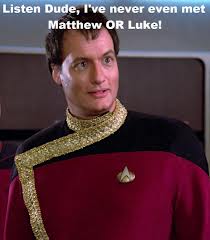
Q disputing the two-source hypothesis

Q disputing the two-source hypothesis

Fans of Star Trek know that the new Star Trek movie: Into Darkness opens today, which gives me an opportunity to plug the complementary nature of theology and science fiction.  Some of the attractions of science fiction are that it has the ability to touch on timeless themes of humanity (morality, purpose, meaning) while at the same time doing thought experiments via wonderful stories.

I would like to highlight a couple of blogs/articles that address the relationship of theology and science fiction.

First, is an article by Jason King of Catholic Moral Theology,  that addresses theo-trekkies and explains why science fiction of appealing to spiritually based humans.  The article summarizes four reasons:  (i) cosmic drama; (ii) critique of societal values; (iii) good vs. evil; and (iv) what you do matters.  The only downside of this article is that they did not mention one of my favorite science fiction series, Julian May’s Galactic Milieu, which describes a future Teilhardian universe.

Second, is a great article from the Catholic Herald from a couple of years ago that summarizes Christian themes from various Star Trek episodes.  I encourage you to read the entire article, but here is an excerpt:

“Star Trek is consistently the most pro-Christian and pro-Catholic show in American television history.

The quintessential science fiction television programme by which all others are judged has had a number of permutations over the past 40 years: The Original Series, The Next Generation, Deep Space 9, Voyager and, most recently, Enterprise. In addition, there have been 10 films that have sent the heroic Enterprise into space to “explore strange new worlds, to seek out new life and new civilisations, to boldly go where no man has gone before”. Gene Roddenberry’s creation has become a cornerstone of popular culture and has helped to popularise and develop the science fiction genre.

In “Bread and Circuses”, the episode that took place in Stardate 4041.7 (AD 2268 for planet-bound humans), Captain James Tiberius Kirk, valiant captain of the good ship Enterprise, in the midst of their five-year mission, came across planet 892-IV, a draconian 20th-century version of the Roman Empire, complete with gladiators, senators and nefarious politics. The empire sponsors state executions of renegade slaves who practice a pacifistic religion of “total love and total brotherhood”. Sound familiar?

The twist is that the slaves imprisoned for practising the religion of their choice are sun worshippers. As Mr Spock, the ship’s Science Officer and Captain Kirk’s logical foil, points out: “It seems illogical for a sun worshipper to develop a philosophy of total brotherhood. Sun worship is usually a primitive, superstitious religion.”

And then the fateful and faith-filled moment memorialised in the hearts of all Christian Trekkers, Lt Uhura pipes up from her communications console to correct her superior officers: “I’m afraid you have it all wrong, all of you,” she says. “I’ve been monitoring some of their old-style radio waves, the empire spokesman trying to ridicule their religion, but he couldn’t. Well, don’t you understand? It’s not the sun up in the sky. It’s the Son of God.”

Posted in Uncategorized | Tagged , | 4 Comments

Scientific Potpourri

Here are a few interesting stories from the last week on cosmology, astronomy and the environment.  Hope you enjoy (or are concerned as appropriate).

1.  Clues to the Supernova that gave rise to the Solar System?  From the New Yorker: Two tiny grains from two meteors may provide clues on the supernova that gave birth to the Solar System:

The implication is that these two grains, in two meteorites, could have come from one supernova.

If this is the case, the supernova may have exploded close to the nebular region from which we formed some 4.6 billion years ago, and this could help explain our very origins. Astronomers have long conjectured that the “bump” of a supernova shock wave could have helped trigger the self-collapse of nebular gas and other dust that led to the formation of our solar system. (Like some giant hand squeezing the interstellar clay.) I

* * * 

With half-lives of around a million years, these radioactive nuclei provide a fierce boost to the heat in the interior of rocky bodies, from asteroids to the proto-planetary embryos of bigger objects. The molten innards of a planet form a mineral pressure cooker, ultimately leading to places like Earth, replete with volcanism and crusty plates of frozen rock afloat on a hot magma ocean.

Although it’s impossible to know how things would have played out in slightly different circumstances, we might owe that supernova a considerable debt. A less heated planet may have evolved differently, with less elemental recycling, or with some other kind of chemical makeup, and, perhaps, a very different environment for the growth of the complex carbon chemistry that led to living things.

All of which leaves us eyeing these two microscopic pieces of sand forged in the turbulent layers of a long-gone exploding stellar neighbor, and now embedded in a pair of polar meteorites. They’re not just a clue to what may have kick-started the formation of our solar system. They also hint at the source of the radioactively hot embers that helped warm our planets and set in motion life’s four-billion-year epic journey.”

2.  Carbon Dioxide Level in Atmosphere Reaches Prehistoric Levels.  From Scientific American:

“there is no question that the world continues to inexorably climb toward higher levels of greenhouse gas concentrations. Barring economic recessions, the world may be lucky to stop at 450, 500 or even beyond. Last year, humanity spewed some 36 billion metric tons of greenhouse gases, up from 35 billion the year before.”

3.  Moon and Earth Have Common Water Source.  From Science News:

“The Moon’s water did not come from comets but was already present on Earth 4.5 billion years ago, when a giant collision sent material from Earth to form the Moon.”

4.  Exotic Atoms Hold Clues to Unsolved Physics Puzzle at the Dawn of the Universe.  From Science News:

“The findings could advance the search for a new fundamental force in nature that could explain why the Big Bang created more matter than antimatter — a pivotal imbalance in the history of everything.”

Posted in Uncategorized | Tagged , , , | Leave a comment

American Teilhard Association (2013) (Additional Resources)

ata-logo

This is a follow up to my first post on Dr. Mary Evelyn Tucker’s speech at the American Teilhard Association meeting.  Today, I am going to very briefly mention of few of the wonderful people I met at the meeting, with links to fantastic resources that they can provide.

kathleen_duffy

Dr. Kathleen Duffy is the Founder and Director of the Institute for Religion and Science at Chestnut Hill College in Philadelphia.  Dr. Duffy is a physicist, member of Sisters of St. Joseph and published author of “Rediscovering Teilhard’s Fire“.

___________________________________

___________________________________

john_grim

John Grim is the Co-Founder and Co-Director with Mary Evelyn Tucker (they are married) of the Yale Forum on Religion and Ecology.  Dr. Grim is a distinguished author and speaker.  Dr. Grim is also the President of the American Teilhard Association.

___________________________________

jennifer_morganJennifer Miller is an award-winning author, storyteller, educator and environmental advocate.  Ms. Miller has written three books for children on The Universe Story (Born With a Big Bang, From Lava to Life and Mammals Who Morph) and is a frequent speaker.  I have ordered Ms. Miller’s three books for my two children and I look forward to reading these books with my boys.

___________________________________

___________________________________

william_grassieWilliam Grassie  is a religious studies scholar known for his writings and advocacy of the concept of Big History.  Dr. Grassie is the founder of the Metanexus Institute, a virtual think-tank devoted to Big History, Big Problems, Big Questions.  Dr. Grassie is also a frequent contributor to the Huffington Post on Science and Religion.  The Metanexus Institute is an amazing resource and I highly recommend that you check it frequently.

Posted in Uncategorized | Tagged , , , , , | 1 Comment

Sean Carroll and the Fallacy of Scientism

Philosophy

Cosmology2

_____________________

I am a strong supporter of science.  I believe that one of the problems with the U.S. education system is that there is too little focus on science.  This lack of education leads to ill-informed citizens, which leads to bad public policies even in the face of overwhelming scientific evidence of known problems (e.g. climate change).

However, one of the ironic side effects of a lack of scientific education in the U.S. is that there is also not a proper understanding of the limits of science and the boundaries of what questions science can answer.  Unfortunately, this conception is perpetuated by many leading scientists who, quite naturally want to speculate on areas such as philosophy and metaphysics, which can be informed by science, but are ultimately outside the boundaries of science.  This tendency is called scientific, materialistic reductionalism.

[As an aside, this is a common trait of many really smart, successful people.  I am a corporate attorney by background, and I do a lot of work with emerging technology companies.  I come across many exciting technologies developed by brilliant scientists who want to commercialize these technologies and start a company. One flaw some of these scientists have is the belief that their raw brain power and success in science will necessarily translate into business success; after all, science is hard and business is easy, right?  Hence, they try to do everything themselves rather than surround themselves with strong, experienced businesspeople.  These companies generally do not get funded as scientific success, without requisite training and experience, often does not translate into business success].

A recent example of scientific, materialistic reductionalism is from Sean Carroll, senior research associate in the Department of Physics at the California Institute of Technology.  I am a big fan of Sean Carroll.  He does outstanding work in theoretical cosmology.  More importantly for a scientific lay person such as myself, Dr. Carroll has an outstanding ability to translate his scientific research into language and concepts that non-scientists can understand.  I highly recommend Dr. Carroll’s three mainstream books on relativity and the search for the Higgs Boson, as well as any interviews you can catch of Dr. Carroll.  

Unfortunately, in a recent article discussing why he does not take funds from the John Templeton Foundation, Dr. Carroll also has a tendency to extend his wonderful scientific knowledge to metaphysics, and specifically the absolute principle that science and religion are at conflict:

“I don’t think that science and religion are reconciling or can be reconciled in any meaningful sense, and I believe that it does a great disservice to the world to suggest otherwise”.

Carroll is an avowed atheist, which is fine.  Carroll uses science to support his atheism, which is also fine.  Where Carroll is intellectually disingenuous is when he states “God does not exist. We have better explanations for how things work.”  Carroll completely misses the point.  The ontological branches of theology and philosophy do not attempt to understand how things work; rather they attempt to explain what things are and why they are they way they are.  When Carroll or others leave the realm of items that can be empirically verified through experiments or mathematics, they are leaving the field of science and entering the field of philosophy.  Hence, the statement, whether it be express or implied, that they are doing science and hence their conclusion (whatever it may be) “trumps” philosophy, theology or religion is simply not accurate.

That is not to say that science and philosophy can not speak to each other.  To the contrary, I strongly believe they are complementary ways of searching for ultimate truths.  Reasonable people can use science to support the ontological concept of atheism, just like reasonable people can use science to support Christianity or other theistic or non-theistic religions.  However, science does not “prove” atheism any more than science “proves” the existence of any particular type of religion.  (This is one problem that advocates of “Intelligent Design” have with scientific, materialistic reductionalists).

Dr. Austin L. Hughes, evolutionary biologist at the University of South Carolina, summarized the tendency of some scientists to confusingly pretend they are being scientific when they step into areas of ontology in his excellent article in The New Atlantis on “The Folly of Scientism”  Here is a key excerpt:

“Advocates of scientism today claim the sole mantle of rationality, frequently equating science with reason itself. Yet it seems the very antithesis of reason to insist that science can do what it cannot, or even that it has done what it demonstrably has not. As a scientist, I would never deny that scientific discoveries can have important implications for metaphysics, epistemology, and ethics, and that everyone interested in these topics needs to be scientifically literate. But the claim that science and science alone can answer longstanding questions in these fields gives rise to countless problems.

In contrast to reason, a defining characteristic of superstition is the stubborn insistence that something — a fetish, an amulet, a pack of Tarot cards — has powers which no evidence supports. From this perspective, scientism appears to have as much in common with superstition as it does with properly conducted scientific research. Scientism claims that science has already resolved questions that are inherently beyond its ability to answer.

Of all the fads and foibles in the long history of human credulity, scientism in all its varied guises — from fanciful cosmology to evolutionary epistemology and ethics — seems among the more dangerous, both because it pretends to be something very different from what it really is and because it has been accorded widespread and uncritical adherence. Continued insistence on the universal competence of science will serve only to undermine the credibility of science as a whole. The ultimate outcome will be an increase of radical skepticism that questions the ability of science to address even the questions legitimately within its sphere of competence. One longs for a new Enlightenment to puncture the pretensions of this latest superstition.”

In summary, I will continue to enjoy reading and listening to leading scientists such as Sean Carroll, Stephen Hawkins and Leonard Mlodinow, both on science and ontology.  I will give eagerly learn from their great scientific knowledge on how the universe works while weighing their ontological positions against great philosophers and theologians who, in my opinion, have a better understanding of the ultimate reality.

Posted in Uncategorized | Tagged , , | 8 Comments

American Teilhard Association Meeting (2013) (Mary Evelyn Tucker)

ata-logo

mary_evelyn_tucker

Last Saturday, I attended the annual conference of the American Teilhard Association (ATA).  The ATA was founded in 1967 and is committed to making the thought and vision of Teilhard more widely available.  According to its website, the ATA’s objectives are:

  1. A future worthy of the planet Earth in the full splendor of its evolutionary emergence.
  2. A future worthy of the human community as a high expression and a mode of fulfillment of the earth’s evolutionary process.
  3. A future worthy of the generations that will succeed us.

The ATA conference was well done.  There was an excellent networking session followed by a lunch.  The keynote speaker was Mary Evelyn Tucker, Executive Director and Co-Author of the EMMY award winning documentary and accompanying book and education series, Journey of the Universe.

Dr. Tucker gave a wonderful lecture.  I tried to take notes but I did a mediocre job of it as I  was too caught up in her lecture.  Here is an all too brief and incomplete summary Dr. Tucker’s main points of emphasis based upon my cryptic notes (please feel free let me know of any corrections via e-mail or in the comment section below):

1.  Evolution and Cosmogenesis.  Evolution, both in the biological sense and the cosmological sense, requires a major change in our thinking, something that humanity is struggling to deal with.  Our understanding of the world had been based on the fairly static world of Artistotle and Newton.  In the last 200 years, we have discovered through biology, physics and cosmology that the universe (and by extraplolation, the Creator of the universe) is far more complex, dynamic and beautiful than we humans had previously imagined.  Humanity is still grappling for ways to understand the implications of these findings, which is leading us to a second axial age.

2.  Grounding in Creation.  Humans, and all physical creation, are grounded in matter.  We are part of a dynamic and living universe.  The direction of the evolutionary universe is not random or purposelessness.

3.  Participating in Pattern.  Logos, the divine ordering of life, is existent in all of creation, both material and non-material.  All of us are called, by the very nature of our being, by the Creator to use our talents and creative energies to participate in the way of the logos.

4.  Hominization / Divinization.  Dr. Tucker used the terms hominization in the way that Teilhard did, namely that hominization is the way in which human thought transforms previously existing practices and functions of the earth.  Humans, by virtue of us being the apex of evolution according to Teilhard, have an acute obligation to mitigate the potential upcoming environmental catastrophe.    Although, Dr. Tucker did not specifically cite Pope Benedict, the theology and the implications were identical, whether it be the appeal to Teilhard or the obligation to take dramatic action on the environment.

Overall, it was a wonderful conference and presentation by Dr. Tucker.  I truly appreciate her passion and inspiration.  I also encourage you to order Journey of the Universe or attend a viewing in your local year.  It is a very inspirational message.

Tomorrow, I will highlight some of the other interesting people I met at the American Teilhard Association Meeting that are doing amazing things and have wonderful resources to share.

Posted in Uncategorized | Tagged , , | 3 Comments