Teilhard de Chardin Quote of the Week (May 13, 2013): Love as the Most Powerful Force

“Love is the most universal, the most tremendous and the most mystical of cosmic forces. Love is the primal and universal psychic energy. Love is a sacred reserve of energy; it is like the blood of spiritual evolution.”

(The Spirit of the Earth, 1931, VI, 32, 33, 34)
Posted in Teilhard Quote of the Week | Tagged , | Leave a comment

Teilhard de Chardin and the Feast of the Ascension

ascension3

The Feast of the Ascension was one of Teilhard de Chardin’s favorite feasts because, in addition to serving as a bookend to the Incarnation in the form of Jesus of Nazareth, it highlights the Cosmic nature of the Christ and the synthesis of matter and spirit. Several years ago, America Magazine’s then editor, Drew Christensen, S.J., did a reflection on how Teilhard de Chardin’s seminal work, The Divine Milieu, both influenced his thought and epitomizes the Ascension.  Set forth below is an excerpt from Fr. Christensen’s article but I encourage you to read the entire article: “The Divine Milieu is a whole spirituality for the whole person from a Jesuit who found his identity at the heart of the church, even though as a paleontologist he worked at the farthest edges of its mission. “This little book,” he wrote, “does no more than recapitulate the eternal lesson of the church in the words of a man who, because he believes himself to feel deeply in tune with his own times, has sought to teach how to see God everywhere, to see him in all that is most hidden, most solid and most ultimate in the world.” Like St. Ignatius Loyola, the Jesuit founder, he sought “to find God in all things” and to teach others to do the same.

* * *  

Spirituality is highly incarnational. Its whole effort is to help us see Christ at work in all of life (and history). Seeing Christ’s action in matter was vital for him as a scientist, but perceiving him in our creative human activity was all the more important, both because we mistakenly tend to regard our creativity as a threat to God, but also because it is through human endeavor that creation comes to Christ and Christ brings it to the Father.”

Posted in Uncategorized | Tagged , | Leave a comment

Sunday Reflection: The Ascension (Our Obligation to Help Build the Kingdom)

ascension2

One of the things I really like about the Easter Season is that the First Reading for both the daily readings and the Sunday readings is from the Acts of the Apostles.  Acts is a wonderful complement to the Gospels.  The Gospels portray the initial apostles and disciples and very ordinary people.   They are easy for me to relate to.  They are trying to do the right thing but they fall prey to the same human follies that I do: pride, excessive ego, fear, doubt, lack of gratitude and an inability to think big.

However, after the Resurrection for the Apostles or witnessing of the Risen Christ for St. Paul, everything changes.  The first disciples have a renewed sense of confidence and purpose.  Not for their own satisfaction, but for building the Kingdom of God in this world.  Driven by a love of Christ, they joyfully endure many hardships in furtherance of this goal.

Today in many dioceses in the U.S., we celebrate the Ascension, which marks a transition point when Christ passes the baton to us to carry on his mission.  This week’s reflection from Living Space (an outstanding site run by the Irish Jesuits) emphasizes the work God calls us to do:

“Before we go to share Jesus’ glory, there is work to be done. When Jesus left us, he made it clear that he wanted us to carry on the work he had begun. He said that we could do the same things he did and even greater. So before leaving them, he tells his disciples to go back to Jerusalem and there wait for the coming of the Holy Spirit.

This experience will be their baptism when they will become filled with the very Spirit of Jesus. But before Jesus leaves them, his disciples ask him, “Lord, are you at this time going to restore the kingdom to Israel?” Even at this late moment, they still do not understand the meaning of Jesus’ life and work. They still do not understand what kind of Messiah he is.

Jesus will not just restore the Kingdom of Israel; he will establish a new Kingdom altogether. This kingdom will be open to include all the people of the world. It will not be a political force or a military power. Rather, it will be – as the Preface of the Mass of Christ the King says,

An eternal and universal kingdom:

a kingdom of truth and life,

a kingdom of holiness and grace,

a kingdom of justice, love, and peace.

The disciples will soon learn this, accept it and promulgate it everywhere. For, after they receive the Spirit of Jesus themselves, they themselves will begin to inaugurate the Kingship of God not only in Israel, in Jerusalem and Judea but in time to the very ends of the earth. This is their mission – and ours: to carry the message of Jesus to the whole world.” (emphasis added)

Posted in Sunday Reflections | Tagged , , , | Leave a comment

The Catholic Teenager: CARA Survey

teen

I am a father of two boys, ages 9 and (almost) 6, so I am not yet the father of teenagers.  However, I have a lot of friends with teenage children.  More importantly, I remember all too well the trials and tribulations of being a teenager myself and I am not entirely looking forward to the next 15 years of being a parent.

One of the challenges I am concerned with is how to raise two joyous faith-filled boys in a secular world where the dominant themes are rampant materialism and lukewarm spiritualities and intellectual relativism.  It is not an easy task.

The Center for Applied Research in the Apostolate (CARA) at Georgetown University recently published an interesting study on attitudes of Catholic teenagers.  You can read the full report here but set forth below are some of my take-aways:

1.  Catholic Identification.  Humans are essentially tribal by nature.  We base the identity of ourselves and others on the groups we identify with.  (As an aside, that is why the Christian idea was, and still should be, extraordinarily revolutionary:  Christ became incarnate not for a chosen few, but for everyone; As St. Paul said, Christ made it clear that these these tribal barriers we create are artificial and we are one in the Body of Christ). This is especially true of teenagers, who are exploring and developing their individual identities.  One of the questions asked by CARA was whether the teen viewed themselves as Catholic.  From the report:

“If you are a Catholic parent of a teenager the study indicates that the first thing you might want to ask your child is if they consider themselves to be Catholic. Although all of the teens we interviewed had Catholic parents or a Catholic parent, some did not share this faith. . . only three in four of all teens interviewed (75%) self-identified as Catholic. Twelve percent said they did not have a religious affiliation, 6% indicated that they were affiliated with a Protestant denomination, and 7% noted an affiliation with some other religion.”

This data is somewhat skewed in that the 75% Catholic identification included all teens in the survey, including those who only had one parent as Catholic.  For those teens who had two Catholic parents, the rate of teen self-identification as Catholic increased to 92%.

2.  Communication.  I grew up in a household with two model Catholic parents, both in terms of their piety and their commitment to serving others.  However, we never talked about our faith, which resulted in them never addressing questions I had about the faith when I hit my teen years.  Today’s teens have a similar situation where only 8% of parents talk daily about their faith and a full 45% talk rarely or never about their faith.

CARA_talking

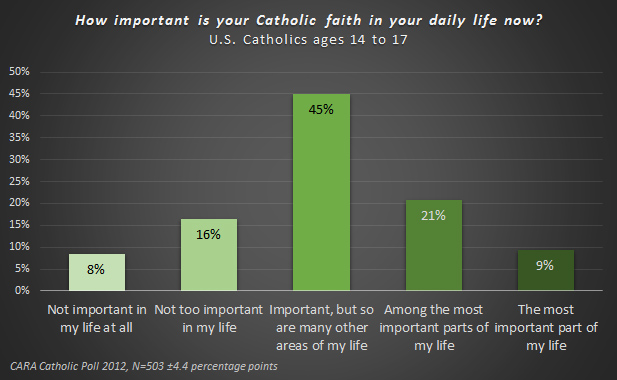
3.  Importance of Faith.  In the CARA Survey, 75% of teens said that the faith was important or very important to them.  25% said faith was not too important in their lives.

CARA_importance

4.  Religious Activities.  The teens were asked about their religious activities.  Prayer ranked highly (71%) but bible study ranked low.  According to the survey:

The teens were also asked about the religious activities they take part in on a regular basis. Thirteen percent indicated regularly participating in retreats. Eight percent say they regularly participate in prayer groups, 7% in Eucharistic adoration, and 7% in Bible study. A quarter (25%) said they had participated in a parish youth group at some point. Fifteen percent said they had been an altar server and this percentage is the same for both males and females.

Only 20% indicated that they read the Bible or pray with scripture at least once a month. Six in ten say they “rarely or never” do this. Fourteen percent indicate they pray the rosary at least monthly. At the same time, 71% say prayer is either “among the most important parts” of their lives (25%) or that it is “important, but so are many other areas of my life” (46%).”

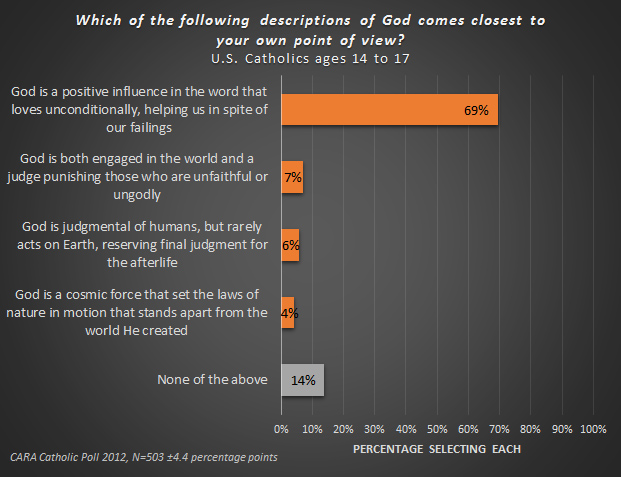
5.  View of God.  Teens had a healthy view of God, with a strong majority saying that you can have a personal relationship with God and 69% saying that “God is a positive influence in the world that loves unconditionally, helping us in spite of our failings”:

CARA_viewofgod

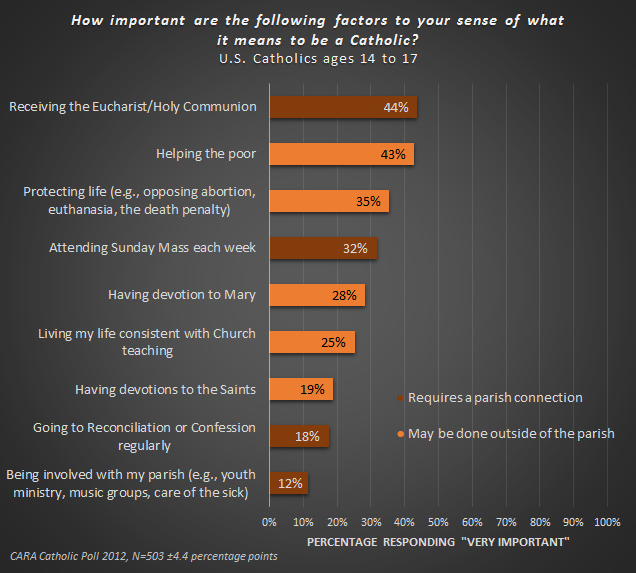
6.  What it means to be Catholic.   Not surprisingly, receiving the Eucharist (44%) and helping the poor (43%) were the leaders in the question: “What it means to be a Catholic”:

CARA_activities

Overall, it is an interesting study.  My impression is that the overall quality of Catholic education, both in Catholic schools and parish faith formation have increased dramatically since the 1970s and 1980s and we are seeing positive results.

However, as a parent, I am always looking for new ways to spread the Christian message to my boys who are sometimes unwilling listeners.  I welcome all feedback that you have in this area in the Comments section below.

Peace,
W. Ockham

Posted in Uncategorized | Tagged , , | Leave a comment

Tribute to Teilhard de Chardin’s Mother

berthe-adele-and-emmanuel-teilhard-de-chardin

Berthe Adele Teilhard de Chardin with her husband, Emmanuel, parents of Pierre Teilhard de Chardin.

Continuing this week’s theme of Mother’s Day tributes it is appropriate that we recognize the Mother of Teilhard de Chardin, the inspiration of this blog.  I have not been able to find out much about the history of Berthe Adele Teilhard de Chardin, other than that she was a native of Picardy, France, was born of a “distinguished lineage” and was the great-grandniece of Voltaire.  Pierre Teilhard de Chardin was the fourth of eleven children born to Berthe and Emmanuel.

It appears that Berthe Teilhard de Chardin was extremely influential in the formation of Pierre’s religious beliefs, vocation and character.  Pierre’s biographer, Robert Speaight described Berthe as

“a woman of exemplary piety to whom Pierre was later to confess that he owed ‘the best of myself’, to her, she instilled in him a devotion to the Sacred Heart, which was to be the radiating center of his own ardent spirituality. . . Berthe rose early; walked every day to Mass before dawn so that she might be at home to breakfast with the family; was indifferent to the conventions of society even when she conformed to them.” 

An online biography of Pierre Teilhard de Chardin would state that

“[h]is sensitive nature was also nurtured by his mother’s steadfast piety. Teilhard’s reflections on his mother’s influence is striking, he writes:  ‘A spark had to fall upon me, to make the fire blaze out. And, without a doubt, it was through my mother that it came to me, sprung from the stream of Christian mysticism, to light up and kindle my childish soul. It was through that spark that `My universe,’ still but half-personalized, was to become amorised, and so achieve its full centration.'”

Going into this Mother’s Day weekend in the U.S., here is a tribute to Berthe Teilhard de Chardin, who lit and kindled the fire of faith in young Pierre that sent him on a wonderful journey to be a light for generations to come.

Posted in Uncategorized | Tagged , | Leave a comment

Mother’s Day Humor

In honor of Mother’s Day in the U.S. this Sunday, here is a cartoon that my Mother can certainly appreciate:

Mother_Day_Humor

Posted in Uncategorized | Tagged | Leave a comment

Embracing Doubt (Part VI): The Incarnation

crooked_lines2

“God Writes Straight With Crooked Lines” — Spanish Proverb

This is the sixth and final installment of “Embracing Doubt to Grow to a Mature Faith”.  [A fully summary of the series is set forth at the end.]  Today, we will continue with the author Julian May’s explanation of Christianity based on the philosophical insights of Teilhard de Chardin.  You can find a more brief summary of Julian May’s outstanding Galatic Milieu series in Part V (which I strongly recommend you read for background), but for anyone who likes science fiction and is a fan of Teilhard de Chardin, I would strongly recommend reading the Galactic Milieu and Pliocene Exile series.  They create a wonderful vision of the future based on Teilhard’s ideas, as well as highlight the all-too human eternal truths of love, pain, sin and redemption on a grand scale in a manner that only great stories can.

Set forth below is a continuation of my adaptation of the telepathic conversion between Teresa Kendall Remillard and her unborn son, Jon Remillard:

Jack said: “God’s creation of the Universe out of love is very mysterious. Contrary to common sense!… Why do I find the concept pleasing? Mama, why do you give gifts at Christmas?”

Teresa:  “It’s a tradition. Wise men gave gifts to the infant Jesus. To Baby God. And he is God’s gift to us.”

Jack said: “That’s the biggest paradox. Even greater than Creation. It was quite unnecessary for God to become human and teach us his love in person. I can see why some Earth religions deny that it happened.”

“Yes, Incarnation is quite absurd. But you must admit it would be an excellent way to catch our attention! And so madly elegant. It’s also much easier for us to pray to and love a God-made-man, who would be more likely to understand our human difficulties, than to try to love an almighty Big-Bang-Creator. Why should he care if my roast is overdone or if I live long enough for you to be safely born?”

Jack said: “I would like him to care.”

“Ah! Now we’re moving into psychology! An incarnate, loving God takes on significant mythic overtones that appeal to the deepest levels of the human psyche. To that almost instinctive part of us called the collective unconscious.”

“I have not yet had any experience of that.”

“You will,” Teresa laughed, “when you really begin to socialize.”

“I—I wish I did not have to. Opening myself up to others can be painful as others are not always nice.”

“You mustn’t fret about it. All people have good and bad in them. I do, and so do you. This is one reason why a loving God is such an amazing consolation. He has no dark about him at all. God must know all there is to know about us—and yet he loves us anyway. He only wishes us well, even when we’re wicked or when we deny him. We would never have guessed that about him in a million years, if he hadn’t told us. It’s mysterious beyond belief”

“But is this mystery true?”

“Of course, none of this is proof of God’s Incarnation. Even though the evidence strongly points to the Incarnation, ultimately it can’t be proved. But I believe it, and so does Uncle Rogi, and your Papa and brothers and sisters, and billions of other entities. That kind of belief is called faith.”

She gave Jack a giant hug and closed her eyes for a moment. “I have faith in God’s love just as I have faith in your great future, Jack. There are many things that frighten me and other things that make me very unhappy. But if I can just hold on to faith, I won’t give in to despair. I won’t.”

Here is a fully summary of the “Embracing Doubt to Grow to a Mature Faith Series”

Part I:  James Martin, S.J.:  The Path of Disbelief.

Part II:  Pope Emeritus Benedict on how doubt serves as a springboard to a richer faith experience.

Part III:  Pope Emeritus Benedict on how faith and doubt can form the basis of cordial dialogue with non-believers and a deeper understanding of our common humanity.

Part IV:  Deacon David Backes on how God would prefer that we wonder in search of the Truth rather than spend our life as spiritual zombies.

Part V: Julian May’s explanation of God’s creation through her wonderful Teilhardian vision of the future evolution of humanity.

Part VI: Julian’s explanation for the Incarnation as part of the Teilhardian evolutionary vision.

A complete summary of my adaptation of Julian May’s beautiful and succinct explanation of Christianity can be found here.

[The summary of the conversation between Teresa and Jon is a modification of the following:  May, Julian (2011-04-27). Jack the Bodiless (Galactic Milieu Trilogy) (pp. 268-275). Random House, Inc.. Kindle Edition.]

Posted in Embracing Doubt and Mature Faith | Tagged , , , , , | 1 Comment

Mother’s Day Prayer from a Working Mother

Being a Mother is a 365-day year job.  Typically, they are only celebrated on Mother’s Day in the United States.  However, this blog will continue to have a prayer devoted to Mothers each day.  This one is a prayer from a working Mother and it has special appeal to me as my Mother was a working Mother.  She worked long hours as a teacher, while also being a wonderful Mother, wife, daughter, daughter-in-law and friend to many, and maintaining a steady calm that I can only wish to emulate.

This prayer is from Creighton’s online ministries:

Prayer From A Working Mother

My Loving Creator,

You know how really tired I am. On days when things are really frantic, I consider how you made the world in seven days — and then I try to remember that you aren’t asking me to re-create that feat.

Please help me to remain a loving mother to my children and to keep some balance in my life. Help me to remember that you are with me in every packed hour of every day. As I am finishing a work project or planning dinner or buying the kids shoes, (sometimes all at the same time) help me to remember your loving care for me and let me sometimes stop for a moment and just wallow in that.

Most of all, my caring Father, let me remember to ask for help and to rely on you for strength when I have none left; for patience when mine is so often gone; and for the wisdom and endless well of compassion and love I need in my job as mother.

Posted in Uncategorized | Tagged , , | Leave a comment

Embracing Doubt (Part V): Creation of Universe Out of Love

Big_Bang-Love

This is Part V of “Embracing Doubt to Grow to a Mature Faith”.  In Part I, I described some of my own faith journey and had an excerpt from Fr. James Martin, S.J.’s book “The Jesuit Guide to (Almost) Everything on how the Path of Disbelief is one of the six paths to God.

In Part II, we discussed Pope Emeritus Benedict’s insights on how doubt is a common feeling, even among revered saints such as Teresa of Avila, and how this doubt can serve as a springboard to strive for a deeper intellectual and spiritual understanding of faith, which leads to a richer faith experience.

In Part III, we discussed how faith and doubt to form the basis of cordial dialogue with non-believers and a deeper understanding of our common humanity.

In Part IV, we discussed how God would prefer that we wonder in search of the Truth rather than spend our life as spiritual zombies.

Today and tomorrow, in the final two installments of Embracing Doubt, we discuss Christianity.  Not the institutional Christianity that is practiced in various forms throughout the world but questions regarding the core truths of Christianity:  Is there a God (or Mind behind the Universe)?  What is the nature of God (deism, pantheism, theism)?  Did God become incarnate in the form of Jesus of Nazareth?  Is God still active in the world?

Theologians and philosophers have been debating these questions for thousands of years.  Obviously, we will not be able to discuss them in any detail in a single blogpost (although we plan to discuss specific issues in the future).  However, we can at least address the uniqueness of Christianity.

Many profound truths are best told in stories, as any reader of the creation-flood story in the Hebrew Bible or the parables of Jesus can attest to.  I am a science fiction fan, primarily because I enjoy the speculative potential for the future of humanity.  One of my favorite authors is Julian May.  May is an award winning author who has published over 30 books.  Her best known works are the four-book series Saga of Pliocene Exile and the four-book Galactic Milieu series.  May is a follower of Teilhard de Chardin and creates a future world based upon his principles of God being the divine author of an evolving universe and humanity (the Galactic Milieu reference is based on Teilhard’s Divine Milieu, or in May’s novels, St. Teilhard de Chardin).  In the not-too-distant future, a critical number of humans evolve to a set of “metaphysic” mental powers that result in humans coming in contact with five other sentient species. 

In one of the scenes of May’s novel Jack the Bodiless, there is a telepathic communication between Teresa Kendall Remillard and her unborn son, Jon Remillard (In May’s novels, the Remillard’s are a Kennedy-esque, Catholic family who help lead humanity into the Galactic Milieu)  in which Teresa and Jon discuss the intellectual problems of God and the Incarnation.  I have modified May’s discussion as follows:

Jon Paul Kendall Remillard had philosophical difficulties with the concept of Christmas. That the scraggly little evergreen tree his mother was trimming was a midwinter hope symbol was easy enough to understand from the explanations and mental images his mother Teresa offered. But the notion of God creating a body for himself to wear—and even Creation itself—bothered Jack. 

Jon said: “It seems a very strange and unnecessary thing for God to do. To become human so that we’d love him rather than fear him. If he’s truly a Supreme Being then it follows that he has no need of any other entity to ensure his own happiness. Especially entities that are so imperfect by their very nature that they will inevitably befoul an otherwise orderly creation. I can understand God creating the physical universe for fun. But why create other minds when you know they’re going to mess things up?”

Teresa: “I believe famous human thinkers have debated those points.” I seem to remember that the theologians of early times were quite positive that God had no absolute need to create other thinking persons,” Teresa said. “This is perfectly ridiculous, of course, since the theologians were willing to concede that he had done it and must have had a good reason. Now, unless we’re ready to admit that a Supreme Being can be capricious or wishy-washy, it follows that he needed to do it. He did need us.”

Jack: “But what prompted God’s need of us?”

“Love,” said Teresa.

Jack said: “That’s irrational.”

“Exactly. I don’t believe anyone has ever reasoned out a satisfactory answer to God’s need of us. Those religions outside the Judeo-Christian tradition rarely hit upon the notion of a loving God at all. As for natural philosophy, loving-kindness would not be an attribute that one would logically deduce that a Big-Bang-Creator-God would have.”

“Hardly.”

“But love is the only motive that seems to make any sense. Without it, you have the Creator-God as a game player trying to assuage his cosmic boredom, caring about us only as game pieces. That is to say, not caring very much! Now, if God wanted us to know that he created us out of love, he’d have to tell us, since we couldn’t figure it out for ourselves. He’d have to get directly involved with us, rather than let us tick along obliviously the way the evolving non-sapient universe does.”

“I suppose so …”

“There are any number of ways he might have done this. But put yourself in God’s position and try to decide the most elegant way to get involved with your thinking creatures. The way that is at once most difficult and unlikely but has the potentiality to succeed in the most magnificent manner imaginable.”

“Not the easiest way?”

“Heavens, no! What would be the satisfaction in that! I can sing ‘Happy Birthday to You’, but I get more satisfaction doing the mad scene from Lucia, even if it tires me out terribly.”

“I understand.”

Pinching and twisting, Teresa affixed one little candle after another, pausing now and then to straighten those that leaned out of true. “God’s most elegant way of involving himself with us would have to be a scandal to the stodgy-minded and a delight to minds that have a sense of humor and of adventure. As his mind does.”

“God can laugh?”

“Of course, dear, and feel sorrowful, too. A Supreme Being without those attributes wouldn’t be supreme. Grim and joyless people try to pretend otherwise, but their arguments are unpersuasive.”

“Explain to me how God became directly involved with us.”

“It has happened differently on different worlds in the Galaxy. On ours, I believe that the primary involvement happened through the Jewish people and the Christians. It’s a long story, and you’ll really have to read it in the Bible. That book is a fascinating account of human moral evolution, with historical and deeply mythic truth all mingled in a wonderful mishmash. It’s a literary treasure as well as the word of God, and some parts of it are profound, and some are fascinating and some are poetic, and some are even a bore. Different religions interpret the Bible in different ways, but we Catholics believe that when the mentalities of one single key tribe of extremely intelligent people were finally mature enough to grasp the concept of a loving God, God simply spoke to them.” She laughed. “Well—perhaps not simply.”

“And the tribe accepted his messages and passed them on?”

“Some members did. Others kept slipping and sliding back into primitive notions of angry gods that constantly needed to be appeased with blood sacrifices and other rubbish. God had to keep coaxing them and putting them in their place the way a loving mother has to do when her children are naughty.”

“Is love the motivation for all creation, then?”

“I imagine so. Mental lattices within our normal Reality can’t exist without the other five kinds, and vice versa. If God wanted to make minds to love, he had to make the whole cosmos. And it is quite lovely.”

“But to create for the love of it seems so odd!”

“Of course it does. It really makes no sense—in a rational view of the universe. And yet every artist knows the truth of it. And every healthy adult human knows that people who are in love want the whole world to be as happy as they are. If you are God, loving yourself or even being Love in some mysterious fashion, and there aren’t any other minds to share happiness with—then you make some.”

“So one may conclude that God does need us?”

“Most of our coreligionists today believe it’s true.”

Jack persisted: “And the problem of the created minds being imperfect? And sometimes evil?”

“There’s a principle to the effect that it is much more glorious to make something wonderful out of imperfect parts. The very imperfection of the individual elements—even when there’s actual evil involved, as there often is in human affairs—challenges God to greater creative heights.”

“What a strange idea.”

“There’s an old proverb that says: ‘God writes straight with crooked lines.’ Human history is just full of crooks and twists and twines. One would think anarchy or barbarism or the lowest common denominator would have triumphed ages ago. But it hasn’t.  All the messes and atrocities and disasters have somehow been woven into a construct that looks better and better every year—at the same time that some things look even worse! The world you’re going to be born into is a wonderland compared to the world that existed only forty years or so in the past. But even so, there are still persons who are discontented or who are villains, and situations that are evil or tragic. Nevertheless we children of God continue to evolve and improve on every level, almost in spite of ourselves.”

Tomorrow, in the final installment of Embracing Doubt, we will continue the dialogue between Teresa and Jon and the question of the Incarnation.

[The summary of the conversation between Teresa and Jon is a modification of the following:  May, Julian (2011-04-27). Jack the Bodiless (Galactic Milieu Trilogy) (pp. 268-275). Random House, Inc.. Kindle Edition.]
 

Posted in Embracing Doubt and Mature Faith | Tagged , , , , , , , | Leave a comment

Mother’s Day Prayer: Blessed Mary Compared to the Air We Breathe

One of my favorite prayer sites (especially for nightly prayer) is Sacred Space, which is run by the Irish Jesuits.  Each week they have a “Something to think and pray about” reflection.  This week, perhaps in honor of Mother’s Day in the U.S., they have a condensed version of the a poem to Mary by the great 19th century poet Gerard Manley Hopkins, S.J., which is reproduced below.  I encourage you to read the full poem, which is absolutely beautiful, here.

The Blessed Virgin Compared to the Air We Breathe
Gerard Manley Hopkins  

Wild air, world-mothering air,
Nestling me everywhere,…
Minds me in many ways
Of her who not only
Gave God’s infinity
Dwindled to infancy
Welcome in womb and breast,
Birth, milk, and all the rest
But mothers each new grace
That does now reach our race…
And makes, O marvellous!
New Nazareth in us,
Where she shall yet conceive
Him, morning, noon, and eve;
New Bethlems, and he born
There, evening, noon, and morn…
Be thou then, O thou dear
Mother, my atmosphere;
My happier world, wherein
To wend and meet no sin…
Stir in my ears, speak there
Of God’s love, O live air,
Of patience, penance, prayer:
World-mothering air, air wild,
Wound with thee, in thee isled,
Fold home, fast fold thy child.

Posted in Uncategorized | Tagged , , , | 1 Comment