Embracing Doubt (Part IV): A God Who Lets Us Wander

wander

This is Part IV of the relationship between faith and doubt (primarily in a Christian context but the same principles apply for other religious traditions).  In Part I, I described some of my own faith journey and the excerpt from Fr. James Martin, S.J. how the Path of Disbelief is one of the six paths to God.

In Part II, we discussed Pope Emeritus Benedict’s insights on how doubt is a common feeling, even among revered saints such as Teresa of Avila, and how this doubt can serve as a springboard to strive for a deeper intellectual and spiritual understanding of faith, which leads to a richer faith experience.

In Part III, we discussed how faith and doubt to form the basis of cordial dialogue with non-believers and a deeper understanding of our common humanity.

Today, we turn to insights from Deacon David Backes.  Mr. Backes is a Professor at the University of Wisconsin – Milwaukee and an ordained deacon in the Roman Catholic Church.  Mr. Backes runs the blogsite, New Wood, which addresses a variety of issues from spirituality, environmental science, everyday mysticism and outstanding sermons.

A couple of years ago, when I was in my own spiritual journey in the desert of doubt, I came across a post by Professor Backes about his own experiences which touched me in a personal way.  Here is an excerpt where David speaks:

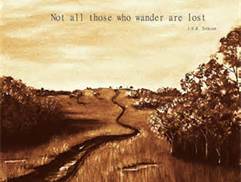
“I wandered for seven years, trying to figure out what to believe and how to live.  I needed that period of wandering.  It was crucial to my spiritual growth.  So many are afraid to wander–as though God will be angry with them for trying to figure things out for themselves rather than accept what is told to them about God by people who may well not be very good sources.  This is yet another variation on the damage that is done by the image of an angry, harsh God.  It makes some people stay in religion like prisoners in a cell, never experiencing the freedom that religion is supposed to help them discover.  And it makes some people turn away from and even against both religion and the God they believe religion teaches.

God lets us wander so we will know what it means to come home.  I’d go even further than that.  I’d argue that God would much rather have us wander than to spend our lives as spiritual zombies, more dead than alive.  He hopes we will want to find our home, but he knows all the twists and turns and what each of us needs and doesn’t need if we are to maximize our chances of becoming the joyful, holy people he made us to be.” — David Backes

The above statement very much describes my journey. I remember when I was younger, I was troubled by the parable of the Prodigal Son.  I identified with the older brother (and not just because I am an oldest brother:-). I was troubled because my understanding of Christianity and the world was that if you worked hard, followed the rules, you would and should be rewarded, both spiritually and materially. Like the older brother, I thought it was fundamentally unfair for someone who had wasted his talents and fortune to be welcomed back in such a loving, compassionate and forgiving manner.

Not surprisingly, as I entered by 20s, this 2nd grade spiritual view did not fill my soul and for 15+ years I meandered through various flavors of agnostism, deism and Eastern spirituality, but mostly I ignored my spirituality to focus on other, non-spiritual areas of my life. Interestingly, those areas (health, family, career) were (and are) going very well but I had this strong undercurrent of angst and fatigue that I always had with me. It was not until this spiritual longing deep inside my soul became unbearable (I call it the God hole as it a hole in the soul that only God can fill) and I let go of my 2nd grade spirituality really started to understand my Catholic faith in a new, adult, way. I realize that the God of unconditional love loved me just as I am, with all of my faults and imperfections, regardless of what I have done or failed to do, and would welcome me back just as the father did to the Prodigal Son.  If I did not have these years of wandering (like the youngest Prodigal son), I would never have returned home.

Posted in Embracing Doubt and Mature Faith | Tagged , , , , , , , | 3 Comments

American Teilhard Association Annual Meeting

journey_universe

The American Teilhard Association is having its annual meeting this Saturday at Noon at Union Theological Seminary in New York.  More information can be found here.

This is my first annual meeting that I will attend and I am looking forward to it.  If you are going to the meeting, please drop be a line in the comment section or drop me an e-mail at williamockham17@gmail.com as I would love to meet you there.

Posted in Uncategorized | Tagged , , , | Leave a comment

Mother’s Prayers: Prayers by and for Mothers

flower-blue

I am not a Mother but I am a son who has been hard on my Mother especially during my teenage and early 20s years.  I am also a husband of a Mother and have seen the trials and tribulations that my two wonderful boys have put my wife through.

Mother’s Day in the U.S. is only five days away.  Creighton’s Online Ministries has a wonderful site of 16 prayers by and for Mothers in all different situations.  The prayer below is on the Cathedral of Home, as it is something I can relate to as a father:

The Cathedral of Home

Dearest Lord,

I sit here quietly in the my room, opening my heart to you. It is so silent! But if I listen intently, I become aware of the breathing of my children in beds down the hall. They sigh softly or move in their beds quietly, nestled warmly into their dreams. These most intimate sounds, coming from the people I love most in the world, transform this room. It becomes a place of honoring you, a cathedral of joy and gratitude toward you for giving me these children.

May I always treasure these gifts you have given me. In each moment of loving them, from kisses to laundry to kitchen, may I be aware of your presence in my life in this way. Thank you!


Posted in Uncategorized | Tagged , , | Leave a comment

Editorial Update

updates

The “Embracing Doubt to Grow to a Mature Faith” will continue with Part IV tomorrow and conclude Wednesday and Thursday with Parts V and VI.  Heading to New York Friday for the American Teilhard Association Annual Meeting.  Hope to provide updates from the meeting.

Posted in Uncategorized | Leave a comment

Teilhard de Chardin Quote of the Week (May 6): Harnessing the Energies of Love

teilhard_fire

“Someday, after mastering the winds, the waves, the tides and gravity, we shall harness for God the energies of love, and then, for a second time in the history of the world, man will have discovered fire.”

(“The Evolution of Chastity,” in Toward the Future, 1936, XI, 86-87)

The above is one of my favorite quotes, and I use it as background for my Twitter image.  The quote echos with Johannian theology of God, especially 1 John 4:7-21.

http://twitter.com/Teilhard_us

Posted in Teilhard Quote of the Week | Tagged , , , | 2 Comments

Sunday Reflection: Sixth Sunday of Easter (The Yes Church of Open Doors)

council_jerusulem

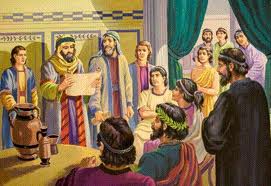
This week, both the first Sunday reading and the first reading during the weekday masses are from Acts of Apostles and deal with the Council of Jerusalem, the first Church council.  The Council of Jerusalem occurred in approximately 50 AD and the core issue was whether the Gentiles (non-Jews) were required to following the Mosaic laws, most specifically circumcision.

The “conservatives”, led by the Pharisee converts, argued that since Jesus, as well as all of the 12 apostles and early disciples, were Jews who followed the Mosaic law, argued that “it is necessary to circumcise them and direct them to observe the Mosaic law.”  The “liberals”, led by Paul and Barnabas, argued that Gentile converts did not need to follow the Mosaic laws as Christ’s resurrection was a new creation that created a new way to encounter the Divine.

Pope Peter settled the matter by stating that Christ’s resurrection transcended the obligation to follow Mosaic law stating: “Why, then, are you now putting God to the test by placing on the shoulders of the disciples a yoke that neither our ancestors nor we have been able to bear? on the contrary, we believe that we are saved through the grace of the Lord Jesus, in the same way as they.”

Unfortunately, the Sunday readings only having the introduction to the Council of Jerusalem and the first encyclical letter, rather than the details of the arguments that were set forth during the weekly readings.  (I strongly recommend anyone interested to read Acts Chapter 15, as well as a good commentary on this Chapter for more historical and factual background.).

It can not be overstated how dramatic the decision to break with Mosaic law was.  Again, Jesus, the 12 apostles and all of Jesus’ disciples were devout Jews who followed the Mosaic laws.  Prior to the Resurrection of Jesus, it would have been unthinkable to have a wholesale break with the Mosaic laws.  However, after the Resurrection, the only thing that matters was following the will of Christ, which we learned last week, was to “love one another”.  Period.  Full Stop.

In Thursday’s homily from Vatican radio, Pope Francis highlighted the importance of the decision made by Pope Peter and other leaders at the Council of Jerusalem:

“There was a ‘No’ Church that said, ‘you cannot; no, no, you must not’ and a ‘Yes’ Church that said, ‘but … let’s think about it, let’s be open to this, the Spirit is opening the door to us ‘. The Holy Spirit had yet to perform his second task: to foster harmony among these positions, the harmony of the Church, among them in Jerusalem, and between them and the pagans. He always does a nice job, the Holy Spirit, throughout history. And when we do not let Him work, the divisions in the Church begin, the sects, all of these things … because we are closed to the truth of the Spirit. “

But what then is the key word in this dispute in the early Church? Pope Francis recalled the inspired words of James, Bishop of Jerusalem, who emphasized that we should not impose a yoke on the neck of the disciples that the same fathers were not able to carry:

“When the service of the Lord becomes so a heavy yoke, the doors of the Christian communities are closed: no one wants to come to the Lord. Instead, we believe that through the grace of the Lord Jesus we are saved. First this joy of the charism of proclaiming the grace, then let us see what we can do. This word, yoke, comes to my heart, comes to mind”.

The Pope then reflected on what it means to carry a yoke today in the Church. Jesus asks all of us to remain in his love. It is from this very love that the observance of his commandments is born. This, he reiterated, is “the Christian community that says yes”. This love, said the Pope, leads us to be faithful to the Lord” … “I will not do this or that because I love the Lord”:

“A community of’ yes’ and ‘no’ are a result of this’ yes’. We ask the Lord that the Holy Spirit help us always to become a community of love, of love for Jesus who loved us so much. A community of this ‘yes’. And from this ‘yes’ the commandments are fulfilled. A community of open doors. And it defends us from the temptation to become perhaps Puritans, in the etymological sense of the word, to seek a para-evangelical purity, from being a community of ‘no’. Because Jesus ask us first for love, love for Him, and to remain in His love. “

As I reflect on today’s readings and the monumentous event that occurred almost 2,000 years ago at the Council of Jerusalem, I pray to the loving Triune God that I may be moved like Peter and the early apostles to set aside my prejudices and slavish devotion to rules and that I may be given the grace to love others as Christ has commanded us to do.

Posted in Sunday Reflections | Tagged , , , | Leave a comment

Teilhard de Chardin and Stephen Jay Gould: The Real Forgery

Piltdown Hoax

This blog will primarily focus on the philosophical and theological aspects of Teilhard de Chardin’s life and contemporary applications of those themes.  Although Teilhard is most widely known today as a leading spiritual visionary, during his lifetime, he was also a highly respected paleontologist.  This post will touch on that aspect of Teilhard’s life.

Teilhard is perhaps most famous in paleontology for his involvement in the discovery of Peking Man, which is outlined in the 2008 book The Jesuit and the Skull.  Peking Man, discovered by an international team led by Davidson Black and Teilhard de Chardin, was one of the earliest discoveries of homo erectus, who lived approximately 750,000 years ago.

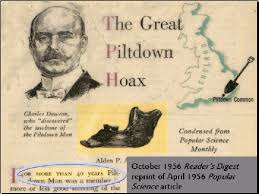
In the latter half of the 20th century, Teilhard’s scientific work was questioned by paleontologist Stephen Jay Gould when Gould accused Teilhard of being a participant in the Piltdown Man Hoax, one of the greatest paleoanthropological hoaxes ever perpetuated.  Most serious scientists and researchers exonerated Teilhard but Gould’s accusations generated a lot of publicity for Gould in the early 1980s and cast a shadow over Teilhard.  Never mind that Teilhard was only tangentially involved with the Piltdown site and that scientific fraud was completely out of character for Teilhard, who by all accounts, had the highest integrity and honor.

A recent paper in LoS Biology by Jason Lewis and colleagues reveals that it was Stephen Jay Gould who was involved is massive scientific fraud.  In the outstanding blog by anthropologist John Hawks, Hawks summarizes Lewis’ paper.  Key quotes from the blog analysis include:

“Some of Gould’s mistakes are outrageous, with others it is hard for me to believe that the misstatements were not deliberate misrepresentations. . . Gould made up the whole thing. It was an utter fabulation (sic). It is disgraceful that later authors have cited this idea as fact. . . With numbers like these, it is natural to wonder exactly where Gould came up with his idea that Morton’s numbers were fudged. Here’s how: Gould fudged his own numbers! (emphasis in original)”

To the extent that Gould had any defenders left for his accusations against Teilhard de Chardin, hopefully they will be now put to rest.

Posted in Uncategorized | Tagged , , , , , | Leave a comment

Embracing Doubt (Part III) (Common Ground with Nonbelievers)

faith_doubt_2

This is Part III of the relationship between faith and doubt (primarily in a Christian context but the same principles apply for other religious traditions).  In Part I, I described some of my own faith journey and the excerpt from Fr. James Martin, S.J. how the Path of Disbelief is one of the six paths to God.

In Part II, we discussed Pope Emeritus Benedict’s insights on how doubt is a common feeling, even among revered saints such as Teresa of Avila, and how this doubt can serve as a springboard to strive for a deeper intellectual and spiritual understanding of faith, which leads to a richer faith experience.

Today, we continue with Pope Emeritus Benedict’s discussion on the ability of faith and doubt to form the basis of cordial dialogue with non-believers and a deeper understanding of our common humanity from his book Introduction to Christianity:

“We can return without any more imagery to our own situation and say: If, on the one hand, the believer can perfect his faith only on the ocean of nihilism, temptation, and doubt, if he has been assigned the ocean of uncertainty as the only possible site for his faith, on the other, the unbeliever is not to be understood undialectically as a mere man without faith. Just as we have already recognized that the believer does not live immune to doubt but is always threatened by the plunge into the void, so now we can discern the entangled nature of human destinies and say that the nonbeliever does not lead a sealed-off, self-sufficient life, either. However vigorously he may assert that he is a pure positivist, who has long left behind him supernatural temptations and weaknesses and now accepts only what is immediately certain, he will never be free of the secret uncertainty about whether positivism really has the last word. Just as the believer is choked by the salt water of doubt constantly washed into his mouth by the ocean of uncertainty, so the nonbeliever is troubled by doubts about his unbelief, about the real totality of the world he has made up his mind to explain as a self-contained whole. He can never be absolutely certain of the autonomy of what he has seen and interpreted as a whole; he remains threatened by the question of whether belief is not after all the reality it claims to be. Just as the believer knows himself to be constantly threatened by unbelief, which he must experience as a continual temptation, so for the unbeliever faith remains a temptation and a threat to his apparently permanently closed world. In short, there is no escape from the dilemma of being a man. Anyone who makes up his mind to evade the uncertainty of belief will have to experience the uncertainty of unbelief, which can never finally eliminate for certain the possibility that belief may after all be the truth. It is not until belief is rejected that its unrejectability becomes evident.

It may be appropriate at this point to cite a Jewish story told by Martin Buber; it presents in concrete form the above-mentioned dilemma of being a man.

“An adherent of the Enlightenment [writes Buber], a very learned man, who had heard of the Rabbi of Berditchev, paid a visit to him in order to argue, as was his custom, with him, too, and to shatter his old-fashioned proofs of the truth of his faith. When he entered the Rabbi’s room, he found him walking up and down with a book in his hand, rapt in thought. The Rabbi paid no attention to the new arrival. Suddenly he stopped, looked at him fleetingly, and said, “But perhaps it is true after all.” The scholar tried in vain to collect himself—his knees trembled, so terrible was the Rabbi to behold and so terrible his simple utterance to hear. But Rabbi Levi Yitschak now turned to face him and spoke quite calmly: “My son, the great scholars of the Torah with whom you have argued wasted their words on you; as you departed you laughed at them. They were unable to lay God and his Kingdom on the table before you, and neither can I. But think, my son, perhaps it is true.” The exponent of the Enlightenment opposed him with all his strength; but this terrible “perhaps” that echoed back at him time after time broke his resistance.”

Here we have, I believe—in however strange a guise—a very precise description of the situation of man confronted with the question of God. No one can lay God and his Kingdom on the table before another man; even the believer cannot do it for himself. But however strongly unbelief may feel justified thereby, it cannot forget the eerie feeling induced by the words “Yet perhaps it is true.” That “perhaps” is the unavoidable temptation it cannot elude, the temptation in which it, too, in the very act of rejection, has to experience the unrejectability of belief. In other words, both the believer and the unbeliever share, each in his own way, doubt and belief, if they do not hide from themselves and from the truth of their being. Neither can quite escape either doubt or belief; for the one, faith is present against doubt; for the other, through doubt and in the form of doubt. It is the basic pattern of man’s destiny only to be allowed to find the finality of his existence in this unceasing rivalry between doubt and belief, temptation and certainty. Perhaps in precisely this way doubt, which saves both sides from being shut up in their own worlds, could become the avenue of communication. It prevents both from enjoying complete self-satisfaction; it opens up the believer to the doubter and the doubter to the believer; for one, it is his share in the fate of the unbeliever; for the other, the form in which belief remains nevertheless a challenge to him.”

In Part IV, we will see what insights we can obtain on the nature of God from the fact that God uses doubt to help us grow closer to him.   

Posted in Embracing Doubt and Mature Faith | Tagged , , , , | 7 Comments

Embracing Doubt to Grow Into a Mature Faith (Part II)

faith_doubt_1

Worship him, I beg you, in a way that is worthy of thinking beings” — Romans 12:1 (Jerusalem Bible Translation)

In Part I of this series, I talked a bit about my own personal journey of how embracing doubt helped me truly discover God’s loving presence.  In addition to the personal revelation that doubt can provide, it can also serve as a communication bridge to non-believers, which is very important in today’s Western secular culture.

In his classic book Introduction to Christianity, Pope Emeritus Benedict summed up the benefits of doubt as follows:

“Anyone today who makes an honest effort to give an account of the Christian faith to himself and to others must learn to see that he is not just someone in fancy dress who need only change his clothes in order to be able to impart his teaching successfully. Rather will he have to understand that his own situation is by no means so different from that of others as he may have thought at the start. He will become aware that on both sides the same forces are at work, albeit in different ways.

First of all, the believer is always threatened with an uncertainty that in moments of temptation can suddenly and unexpectedly cast a piercing light on the fragility of the whole that usually seems so self-evident to him. A few examples will help to make this clear. That lovable Saint Thérèse of Lisieux, who looks so naive and unproblematical, grew up in an atmosphere of complete religious security; her whole existence from beginning to end, and down to the smallest detail, was so completely molded by the faith of the Church that the invisible world became, not just a part of her everyday life, but that life itself. It seemed to be an almost tangible reality that could not be removed by any amount of thinking. To her, “religion” really was a self-evident presupposition of her daily existence; she dealt with it as we deal with the concrete details of our lives. Yet this very saint, a person apparently cocooned in complete security, left behind her, from the last weeks of her passion, shattering admissions that her horrified sisters toned down in her literary remains and that have only now come to light in the new verbatim editions. She says, for example, “I am assailed by the worst temptations of atheism”. Her mind is beset by every possible argument against the faith; the sense of believing seems to have vanished; she feels that she is now “in sinners’ shoes.”  In other words, in what is apparently a flawlessly interlocking world someone here suddenly catches a glimpse of the abyss lurking—even for her—under the firm structure of the supporting conventions. In a situation like this, what is in question is not the sort of thing that one perhaps quarrels about otherwise—the dogma of the Assumption, the proper use of confession—all this becomes absolutely secondary. What is at stake is the whole structure; it is a question of all or nothing. That is the only remaining alternative; nowhere does there seem anything to cling to in this sudden fall. Wherever one looks, only the bottomless abyss of nothingness can be seen.

Paul Claudel has depicted this situation in a most convincing way in the great opening scene of the Soulier de Satin. A Jesuit missionary, brother of Rodrigue, the hero of the play (a worldling and adventurer veering uncertainly between God and the world), is shown as the survivor of a shipwreck. His ship has been sunk by pirates; he himself has been lashed to a mast from the sunken ship, and he is now drifting on this piece of wood through the raging waters of the ocean. The play opens with his last monologue:

“Lord, I thank thee for bending me down like this. It sometimes happened that I found thy commands laborious and my will at a loss and jibbing at thy dispensation. But now I could not be bound to thee more closely than I am, and however violently my limbs move they cannot get one inch away from thee. So I really am fastened to the cross, but the cross on which I hang is not fastened to anything else. It drifts on the sea.”

Fastened to the cross—with the cross fastened to nothing, drifting over the abyss. The situation of the contemporary believer could hardly be more accurately and impressively described. Only a loose plank bobbing over the void seems to hold him up, and it looks as if he must eventually sink. Only a loose plank connects him to God, though certainly it connects him inescapably, and in the last analysis he knows that this wood is stronger than the void that seethes beneath him and that remains nevertheless the really threatening force in his day-to-day life.

Ratzinger, Joseph Cardinal; Pope Benedict XVI; Benedict; J. R. Foster; Michael J. Miller (2010-06-04). Introduction To Christianity, 2nd Edition. Ignatius Press. Kindle Edition.

In Part III of this series, I will continue with additional insights from Pope Emeritus Benedict on how embracing doubt is an authentic way to live an enhanced faith and a way to form a bridge to non-believers.

Posted in Embracing Doubt and Mature Faith | Tagged , , , , , , | 5 Comments

Embracing Doubt to Grow Into a Mature Faith (Part I): The Path of Disbelief

calvin-565x191

My own spiritual journey was a very circuitous one.  I was born and raised Catholic, but by the time I was a teenage years and young adulthood, I drifted away, in part because I was drawn to the allure of the consumer culture in the U.S. and in part because I did not have a strong theological foundation in my youth.

During most of my 20s and 30s, I fell away from Christianity, viewing it as an anachronism of a bygone era.  I respected the institutional legacies of Christianity (schools and hospitals) but thought the Mass was boring and that doctrines had no relevance to daily life.  To the extent I thought about theology, I ranged between agnosticism to a vague deism.  Mostly, I focused on getting ahead in my career.  I did not consider God part of my life for almost 20 years.

As I was reaching my late 30s, and having sufficient career and personal success that from an objective view of the consumerist society, I should have been happy.  But I wasn’t.  I had an inner angst that kept getting bigger.  I was becoming more concerned about climbing the next run on the career ladder and was becoming increasingly irritable with my family, friends and co-workers.  Intellectually, there was a disconnect between my outwardly apparent success and my inner anxieties.  I was stuck in what Dave Schmelzer and Scott Peck would describe as Stage 3 spirituality or what Richard Rohr would call first half of life spirituality.

After failing to open the door that God had been knocking on for a couple of decades, I finally decided to open it in the form of several virtual spiritual mentors who helped lead me back home to my Christian faith, albeit in a very different mindset of my youth.  One spiritual mentor of course is Teilhard de Chardin, who is the namesake for his blog.  While some of his readings can be challenging, his attraction stems from the combination of his big picture synthesis of the cosmic truths of Christianity and his living embodiment of those truths with joy and humility despite many personal tragedies that would led a less God-centric person to bitterness and despair.  I will speak much more on Teilhard de Chardin’s thoughts in the future.

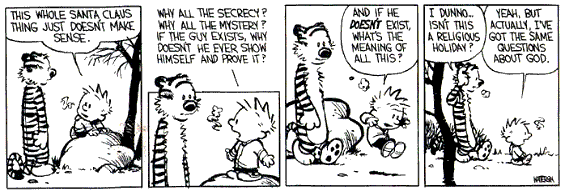
However, I would like to focus this series on how doubt, especially doubt about the really big questions such as “Is there a God?” and  “What is the nature of God?”.  I had core doubts on these questions and went on a massive investigative study where I researched the best writings of the five major world religions (Judaism, Christianity, Islam, Hinduism and Buddhism).  One of my key influences during this period was James Martin, S.J. and his outstanding book The Jesuit Guide to (Almost) Everything.  In this book, Fr. Martin discusses six different paths to God: belief, independence, disbelief, return, exploration and confusion.  My personal path crossed several of these path but the most fruitful one for me was the path of disbelief.  It was not until I both embraced and confront my own doubt of God’s existence that I was finally able to open myself up to the loving presence of God.

Fr. Martin published excerpts on the Six Paths to God on the Huffington Post a couple of years ago.  Here is a quote from The Path of Disbelief:

“You might be surprised to hear of agnosticism or atheism as a path to God. But, in my experience, believers have often found themselves on this path. This is not to say that atheism or agnosticism ineluctably leads to God. Obviously it does not. But for some the path ultimately leads to a desire to understand the transcendent.

Those traveling along the path of disbelief not only find that organized religion holds no appeal (even if they sometimes find its services and rituals comforting), but have also arrived at an intellectual conclusion that God may not, does not or cannot exist. Often they seek proof for God’s existence and finding none, or encountering intense suffering, reject the theistic worldview completely.

The cardinal benefit of this group is that they take none of the bland reassurances of religion for granted. Sometimes they have thought more deeply about God and religion than some believers have.”

Here is the full summary of the Embracing Doubt reflections:

Part I:  James Martin, S.J.:  The Path of Disbelief.

Part II:  Pope Emeritus Benedict on how doubt serves as a springboard to a richer faith experience.

Part III:  Pope Emeritus Benedict on how faith and doubt can form the basis of cordial dialogue with non-believers and a deeper understanding of our common humanity.

Part IV:  Deacon David Backes on how God would prefer that we wonder in search of the Truth rather than spend our life as spiritual zombies.

Part V: Julian May’s explanation of God’s creation through her wonderful Teilhardian vision of the future evolution of humanity.

Part VI: Julian’s explanation for the Incarnation as part of the Teilhardian evolutionary vision.

Posted in Embracing Doubt and Mature Faith | Tagged , , , , , , , , | 6 Comments