Feast of St. Francis Xavier, S.J. (December 3)

St. Francis Xavier, S.J.

St. Francis Xavier, S.J.

Today is the Feast Day of St. Francis Xavier, S.J., one of the most famous early Jesuits. He was a close companion of St. Ignatius of Loyola and one of the first seven Jesuits. Francis Xavier led an extensive mission into Asia, mainly in the Portuguese Empire of the time. He was influential in the spreading and upkeep of Catholicism most notably in India, but also ventured into Japan, Borneo, the Maluku Islands, and other areas which had thus far not been visited by Christian missionaries. It was a goal of Xavier to one day reach China, but he died just before reaching the mainland.

Francis Xavier was born on April 7, 1506 in his family’s small castle in Navarre, a Basque area in the Pyrenees. In September 1525 he went to begin studies at the College of Sainte-Barbe in the University of Paris. His roommate was the soon-to-be Saint Peter Faber (Pierre Favre) from the Savoy region of France. Everything changed for Francis, when, four years later, Ignatius Loyola (Inigo Lopez de Loyola), another Basque nobleman, moved in with them. Loyola soon persuaded Faber to become a priest but Xavier was more interested in a secular career and became a lecturer at the university. However in 1533, Ignatius finally got through to Xavier and won him over. Eventually the group would increase to seven with Ignatius as their mentor. He inspired them to join him in going to work in the Holy Land. On August 15, 1534, in the chapel of Saint-Denis in Montmartre, they all made vows of poverty and chastity and committed themselves to convert non-believers in the Holy Land. In 1536 the group – without Ignatius who had returned to Spain – went to Venice in preparation to go to the Holy Land. While waiting, they worked in hospitals and then went to Rome where the non-priests were ordained by a papal delegate on June 24, 1537. When war prevented their going to the Holy Land, the group put themselves at the disposal of the pope. In the meantime they went to various universities to preach; Xavier went to Bologna and later to Rome. During Lent 1539, the group discussed becoming a religious institute. Pope Paul III gave his consent provided they would send two of their number to evangelise in the new Portuguese colony in India – a request that had come from King John III of Portugal. Simon Rodrigues and Nicholas Bobadilla were chosen but, when Bobadilla fell sick, Ignatius reluctantly asked his close friend, Xavier, to take his place. They would never meet again.

Xavier and Rodrigues left Rome on March 15, 1540. While waiting for a ship, they preached and took care of prisoners in Lisbon. They so impressed the king that Rodrigues stayed on while Xavier would go alone to India. As Xavier was boarding the ship on April 7, 1541, he was told he had been appointed apostolic nuncio with authority over all the Portuguese clergy in Goa. The voyage to India took one year and one month. Xavier immediately began preaching to the Portuguese, whose Catholic behaviour left much to be desired. He began by reforming Goa, concentrating on the Portuguese colonists who, though nominally Catholic, were notoriously cruel to slaves and lived in open concubinage, with total neglect of the poor. By his example, preaching, and writing verses on Christian truths set to popular melodies, Francis did much to undo the scandalous behavior of the European Christians.  His first mission was to the Paravas, pearl fishers on the southeast coast of India, near Cape Comorin.

He mingled with the poor as a poor man himself, sleeping on the ground and living mainly on rice and water. Generally speaking, he was welcomed by the low-caste peoples but ignored by the higher castes, especially the Brahmins. Everywhere he left numerous viable Christian communities. One good example was the persistent fidelity to Christianity of the Paravas, whose very existence he probably saved from extinction.

For long he dreamed of going further east, although he was not a good sailor and was poor at languages (despite a myth to the contrary). Xavier then sailed to the Portuguese colony of Malacca, on the west coast of the Malayan Peninsula, before moving on to the Moluccas, or Spice Islands (in eastern Indonesia) where he arrived in February 1546.

In Malacca, Xavier met a Japanese named Anjiro interested in Christianity. What he told Xavier about Japan intrigued him and decided to evangelise there. In April 1549 he set sail for Japan with Anjiro, now a Christian, and a number of Jesuits. Because of delays on the way, they did not reach Kagoshima, Anjiro’s hometown at the southernmost tip of Japan, until August.

At first the mission went very smoothly and Xavier produced an abridged catechism in Japanese. The local prince allowed the missionaries to preach Christianity but he did not convert. Xavier felt that the conversion of the Japanese would have to begin at the top with the emperor but he did not know how to reach the imperial city, Miyako (Tokyo today). He made only 100 converts in Kagoshima and another 100 in Hirado, a port on Kyushu used by the Portuguese. He then moved to Yamaguchi, Japan’s second largest city. He had an unsuccessful meeting with the daimyo there so in December 1550 he went on to Sakai. At last in January 1551 Xavier found a prince ready to take him and a fellow-Jesuit to Miyako, as servants in his entourage. They failed to see the emperor but learnt that the most powerful ruler in Japan was the daimyo of Yamaguchi. Now the two Jesuits rented horses and dressed in silken robes. They were received formally by the daimyo and presented him with an array of expensive gifts and with impressive credentials from King John III of Portugal and Pope III. They were allowed to preach Christianity and Japanese were free to convert. He also gave them a deserted Buddhist monastery to live in. Within six months they had 600 converts. By the time he left Japan, there were about 2,000 Christians in Japan.

In September 1552 he landed on Shangchuan (Sancian) island, off the south coast of China, near Canton (Guangzhou). It was a hideout for Chinese smugglers and a base for Portuguese ships (soon to be replaced by Macau). None of the smugglers was willing to risk taking the Jesuit missionary over to China. One who promised to do so, took Xavier’s money and disappeared. On November 21 he got a fever and was confined to his hut on the shore facing the Chinese mainland. Seven days later he fell into a coma but on December 1 regained consciousness and kept praying. He died within sight of his goal, alone except for a young man who looked after him. It was the morning of December 3, 1552. He was buried on the island and his body placed in quicklime to hasten its decomposition so that it could be brought to India. But on being exhumed, it was found to be in perfect condition. It was first brought to Malacca and later to its present resting place in the basilica of the Bom Jesu in Goa.

Several religious missionary congregations bear his name while many churches and colleges are dedicated to him in different parts of the world. During his missionary life, he suffered extreme hardship, wore himself out with ceaseless activity, but lived a deeply spiritual life. Part of his unceasing labors were due to a conviction that all the non-baptised were damned to eternal damnation, a conviction held by Christians of all kinds at the time. Later missionaries would come to have a much deeper respect for the religions they encountered and would not speak of ‘pagans’. Francis was a man of his times and his methods were not followed by later Jesuit missionaries such as John de Brito and Matteo Ricci but there was no doubt about his integrity and his zeal. He is remembered for his tireless efforts in proclaiming the Gospel in foreign lands and for his solidarity in word and lifestyle with the poor.

Sources:

Living Space
Wikipedia
Catholic Online
Ignatian Spirituality

Posted in Ignatian Spirituality | Tagged , , , , , , , , , , , , , , , , , , , , , , , , , , , | 6 Comments

Teilhard de Chardin Quote of the Week (December 2, 2013)

Disputa_del_Sacramento_(Rafael)

“[W]hen one understands how physical and immediate is the omni-influence of Christ, the vigor assumed by every detail of the Christian life is quite astonishing; it gains an emphasis never dreamt of by those who are frightened of the realistic view of the mystery of the Incarnation. Take charity, for example, that complete change of attitude so insistently taught by Christ. It has nothing in common with our colorless philanthropy, but represents the essential affinity which brings men closer together, not in the superficial sphere of sensible affections or earthly interests, but in building up the pleroma. The possibility, and even the obligation of doing everything for God (‘Quidquid facitis, in nomine Domini nostri Jesu Christi facite’) are no longer based solely on the virtue of obedience, or solely on the moral value of intention; they can be explained, in short, only by the marvelous grace, instilled into every human effort, no matter how material, of effectively cooperating, through its physical result, in the fulfillment of the body of Christ.”

Teilhard de Chardin, Pierre (2002-11-18). Christianity and Evolution (Harvest Book, Hb 276) (Kindle Locations 898-907). Houghton Mifflin Harcourt. Kindle Edition.


Posted in Teilhard Quote of the Week | Tagged , , , , , , | 2 Comments

First Sunday of Advent (December 1, 2013): Preparing for Christ

first_sunday_advent

This Sunday is the First Sunday of Advent, the beginning of the Church year. The readings can be found here. The themes include preparing for the various comings of Christ. The reflection comes from Living Space run by the Irish Jesuits. I encourage you to read the entire reflection here but set forth below is an extended summary:

This period is appropriately called “Advent”.  It comes from the Latin word adventus which simply means ‘coming’.  But whose coming are we talking about?  Obviously we are beginning to prepare to remember God coming to be a human being among us, with us and like us.  And yet, although the Scripture for today does speak of the coming of God, it makes no mention of the coming of Christ as Christmas.

Actually, at this time we can speak of three comings of God.  The first, is when Jesus, the Son of God came to be born in the stable at Bethlehem.  But today’s Mass also speaks of the final coming of Jesus at the end of the world.  And there is still a third kind of coming we need to be aware of, namely, when God enters our lives every day.  Every single experience can be an opportunity to make contact with God.  And we are reminded of that ongoing contact with God especially in the celebration of the sacraments, including this Eucharist.

Preparing for the end

Today’s Mass actually says very little about the first coming of Jesus or, about his birth in Bethlehem.  The Scripture readings rather emphasize our need to prepare for the final coming of Jesus, whether that means the end of the world as we know it or of the end of our own individual lives.

The First Reading invites us to go with God.  It says, “Let us go together to the Temple of God.”  Of course, we know that for us Jesus himself is the real Temple of God.  And, because of that, the body of the Christian community united with Christ its Head is also God’s Temple.  And we go to him and with him because “he will teach us his ways that we may walk in his paths”.  He will show us the way for us to follow on our pilgrimage through life, the way that will lead us to meet him on that last day on earth.

A final coming

The Second Reading and the Gospel emphasize that we must prepare for that final coming of Jesus, whatever form it is going to take.  The first coming of Jesus in Bethlehem is to help us prepare for this final coming.

We really need this warning.  On the one hand, we do not like to think too much about how or when we will leave this world.  But it is a fact.  It is the one future fact of our lives of which we can be absolutely certain.  There are people who are very afraid to die and who do not even want the subject raised.  Today’s Scripture wants to remind us of the final purpose of our lives.

Many of us are like the people mentioned in today’s Gospel: “Before the flood they were eating and drinking, marrying and giving in marriage, until the day Noah entered the ark, and they knew nothing till the flood came and swept them all away…”  These people were doing very ordinary things.  Exactly the same things that we do.  But they were so busy doing them that they failed to give any thought to where their lives were ultimately leading and what was the goal of that life.

They were very busy, just like us.  Maybe they were very successful, maybe they made a lot of money, maybe they made wonderful marriages, had lots of exciting experiences…  But, in the end, they were not ready for the most important appointment of their lives.  The question is: how ready am I right now?

* * *

We sometimes think that the busier we are the  better.  (We even like to say, “The devil finds work for idle hands to do.”)  We work for today, for tomorrow, for next month, for next year, for our future, for our children’s future…  But what about our real future?  Our future with God?  What preparations are we making for that future?

* * * 

The obvious question to ask is, How are we to prepare?  St. Paul today in the Second Reading has some advice.  “Let us give up all the things we tend to do under cover of darkness and live decently as people do in the daytime.”  I guess there are dark areas in all of our lives.  Things we do, things we say, things we think, the indulging of our lower and self-centred appetites; things which we would not like other people to know about because they are quite wrong.  They do no good to me or to others.

Instead, we need to develop our relations with God and with our brothers and sisters based on a caring and unconditional love for all.  We need to learn how to find God, to find Jesus in every person, in every experience.  We need to respect every person as the image of God.  We are to love our neighbours as ourselves, to love everyone just as Jesus loved us.

If, in our words and actions, our daily lives are full of the spirit of Jesus, then we have prepared.  We do not need to be anxious about the future or what will happen to us.  Concentrate on today, on the present hour, the present situation and respond to it in truth and love and the future will take care of itself.  Then we do not have to fear no matter when Jesus makes his final call.  Because we know he is going to say:  “Come, my friend. I want to call you now; I want to share with you my life that never ends.”  And we will respond: “Yes, Lord, I am ready.  I have been waiting for you all this time.”  It will be an encounter, not of strangers, but of two old friends.

Sunday Reflection from Living Space

Posted in Sunday Reflections | Tagged , , , , , , , , , , , , , | 6 Comments

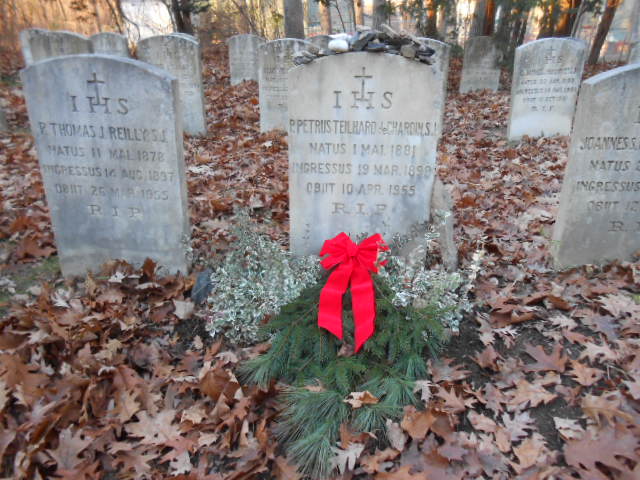
Teilhard de Chardin Grave at Advent Season

TdC-grave-Nov-2013-3

Today is Thanksgiving in the U.S. and the Church is heading into the Advent Season this weekend. The above photo is of Pierre Teilhard de Chardin’s grave in Poughkeepsie, New York, USA. The photo is courtesy of Jacqueline and Pierre Francois and The Teilhard Project. I thought it is fitting as I am hopeful that we will be witnessing a rebirth on the ideas of Teilhard de Chardin in the next few years.

Posted in Uncategorized | Tagged , , , | 7 Comments

Peter Faber, S.J. to be declared Saint

Blessed Peter Faber

Soon-to-be Saint Peter Faber, S.J.

I had previously written about the life of Peter (Pierre) Faber, S.J., a companion of St. Ignatius of Loyola and the first Jesuit priest. Pope Francis mentioned Fr. Faber as one of his role models for his pontificate. Pope Francis is elevating the status of Fr. Faber within the Church also as Vatican Insider says that Faber will be declared a Saint before Christmas this year.  From Vatican Insider:

“Pierre Faber, a “Reformed” Jesuit priest whom Francis sees as a model figure, is to be proclaimed as saint before Christmas, Stefania Falasca reports in an article for Italian Catholic newspaper Avvenire. The process for his cause in the Congregation for the Causes of Saints is complete and now all that remains is for Francis to issue the Bull of Canonization that will proclaim the first companion of St. Ignatius a saint, extending the cult of the soon-to-be-saint to the Universal Church.

* * *

Faber’s canonization takes on a whole new meaning as the Jesuit is “a model of spirituality and priestly life for the current successor of Peter. At the same time, he is an important reference point for understanding the Pope’s leadership style.” Faber lived on the cusp of an era when the unity of the Church was being threatened. He mostly kept out of doctrinal disputes and steered his apostolate towards a reform of the Church, becoming a pioneer of ecumenism.”

Francis spoke about Faber in his famous interview with Jesuit journal Civiltà Cattolica, revealing some key aspects of the priest as a figure: “[His] dialogue with all, even the most remote and even with his opponents; his simple piety, a certain naïveté perhaps, his being available straightaway, his careful interior discernment, the fact that he was a man capable of great and strong decisions but also capable of being so gentle and loving.”

“The picture of Faber that emerges from the texts is that of a thinker in action, a man who was profoundly attracted by the figure of Christ and was understanding of people. The cause of separated siblings was one he held close to his heart and he was good at discerning spirits. He lived an exemplary priestly life and the unconditional nature of his ministry was reflected in his patience and gentleness. He gave himself without asking others for anything in return. Faber distinguished himself for his “affective magisterium”, in other words, his gift for spiritual communication with people and his ability to put himself in other people’s shoes.”

Attached here is a wonderful document on the life and spirituality of Peter Faber by Severin Leitner that was graciously provided by Claire Bangasser.

Posted in Ignatian Spirituality | Tagged , , , , , , , , , , , , | 3 Comments

Site Update

sabbatical

When I started this blog just over six months ago I had no idea what to expect. Unlike most areas of my life, there was not a clear direction or goals. I was not convinced that the internet needed yet another blog, but at the same time I needed an outlet for my musings on faith, science, reason, Ignatian Spirituality and Teilhard de Chardin that was not being met in family or church circles. So I took the plunge into the blogosphere.

I had the same trepidation that many first-time bloggers do; that my thoughts would disappear into the great internet void and no one would read them. I was very pleasantly surprised when I first started getting some hits and good comments. Eventually, I found other fascinating blogs (please check out the links on the right side of this page!), traffic picked up and I was getting into a routine. I had a fantastic time “meeting” other bloggers and learning other perspectives.

My initial goal was to follow my inspiration and post something at least six times a week for the first year. Alas, the reality of a demanding job, fatherhood and other commitments starting taking its toll. In part, due to the advice of a couple of my blogging friends, I am going to try to set aside some more time for myself (thank you Julie and Lynda!). As a result, while I am going to continue blogging, it may be closer to two to four posts a week rather than six. Hopefully there will be improved quality to make up for the lower quantity 🙂

Posted in Uncategorized | 11 Comments

Teilhard de Chardin Quote of the Week (November 25, 2013)

incarnate_universe

[I]f in his interpretation of the process of the Incarnation a Christian adopts the eminently justifiable point of view which rests on organic and physical analogies, then nothing in the world any longer subsists permanently for him apart from the unifying influence of Christ. Throughout the whole range of things Christ is the principle of universal consistence: ‘In eo omnia constant.’ For such a Christian, exactly as for the modern philosopher, the universe has no complete reality except in the movement which causes all its elements to converge upon a number of higher centers of cohesion (in other words, which spiritualizes them); nothing holds together absolutely except through the Whole; and the Whole itself holds together only through its future fulfillment. On the other hand, unlike the free-thinking philosopher, the Christian can say that he already stands in a personal relationship with the centre of the world; for him, in fact, that centre is Christ—it is Christ who in a real and unmetaphorical sense of the word holds up the universe. So incredible a cosmic function may well be too much for our imagination, but I do not see how we could possibly avoid attributing it to the Son of Mary. The Incarnate Word could not be the supernatural (hyper-physical) center of the universe if he did not function first as its physical, natural, center. Christ cannot sublimate creation in God without progressively raising it up by his influence through the successive circles of matter and spirit. That is why, in order to bring all things back to his Father, he had to make himself one with all—he had to enter into contact with every one of the zones of the created, from the lowest and most earthly to the zone that is closest to heaven.”

Teilhard de Chardin, Pierre (2002-11-18). Christianity and Evolution (Harvest Book, Hb 276) (Kindle Locations 880-892). Houghton Mifflin Harcourt. Kindle Edition.


Posted in Teilhard Quote of the Week | Tagged , , , , , , | 3 Comments

Seeking the sacred

I am reblogging this very meaningful and poignant reflection about ultimate meaning as I am going through some (hopefully short-term) challenges in some of my important relationships at the moment.

Peace,
W. Ockham

Casey's avatarThe Sprightly Writer

I heard about a hit-and-run that happened in our area last week from a police officer friend of mine.  He was just telling me about it on Saturday night, when I brought him maple syrup from our  maple tree tapping outing we went to that day.  Four county correctional officers were struck by an SUV while they were jogging Tuesday night.  Three of them were injured, but one of them, a 25 year old mother of a 5 month old, died at the scene of the accident.

He was also telling me other horror stories of what goes wrong in this area and on the news.  I often wonder if he has any positive stories about anything to talk about.  I worked in a crime lab for 5 years, I know all about the horrific things that can happen between people but I don’t go talking about them.

On Sunday…

View original post 1,178 more words

Posted in Uncategorized | 7 Comments

Sunday Reflection, Solemnity of Christ the King of the Universe (November 24, 2013): Teilhard de Chardin’s Universal Christic Vision

christ_king

“Our individual mystical effort awaits an essential completion in its union with the mystical effort of all other men. The divine milieu which will ultimately be one in the Pleroma, must begin to become one during the earthly phase of our existence . . .To what force is it given to merge and exalt our partial rays into the principal radiance of Christ? To charity, the beginning and the end of all spiritual relationships . . . It is impossible to love Christ without loving others . . . And it is impossible to love others (in a spirit of broad human communion) without moving nearer to Christ.” — Pierre Teilhard de Chardin

This week is the last Sunday in Ordinary Time and we celebrate the Solemnity of Christ the King of the Universe. The readings can be found here.

The Feast of Christ the King was instituted in 1925 by Pope Pius XI in his first encyclical letter Quas Primas, in response to growing nationalism and secularism of Europe. The title of the feast was “D. N. Jesu Christi Regis” (Our Lord Jesus Christ the King), and the date was “the last Sunday of the month of October – the Sunday, that is, which immediately precedes the Feast of All Saints.

In his 1969 motu proprio Mysterii PaschalisPope Paul VI gave the celebration a new title: “D. N. Iesu Christi universorum Regis” (Our Lord Jesus Christ King of the Universe). He also gave it a new date: the last Sunday in the liturgical year. Through this choice of date “the eschatological importance of this Sunday is made clearer”. He assigned to it the highest rank, that of “Solemnity”.

The change in name to “Christ the King of the Universe”, the change in date to the last Sunday of the year and the elevation of rank from Feast to Solemnity all reflect the influence that Teilhard de Chardin’s ideas have had within the Church of the nature of Christ. Christ is not only the Greek Logos set forth in the first chapter of the Gospel of St. John or the incarnation of the form of Jesus of Nazareth. Christ also continues to be the prime mover within the Universe, attracting everything towards him as part of the evolutionary process towards greater unity of the Omega Point that began with the Big Bang. Pope Paul VI’s elevating the celebration of Christ the King of the Universe recognizes these cosmic attributes of the second person of the Trinity.

As David Grumett says:

“Teilhard presents this cosmic dimension [of Christ] as providing a challenges of modern critical thought that does not compromise theology in the way that modernist tendencies did. He wishes to articulate Christ’s universal power over creation in more than the extrinsic and juridical terms to which he found that power to be so often reduced. Teilhard is inspired in his task by the 1925 encyclical Quas Primas, proclaiming the Feast of Christ the King. This encyclical connects Christ’s spiritual reign in hearts and wills with the enthroning of the Sacred Heart by families in their homes and with efforts to combat republican anticlericalism. Promulgated in the sixteenth millennial year of the Council of Nicaea, the encyclical’s naming of Christ the King is justified as a consequence of the everlasting kingdom of Christ referred to in the Nicene Creed produced in the Church’s confrontation with Arianism. . . . On realizing that the world comprises a single whole:

“we begin to see more distinctly rising over our interior world the great sun of Christ the King, of Christ amictus mundo, of the Universal Christ. Little by little, stage by stage, everything is finally linked to the supreme center in quo omnia constant.”

Quas Primas recognizes Christ as being the ‘crowing glory’ of the world, and the encyclical’s teaching, Teilhard states, makes a ‘gesture which marks a decisive stage in the development of dogma . . . towards a more universalist and more realistic appreciation of the Incarnation. Teilhard himself employs the image of Christ the King to show how Christ sustains all material things by unifying and governing them. This christology is a natural consequence, he believes, of any serious appraisal of the power of Christ’s resurrection in its full extent:

‘We are too often inclined to regard the Resurrection as an isolated event in time, with an apologetical significance, as some small individual triumph over the tomb won in turn by Christ. It is something quite other and much greater than that. It is a tremendous cosmic event. It marks Christ’s effective assumption of his function as the universal center.’

This cosmic christology appears synonymous with the doctrine of the kingship of Christ contained in Quas Primas, but is in fact a significant development of it. Teilhard rereads the encyclical on the final day of his 1939 retreat, and demurs that it depicts Christ as possessing an inferior primacy to that granted him in [Chapter 1 of] the Letter to the Colossians, in which Christ is the ‘image of the invisible God, the firstborn of all creation’, creator and sustainer of all things, whether heavenly and earthly, and the source of their consistency. . . . Christ’s primacy is too often reduced, Teilhard complains, to purely moral or legal terms, which fail by themselves to communicate its organic character:

‘Between Christ the King and the Universal Christ, there is perhaps no more than a slight difference in emphasis, but it is nevertheless all-important. It is the whole difference between an external power, which can only be juridical and static, and an internal domination which, inchoate in matter and culminating in grace, operates upon us by and through all the organic linkages of the progressing world.’

James Lyones argues that the term ‘universal Christ’ . . . is virtually synonymous with the ‘cosmic Christ’ but conveys a stronger sense of the personality of the second member of the Godhead. The concept of universality thus contains a clearer affirmation of the particularity of Christ and the possibility of humanity entering into a relation with Christ.”

Source: David Grumett, “Teilhard de Chardin: Theology, Humanity and Cosmos”, Leuven and Dudley, Mass.: Peeters, (2005), pp. 126-28.


Posted in Ignatian Spirituality, Sunday Reflections | Tagged , , , , , , , , , , , , , , , , , , | 6 Comments

It’s not always what you think

Love the G.K. Chesterton quote and the imagery of the birds as we prepare for Advent.

Julie (aka Cookie)'s avatarcookiecrumbstoliveby

To love means loving the unlovable. To forgive means pardoning the unpardonable. Faith means believing the unbelievable. Hope means hoping when everything seems hopeless.
Gilbert K. Chesterton

DSCN2600

DSCN2603

DSCN2586

DSCN2595

Upon first glance, the tree out in the pasture appears to be rather bare with only what one would assume to be a few straggling leaves. . .and then, suddenly, you hear it. There is a rousing deafening din of chatter–rising and falling to a crashing crescendo of chirping only to immediately and eerily cease—a few seconds later, it begins again.

Upon further inspection the leaves, or so it seems, are not leaves at all but rather hundreds of starlings, better known as grackles. I posted some images a week or so ago of this massive flock covering the telephone lines up and down our street. Today the roosting spot of preference is the tree in the pasture.

These pictures simply do not…

View original post 199 more words

Posted in Uncategorized | Leave a comment