Teilhard, the Church & Henri de Lubac

Reblog and a heartfelt thank you for the reference.

David H Lukenbill's avatarThe Catholic Eye

I first discovered Teilhard de Chardin’s writings in McNeil Island Federal Penitentiary in the 1960s, obtaining a donated copy of The Divine Milieu, which completely entranced me.

At the time I was also reading Jean Paul Sartre (Saint Genet) and G.I. Gurdjieff (All and Everything), using them as subjects in an informal discussion group a few of us organized, and I found a rough congruence in all three thinkers: plunging the depths, examining everything, and creating synthesis.

That period at McNeil Island, lasting roughly three years, formed the foundation upon which I eventually became a Catholic, and though I do not read Gurdjieff anymore, Sartre rarely, Teilhard is virtually a daily companion.

One of the places I daily visit is the Teilhard Blogand a recent postdiscussing an article where Teilhard’s censure by the Church was mentioned without the mention of the popes and…

View original post 509 more words

Posted in Uncategorized | 1 Comment

Sunday Reflection, 31st Sunday in Ordinary Time (November 3, 2013): God’s Redemptive Grace

zaccarius

This weekend is the 31st Sunday in Ordinary Time. You can find the readings here. We continue the themes from last Sunday: God’s attitude towards the sinner and the social outcast. Today’s reflection comes from the great Jesuit site Living Space. I encourage you to read the entire reflection here but set forth below is an extended excerpt:

“Imagine Zacchaeus’ surprise when Jesus looked up and said, “Zacchaeus, hurry and come down; for I must stay at your house today.” What wonderful words for Zacchaeus to hear! How wonderful when Jesus says them to us! Yet at every Eucharist he makes his invitation at communion. But at many other times too he wishes to enter into our lives. The Book of Revelation has Jesus in a beautiful image: “I stand at the door and knock; if anyone hears my voice and opens the door, I will come into his house and eat with him and he will eat with me” (Rev 3:20). Are our doors always open and ready to offer him hospitality?

Zacchaeus has no hesitation. He climbs down quickly, delighted to welcome Jesus into his house. The reaction of the crowd, however, is something else. They are deeply shocked and scandalised. “He has gone to be the guest of one who is a sinner.” Of all the people in Jericho, Jesus picks the house of possibly the most obnoxious and detested person in the town.

It is not the first time this charge was made about Jesus. On another occasion the Pharisees said, “He mixes with sinners and tax collectors and even eats with them.” Of course, they do not understand Jesus’ point of view. There was no need for him to go to the houses of the good. It was those who were far from God that he went looking for. “People who are well do not need a doctor but only those who are sick. I have not come to call the respectable people but the outcasts” (Mark 2:17)

The remarks of the crowd are seen to be those of religious bigots and hypocrites who put themselves on a higher moral plane than others. To be honest, this is something we have all been guilty of at one time or another.

One meaning…

There are two interpretations of what follows, depending on how one reads the original text. “Zacchaeus stood there and said to the Lord…” He is standing, the position of one who is confident he is accepted by his Lord. It reminds one of a saying in the early Church: “The one who is risen stands.”

Our translation from the Greek goes on: “Look, half of my possessions, Lord, I will give to the poor, and if I have defrauded anyone of anything, I will pay back four times as much.” This implies that Zacchaeus, because of his encounter with Jesus, has undergone a radical conversion. He will give up his corrupt and rapacious ways. He will share his wealth with the poor and will make restitution to those he has cheated.

All this is in striking comparison to another rich man, an apparently very good man. He asked Jesus what he should do “to gain eternal life”. Jesus’ answer was, “Keep the commandments, the laws of God’s people.” “I have done that all my life,” says the rich man. “Then,” says Jesus, “there is just one more thing. Share what you have with the poor and then come and follow me.” And this very religious, very pious man, went away sad-faced “because he had many possessions” and could not let go of them.

Here, though, we have another rich man, apparently far from being religious or pious, a sinner in the eyes of the public, giving away half of his wealth. He will become a disciple. He has the necessary qualifications.

…another meaning

There is, however, another way of reading the text which seems closer to the original text of Luke. In this interpretation, Zacchaeus speaks in the present tense: “Half of my possessions I give (Greek,didomi, didwmi, present tense: ‘I give’ or ‘I am giving’) to the poor; and if I find I have taken more than I should, I pay back (apodidomi, apwdidwmi, ‘I give back’) fourfold.”

In other words, although he is a tax collector and apparently rich, he is, in fact, a very good man. Jesus recognised that when he invited himself into Zacchaeus’s house. The crowd, however, judged Zacchaeus simply by his profession. He is a tax collector,therefore he is an evil and corrupt man. And he was treated as an outcast not to be approached by any decent person. A perfect example of stereotyping and of judging people’s ‘holiness’ by their external observance of religious ritual.

But Jesus always sees beyond the external to the potential inside. He praises the repentant tax collector in last week’s Gospel over against the proud and arrogant Pharisee. Today he praises a tax collector whom he knows to be a good and generous person. He sees a unique individual and not just a stereotype.

How often are blinded by the stereotype of a person’s profession, or race, or religion and fail to see the unique individual inside? A policeman, a truck driver (a hard-drinking womanizing redneck), a single mother, a recovering alcoholic, a homosexual…?”

Living Space Reflection

Posted in Sunday Reflections | Tagged , , , , , , , , , , , | 5 Comments

Dan Burke and Accuracy on Teilhard de Chardin

Dan Burke: A good man, but absolutely wrong about Teilhard de Chardin

Daniel Burke: A good and holy man

“By now, no one would dream of saying that [Teilhard] is a heterodox author who shouldn’t be studied” – Fr. Federico Lombardi, Vatican spokesman (July 2009).

[Editor’s Note: This posting is in response to a recent article by Dan Burke in National Catholic Register in which he encourages readers to avoid Teilhard de Chardin, contrary to the statements of Pope Benedict, Pope John Paul II and other leading theologians of the last 50 years. My apologies in advance for the length of this article. I tried to parse it down or break it into multiple blogposts but given that it responds to a specific article it is hard to do without losing continuity. If you are one who is not interested in reading about theological minutia or Vatican interpretations of Teilhard de Chardin, please peruse another blog, celebrate All Saints’ Day Mass or go for a long walk rather than read this post. Your time will be better spent on one of those endeavors :-).  For those few persons who enjoy theological minutia, legal briefs or discussions of Vatican interpretations of Teilhard de Chardin, please continue reading and provide me with your thoughts on where I am off-base in the comments section below.]

Introduction

One of the perplexing items about Pierre Teilhard de Chardin is the continued misconceptions that surround his writings and philosophy. During his lifetime Teilhard de Chardin was censored and marginalized within the Catholic Church. However, in recent decades Teilhard de Chardin’s reputation went from being an outcast, to being tolerated, to having his ideas incorporated as part a central component of Catholic theology. I have written a six part series of blogposts which consists of various statements by two of the preeminent theologians of the last 50 years, Pope Benedict XVI and Cardinal Henri de Lubac. You can read additional statements of the contributions Teilhard de Chardin has made to Catholic theology by Pope John Paul II, Cardinal Agostino Casaroli, Cardinal Avery Dulles, Cardinal Christoph Schönborn and other leading theologians here.

Perhaps the culminating moment of the integration of Teilhard de Chardin’s vision into mainstream Catholic theology was the pontificate of Pope Benedict XVI. Pope Benedict had a well-deserved reputation as a first-rate theologian with a keen intellect. Morever, Pope Benedict, like Teilhard, has a deep respect for the richness of the Catholic tradition. Further, as successor to St. Peter, Pope Benedict’s views carry extra clout even when he is not issuing formal papal announcements. This combination of intellect, respect for tradition and teaching authority carry a tremendous amount of weight and deference.

As such, it is important that Pope Benedict has been speaking glowingly of Teilhard de Chardin’s evolutionary theology for over forty years. It is important that Pope Benedict cites Teilhard de Chardin’s concept of the Noosphere as a central feature of the Catholic Mass. It is important when Pope Benedict talks about Teilhard’s vision of The Mass on the World of the cosmos as a living host. It is important when the Vatican hosts a conference on Teilhard de Chardin in 2012 and Pope Benedict cites Teilhard de Chardin as an example of the New Evangelization needed at the beginning of the Year of Faith.

I am not surprised that some schismatic sects would spurn the Church hierarchy and dissent on the merits of the theology and vision of Teilhard de Chardin. However, I am surprised when this dissent extends to mainstream Catholics. The latest example is Daniel Burke and his recent article in National Catholic Reporter titled “Who Can I Trust” that is critical of Teilhard de Chardin and recommends avoiding him.

Dan Burke: An Exemplary Human Being

As background, I have tremendous professional and personal respect for Dan Burke. He is an award-winning author, speaker and entrepreneur. Dan is a founder of the outstanding site Roman Catholic Spiritual Direction and has just finished his latest book, Navigating the Interior Life – Spiritual Direction and the Journey to God. Dan’s journey began in Judaism, developed into a living relationship with Christ as a Protestant, and after fifteen years of continued exploration he converted to Catholicism.

I had the pleasure of meeting Dan Burke at a conference in 2012. He stood out as an extremely humble man who had a deep relationship with God. Moreover, his personal story is compelling from a troubled childhood to his deep spiritual journey. Other than the brief meeting at which I sat next to him at dinner, I do not know Dan. However, I am confident in saying that neither my faith nor my actions can compare to his. I would be a better person if I emulated Dan’s spiritual life. If only one of us could get to heaven, I would not hesitate to wager my entire current and future net worth that it would not be me.

Why Dan Burke’s Article is Inconsistent with Church Teaching

With that said, I believe his National Catholic Register article is wrong with respect to his conclusions on Teilhard de Chardin. My comments are in [red brackets below].

The article starts off well enough with Dan describing his personal spiritual journey:

About a decade before I converted to Catholicism, I was struggling with aridity. Former protestants can attest to the fact that there is little help in protestantism for this or any other significant spiritual malady. So, I began searching, and I stumbled across a priest who had written on the topic. This priest provided me with the wisdom I needed — wisdom the Holy Spirit used to not only help me get past that particular challenge, but also to deepen my understanding of how the Lord works in and through aridity to further our union with him. [God helped make the ideas of this long-dead priest available to Burke]

After becoming Catholic, I discovered that this author was condemned by the inquisition, and appropriately so, for the heresy of Quietism. [I do not know who Burke is referring to but as we see later it is important to note that the priest was criticized for a specific belief, not a general, unsubstantiated allegation.] 

That said, I still have some affection for this priest and a great appreciation for what God did through my encounter with him — and with the portion of his writings that were in keeping with the teachings of the Church. [Note that there was a demarcation between those writings which were consistent with the teachings of the Church and those that were not.]

I eventually came to learn that there was an abundance of wisdom available on the topic of aridity from trustworthy spiritual doctors of the Church like Sts. Teresa of Avila and John of the Cross. [Very true. In my opinion, these two great Spanish mystics are not sufficiently well-known or studied today. However, St. Teresa of Avila and St. John of the Cross are hard and not easily assessable, as in graduate-level prayer hard. Most beginners, such as me or Burke at his earlier stages of spiritual development, needed help from others to get to a more advanced spiritual level.]

So, I traded in the writings of this condemned priest for those who have been proclaimed great saints by the Church. [While Teilhard de Chardin has not been proclaimed a Saint, Pope Benedict and others have repeatedly been effusive in his statements on Teilhard and has acited Teilhard’s concept of the Noosphere as a central component of the Catholic liturgy.] To do any less would reflect a disordered clinging to a priest who served up spiritual poison alongside the truth and lived a life that, in the most important ways, bore no resemblance to those of the saints. [The attempted analogy to Teilhard de Chardin is way off base. First, I highly doubt that Burke is saying that Pope Benedict is advocating “spiritual poison”. Second, while Teilhard may not be a saint, his life of obedience to the Church and to his Jesuit order is exemplary.]

This brings me to the purpose of this post. When I personally seek out and drink from the wisdom of the Church, I do so from the purest wells possible (the doctors of the Church). But, taking it a step further, as a public figure (whatever that means), I also will not quote from questionable resources, even if I only agree with them in part. The reason is that in our culture, even a partial reference is often seen as a full endorsement of all that the quoted author has written. [I do not necessarily agree with the last statement. However, if it is true, it undermines Burke’s entire thesis. It means that means that Pope Benedict, who is certainly a public figure and who has been quoting Teilhard de Chardin for over 40 years, has fully endorsed the views of Teilhard de Chardin, not to mention Pope John Paul II and other Cardinals who have done the same.]

In the past world of academia, this was not a problem because the academic conversation was not open to the general public. Thereby, lesser formed hearts and minds would not be damaged by a partial exploration into the thoughts of those who provided some valuable insights, but were less tethered to the truth overall. Because of the ubiquitous flow of information in our time, this kind of exploration, once it even touches the edge of the all-knowing communication vortex, becomes completely accessible to the masses — and the result is often damaging to unsuspecting souls. [There are a couple of problems with this statement. First, it is a very condescending view that “the masses” are unable to understand basic theology taught by Pope Benedict and other Church leaders. Second, there is an implication that Teilhard is “less tethered to the truth overall” without making the case why this is correct. Is Burke implying that Pope Benedict, who as successor to St. Peter has been entrusted with teaching the doctrine of the Church, is saying things that are damaging to unsuspecting souls by his promotion of Teilhard de Chardin? That certainly is the implication.] 

As an example, Teilhard de Chardin has been quoted by Pope Benedict, Cardinal Avery Dulles and many other perfectly reliable scholars. [Yes, and quite extensively at that. Is Burke saying that these “perfectly reliable scholars” are incorrect in their assessment of Teilhard de Chardin? If yes, say so, and say why.]

Even so, according to the official stance of the Holy See, Chardin [Nit pick, it is either Teilhard or Teilhard de Chardin] has deeply flawed theological and philosophical issues in his writings — so much so that they have condemned his writings no less than twice. The second monitum was issued to reaffirm the first and can be found here. Scholars and teachers of our time must be more aware of the consequences of references to those who can and will lead unknowing seekers deeper into error.

[Ah yes, the infamous 1962 Teilhard monitum; the last resort of those who want to criticize Teilhard de Chardin but who can not find specific fault with his writings. The interesting thing is that the monitum did not find specific fault either. The language used in the monitum was that Teilhard’s writings had “ambiguities and indeed even serious errors.” However, the monitum never cited any specific writings or ideas that were in error. Neither did the reaffirmation that Burke refers to. This is quite unlike other warnings issued by the Vatican.

Two examples are relevant for how deficient the Teilhard monitum is. First, when the monitum was issued, there existed an Index of Forbidden Books which specified that certain books were contrary to the Faith. It is important that none of Teilhard’s books were ever listed on the Index. Second, in contrast to the Teilhard monitum, censures are usually fairly detailed in the theological deficiencies of the person subject to censure. (The Church does not get everything right but it is usually intellectually transparent, except for the Teilhard monitum). For example, in 1998 the Congregation for the Doctrine of Faith (and very importantly its Prefect Joseph Ratzinger), issued a warning on the writings of Anthony de Mello, S.J. Whether one agrees with the censure or not, the censure was very specific on both the benefits and shortcomings of Fr. de Mello’s writings. Joseph Ratzinger could have done something similar for Teilhard de Chardin. He deliberately chose not to.]

Chardin may have innocently participated in the Piltdown Man hoax, [This is another common mistake. There is no credible evidence that Teilhard de Chardin participated directly or indirectly in the Piltdown Max hoax. This was a rumor started by an attention-seeking forger.] and he may have unknowingly meandered on the edges of theological and philosophical sanity. [??? That is a harsh and unsubstantiated allegation.].

However his ideas and the related fruits were and are sufficiently problematic to incur official sanctions from the Holy See which characterized them as having “grave doctrinal errors.” Is the phrase “grave doctrinal error” in any way unclear?

[Yes, it is unclear. What is the “grave doctrinal error” of Teilhard? As shown above, contrary to common practice the original monitum never specified any. As such, we are left to speculate on what shortcomings Teilhard may have had in his writings. The best place to start is with the 1981 reaffirmation which stated that the letter sent by Pope John Paul II praising Teilhard de Chardin also “expresses reservation in various passages . . . reservations which refer precisely to the judgement given in the monitum of June 1962, even though this document is not explicitly mentioned.” The reaffirmation appears to indicate that the letter sent by Pope John II clarified the generalities of the 1962 monitum. 

The problem with this argument is that the letter, which I encourage you to read, is glowing about Teilhard. The only language that is remotely cautionary is reproduced below:

“At the same time, the complexity of the problems he analyzed and the variety of approaches he adopted raised difficulties that understandably called for a calm, critical study – in the scientific, philosophical and theological realms – of his extraordinary work.

“There can be no doubt that the celebrations of his 100th birthday – at the Catholic Institute of Paris, the Museum of Natural History, UNESCO, and Notre Dame of Paris – are an occasion for an encouraging evaluation [of his work] using a just methodological distinction of procedures in order to achieve a rigorous epistemological study.

“What our contemporaries will undoubtedly remember, beyond the difficulties of conception and deficiencies of expression in this audacious attempt to reach a synthesis, is the testimomy of the coherent life of a man possessed by Christ in the depths of his soul. He was concerned with honoring both faith and reason, and anticipated the response to John Paul II’s appeal: ‘Be not afraid, open, open wide to Christ the doors of the immense domains of culture, civilization, and progress.'”

OK, so the “grave doctrinal error” cited by the reaffirmation is Teilhard’s “difficulties of conception and deficiencies of expression in [his] audacious attempt to reach a synthesis.” That sounds pretty dangerous to me [Sarcasm meter on high alert]. I’ll admit that Teilhard can be challenging reading at times because he meanders in his writing (or perhaps it is the translation). However, Teilhard never claimed to be systematic theologian. He left that task to brilliant younger men such as Cardinal Henri de Lubac and Joseph Ratzinger.

Speaking of which, let’s see what Pope Benedict had to say that was critical of Teilhard. I have read a lot by Pope Benedict as he is one of my favorite contemporary theologians. Thanks to the power of e-books and word searching, I was able to scan my entire Benedict library (which is large but far from comprehensive so I likely missed some things) for this pronouncements on Teilhard for any criticism. The only criticism I found was that Teilhard had “a not entirely unobjectionable tendency toward the biological approach”. 

OK then. We have the facts that none of Teilhard’s writings were ever put on the Index of Forbidden Books. No specific criticisms of Teilhard’s writings were ever issued after they were published. The “ambiguities” and “serious errors” of the Teilhard monitum appear to come down to (i) a not entirely unobjectionable tendency towards the biological approach and (ii) general difficulties in conception and difficulties in expression. This sure does not seem enough to warrant the poison label that Dan gives it 🙂

The bottom line? If we want to know who we can trust to help us understand how to pursue God with all of our heart, soul, mind and strength, we must look to those who lived holy lives that were beyond reproach, and those whose teachings have been thoroughly tested and found true. If we stick with the spiritual doctors of the Church [That is a very narrow list. I would not want to give up reading Pope Benedict or St. Ignatius of Loyola who fall short of this standard] and those who know them well, we will avoid the potentially severe spiritual injury caused by drinking from a poison well. Our hearts may settle for less, but they will never rest until they receive the Pure Water that truly fulfills all holy desire.” [I absolutely agree with this statement. However, Burke never said why Teilhard de Chardin falls within the category of those endorsed by the Church and its leaders].

End of Dan Burke article.

Addendum

I will make two additional brief comments. First, Burke could have cited theologians such as Jacques Maritain or Dietrich von Hildebrand who were very critical of Teilhard de Chardin. Burke chose not to even though he was familiar with the writings of these men. That was a wise move by Dan as Cardinal Henri de Lubac addresses these criticisms in great detail in his two books “Teilhard de Chardin: The Man and His Meaning” and “The Religion of Teilhard de Chardin“. After reading those books the arguments of Maritain and von Hildebrand are shattered beneath the great intellect of de Lubac. Of lesser intellects who have criticized Teilhard, de Lubac has even stronger words “We need not concern ourselves with a number of detractors of Teilhard, in whom emotion has blunted intelligence”.

Second, I believe the Teilhard monitum was so deficient in its specificity because it was tilting at strawmen ideas from Teilhard’s youth that Teilhard had discarded later in his life. Specifically, some of Teilhard’s earliest writings, which by his own admission were speculative and not intended for a broad audence, advocated a radical change in the Catholic concept of Original Sin. It is likely that these writings got Teilhard prohibited from publishing during his lifetime. Interestingly, Teilhard’s understanding of Original Sin evolved over time and he specifically affirmed the doctrine in four different places in The Phenomenon of Man.  Teilhard’s beliefs at the end of his life as set forth in his later writings are not that different from what Pope Benedict wrote in “In the Beginning . . . A Catholic Understanding of the Creation and the Fall.” My hypothesis is that the Church authorities had a preconception of Teilhard based upon his earlier speculative writings not intended for publications. They could not find any problems with his more comprehensive writings such as “The Divine Milieu” or “The Phenomenon of Man” and resorted to publishing a generic monitum which lacked intellectual rigor. All this is speculation on my part but if true, it is grossly unfair to attack Teilhard for the speculative writings of his youth.

Summary

So, where does that leave us? Here is a woefully inadequate attempt at an all-too-brief summary of the official teachings of the Church and its leading theologians on Teilhard de Chardin:

Concerns on Teilhard de Chardin

  • Teilhard has a tendency to focus too much of his theology on the biological plane of existence.
  • Teilhard’s writings are sometimes difficult to comprehend due to his use of terms that are not clearly defined and language that is poetic in nature.
  • Although Teilhard fully accepted the idea of the existence of Original Sin, his early writings treated in an incomplete manner which he was never able to integrated into a comprehensive synthesis. As such, one should look to sources other than Teilhard’s earlier writings on Original Sin. Three of the better summaries are found here, here and here.

Ideas of Teilhard de Chardin That are Part of Christian Theology and Should be Studied

  • Science and faith are not only compatible, but science is a holy endeavor and noble vocation to glorify God.
  • The theories of the Big Bang and biological evolution are the best explanations we currently have to understand how God created the world.
  • Christ, as the second person in the trinity, is not only the pre-existent logos (John 1:1) that created the word but the Christ who continues to create within the world. It is in him that we live and move and have our being. (Acts 17:28)
  • Christology and belief in goodness of creation and the physical world are related to each other. As Pope Benedict demonstrated during his pontificate, this calls for a much greater care for and communion with nature and our environment than we have shown in the past few centuries.
  • Teilhard de Chardin was a traditional Catholic that incorporated current scientific understanding into his theology. This synthesis resulted in an exceptionally high Christology for Teilhard. It is ironic that Teilhard sometimes gets accused of being a modernist, which is simply inaccurate.
  • As Christ created the universe with the Big Bang and continues to create within the world, there is a deep connection both on the vertical level among God, humanity and the rest of the physical universe and on the horizontal level among all humans (living, dead and yet to be born).
  • This deep interconnectiveness exists both on the physical dimensions (all of us are made from the matter that formed from God’s initial thought in the Big Bang) but more importantly on the spiritual dimensions. Humans were created for deeper connection with God and with one another.
  • There is a clear direction in the evolutionary worldview from the disorganized to the highly unified and complex. From the pre-time and pre-matter universe immediately after the Big Bang, evolution is an ascending process of growth or becoming driven by a universal energy; it reaches a first peak in the genesis of living things and then continues to advance to those highly complex creations that give the cosmos a new center.
  • This universal energy is the same Christ that is pre-existent logos, who became Incarnate in Jesus of Nazareth and is pulling all of humanity and creation forward towards greater unity, in what Teilhard refers to as the Omega Point, or Christ.
  • The trend towards greater unity in the cosmos could not have happened by accident and the only rationale explanation is that Christ is the Divine Mind behind unification.
  • Humans are called to assist God (co-create) to bring about greater unity by prayer and loving God and neighbor.
  • The trend towards greater unity results in a sort of collective consciousness which Teilhard and Pope Benedict call the Noosphere, which is also referred to as the Body of Christ.
  • The concept of the Noosphere or moving towards greater unity with Christ and other humans (both living and dead) is a central feature of Catholic liturgy. As Pope Benedict says, the transubstantiated Host is the anticipation of the transformation and divinization of matter in the christological “fullness” in the Noosphere.
  • Despite all of the inherent problems of the institutional Catholic Church (which is inevitable as it is run by flawed humans), the Church remains the best way of describing the ultimate Truth and in achieving the unity of humanity that is called for with the Cosmic Christ. Even if the Church is incorrect on a particular point, schism is contrary to the goal of evolutionary unity and the triune God will eventually steer humanity back on course (Teilhard’s own life of obedience is a great example of this).
  • Teilhard had a deeply Christocentric prayer life which encompassed all of his waking moments. He was truly Ignatian in that he found God in all things. Specifically, for Teilhard Christ was at the heart of all matter and Teilhard’s deep prayer life combined traditional Catholic devotions such as the Sacred Heart and the Eucharist and, echoing St. John and St. Paul, expanded them to the divinization of the entire cosmos.

It is impossible to do a comprehensive treatment of Teilhard de Chardin in a few bullet points but I have attempted to summarize his thoughts in digestible form. Please let me know in the comments below where I am deficient. If you are interested in learning more about the philosophy of Teilhard de Chardin, please check out the Resources Tab.

Posted in Ignatian Spirituality, Orthodoxy of Teilhard de Chardin, Reason and Faith | Tagged , , , , , , , , , , , , , , , , , , , , , , , , , , , | 25 Comments

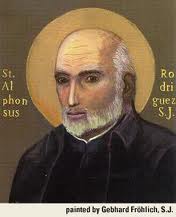
Feast of St. Alphonsus Rodriguez, S.J. (October 31)

St. Alphonsus Rodriguez, S.J.

St. Alphonsus Rodriguez, S.J.

Alphonsus Rodriguez was born in Segovia, Spain, on July 25, 1533. He was the second son of eleven children of a successful wool and cloth merchant and the family was financially comfortable. Alphonsus had contact with the first Jesuits at a young age. When Blessed Peter Faber (one of Pope Francis’ models)  came to Segovia to preach, Alphonsus’ family offered him the hospitality of their home and Faber prepared Alphonsus for his first communion.

When Alphonsus was 11 years old, his father sent him to the Jesuit college at Alcala but he never completed his studies due to his father’s sudden death. He helped his mother run the family business and eventually took over the business. At the age of 26 Alphonsus married Maria Suarez. They had three children together but a series of tragedies hit Alphonsus. In a brief period of time, his three children and his wife died. Around the same time, he was forced out of the clothing business due to heavy export taxes on wool products. Viewing himself as a failure and filled with internal anxiety and distress, he sought spiritual direction from the Jesuits.

He eventually developed a desire to enter religious life. He had met some of the first Jesuits to come to Spain, including but his age and lack of education was a major obstacle to his joining the Society. His extreme penitential practices had also undermined his health. Eventually, in January 1571, at the age of 37, he was accepted into the Jesuit novitiate as a brother.

After just six months he was assigned to the College of Montesion in Palma de Mallorca where he served as porter or doorkeeper until the end of his life 46 years later. Over this long period he exerted an extraordinary spiritual influence not only on his community but on the students and all those who came to the porter’s lodge for advice and direction.
He was already 72 when a young Jesuit, Peter Claver, came to the college, filled with a desire to do something for God but uncertain how to do so. The two became friends and often discussed prayer and the spiritual life. The elderly Brother mentor encouraged the student to go to the American missions. Peter would become famous as the apostle to the thousands of slaves brought over from Africa and who landed in Cartagena.

Alphonsus practised very severe penances and suffered sometimes from scruples. His obedience was total and at all times he was steeped in prayer. He left behind quite an amount of writing, some of it simply notes from spiritual talks given to the community. He had no intention of making them public and some were written in obedience to superiors.
He died on October 31, 1617 aged 84 at Palma, Mallorca and was declared Venerable in 1626. In 1633 he was chosen by the Council General of Majorca as one of the special patrons of the city and island.

In 1760 Pope Clement XIII decreed that “the virtues of the Venerable Alonso were proved to be of a heroic degree” but the expulsion of the Jesuits from Spain in 1773 and their suppression, delayed his beatification until 1825. He was canonised by Pope Leo XIII on September 6, 1887. His remains are enshrined at Majorca.

Alphonsus is remembered for his fidelity, kindness, spiritual struggles, and widespread influence as a counsellor to the students and others who sought his advice. He features in a poem by the Jesuit poet, Gerard Manley Hopkins, who recalled his outstanding holiness in a singularly unspectacular and humdrum life:

Yet God (that hews mountain and continent,
Earth, all, out; who, with trickling increment,
Veins violets and tall trees makes more and more)
Could crowd career with conquest while there went
Those years and years by of world without event
That in Majorca Alfonso watched the door.

Sources:

Living Space
Joseph N. Tylenda, S.J., “Jesuit Saints & Martyrs”
Wikipedia

Posted in Uncategorized | Tagged , , , , , , , , , , , | 3 Comments

Site Update: Teilhard de Chardin Resources

Things are fairly crazy at work and I have not been able to produce as much material for the blog as I would like. I am working on a number of items including a response to Dan Burke (currently at 3,000 words so I have some editing to do) and some book reviews. However, over the past few weeks I have been updating resources on Teilhard de Chardin, which you can find on the Teilhard de Chardin Resources tab and accompanying links.

Writings by Teilhard de Chardin.  Someone (avatar name is Badir) put a lot of effort in digitizing the primary works of Teilhard de Chardin and making them available for free through Community Books. It is an outstanding library that is downloadable in multiple electronic formats. It is a tremendous resource to the best of Teilhard de Chardin’s writings.

Writings About Teilhard de Chardin.  This contains a list of books about the writings of Teilhard de Chardin. I have included links to some of the books, will work on updating more when time permits.

Podcasts About Teilhard de Chardin.  I have recently added this feature. As of now, I have found three really good series of podcasts:

  • One podcast from Catholic Laboratory, which focuses on Teilhard de Chardin’s paleontology contributions.
  • One podcast from OnBeing with interviews by Ursula King, Teilhard de Chardin scholar and biographer; David Sloan Wilson, Professor of Biology and Anthropology; David Sloan Wilson; and Andrew Revkin, Senior Fellow for Environmental Understanding at Pace University.
  • A four podcast series with Bishop Christopher Coyne of Indianapolis and Father Mark Hunt of Holy Family University in Philadelphia on the life and theology of Teilhard de Chardin.

I am always looking for additional resources on Teilhard de Chardin so any and all contributions are welcome.

Posted in Uncategorized | Tagged , , , , , , , , , , , , , , , , | 7 Comments

Teilhard de Chardin Quote of the Week (October 28, 2013): Union with God

union

“Let man live at a distance from God, and the universe remains neutral or hostile to him. But let man believe in God, and immediately all around him the elements, even the irksome, of the inevitable organize themselves into a friendly whole, ordered to the ultimate success of life. For the believer everything is still, externally and individually, what it is for all the world; and yet God’s power solicitously adapts the whole to serve him. At every moment it in some way re-creates the universe expressly for the man who prays to it. ‘Credenti omnia convertuntur in bonum.’ “

Teilhard de Chardin, Pierre (2002-11-18). Christianity and Evolution (Harvest Book, Hb 276) (Kindle Locations 404-408). Houghton Mifflin Harcourt. Kindle Edition.

Posted in Teilhard Quote of the Week | Tagged , , , , | 2 Comments

Feast of Saints Simon and Jude (October 28)

Today is the Feast of Saints Simon and Jude, two of the twelve Apostles. These two are among the least well-known of the Apostles. Apart from their names in the Gospel, there is very little we know definitely about these two Apostles.

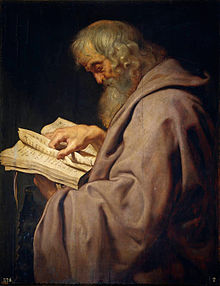
St. Simon the Zealot, Apostle

St. Simon the Zealot, Apostle

Simon is called either the Canaanite or the Zealot (Mt 10:4, Mk 3:18, Lk 6:15, Acts 1:13) by the evangelists. To distinguish him from Simon Peter, he is called Kananaios or Kananites (in Matthew and Mark) and Zelotes (in Luke and the Acts). Both titles come from the Hebrew qana, which means ‘the zealous one’ but some, like St Jerome, misread it as a reference to the town of Cana or to the region of Canaan. (This led to a story that at the wedding feast at Cana [John 2] Simon was the bridegroom!). The preferred reading in all the texts now is ‘Zealot’.‘Zealot’ may indicate membership of a strict Jewish sect. There was a party called Zealots famous in the war of the Jews against their Roman occupiers. They killed many of the nobility and filled the Temple with blood and brought ruin on their people.

After Pentecost, Simon, like several other Apostles, is not heard of again in the New Testament. However, there is an abundance of legends about his subsequent life and final martyrdom. So one eastern source gives Edessa in Mesopotamia as the place where he died but a western tradition (represented by the Roman Missal and the Martyrology) affirms that he first preached in Egypt. He then joined his fellow Apostle Jude, who was in Mesopotamia, and they both went east to Persia. Here they were martyred at Sufian (or at Siani). In one story their throats were cut and in another Simon was sawn in two, like the prophet Isaiah. This tradition only dates from the 6th century, 400 years after the Apostle’s death, but devotion to him goes back much further. There is even a tradition that Simon got as far as Britain, perhaps Glastonbury, and was martyred in Lincolnshire. In art Simon is usually symbolised with a boat or a falchion (an axe-like sword), allegedly the weapon by which heathen priests cut him down.

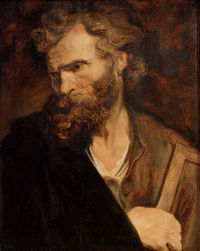
St. Jude the Apostle

St. Jude the Apostle

Jude, called “Judas, son of James”, is mentioned by Luke in his gospel (Lk 6:16) and in the Acts (Acts 1:13) and also in John 14:22 . He is commonly identified with Thaddaeus, who appears in the list of Apostles in Matthew and Mark, but where there is no mention of Jude. Some scholars believe he was a relative of Jesus. He is also believed to be the author of the Letter in the New Testament bearing his name. As with Simon, nothing certain is known of his life after Pentecost but again there are many legends. As mentioned, a Western tradition says that he joined up with Simon to preach the Gospel in Persia, where he, too, died a martyr’s death.

In more modern times, Jude has acquired the reputation as the ‘patron of hopeless cases’, as attested by expressions of gratitude in Catholic devotional periodicals. The origin of this devotion is said to be that no one would pray to him because his name was so like that of the traitor Judas Iscariot. Only people who had tried every other option would in desperation turn to him!

The relics of Simon and Jude are believed to have been brought to St. Peter’s in Rome in the 7th-8th century. Rheims and Toulouse also claim to have relics. In art Jude’s usual emblem is a club, the instrument of his death; otherwise he holds a ship, while Simon holds a fish. This is perhaps because, as a cousin of the Zebedee brothers, he was also a fisherman.

Sources:

Living Space
Catholic Culture
Wikipedia (St. Simon)
Wikipedia (St. Jude)

Posted in Uncategorized | Tagged , , , , , , , , | Leave a comment

When Prayer Becomes About Us

Additional thoughts on today’s readings.

Posted in Uncategorized | 3 Comments

Sunday Reflection; 30th Sunday in Ordinary Time: Humility in Prayer

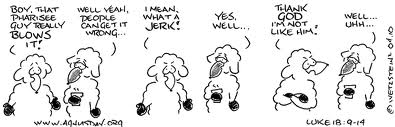
Whoever exalts himself will be humbled, and the one who humbles himself will be exalted.” — Luke 18:14

This week is the 30th Sunday in Ordinary Time. The weekly readings can be found here. The theme is humility in prayer (and in general). The Gospel reading contrasts the prayer of a Pharisee with the prayer of the tax collector, Jesus teaches his disciples to pray in humility before God. Jesus again surprises his listeners by showing the tax collector as the example of faith, rather than the Pharisee. As I have said before, humility is something that is challenging to me and I have some Pharisee in me.

Today’s reflection comes from the outstanding blog Whosoever Desires, a blog run by five young Jesuits. Other duties prevent them from posting very often but their lack of quantity is more than made up with their outstanding quality. The reflection is from a homily given by Aaron Pidel, SJ. You can read the fully homily here but set forth below is an extended excerpt:

Can we see the Pharisee in today’s Gospel as a ‘normal’ person with ‘normal’ attitudes?  And, as a result, can we see Christ’s disapproval of the Pharisee’s attitudes as an invitation to a discipleship that goes beyond conventional morality?  This, to my mind, is the imaginative challenge that our Gospel poses.  The problem is that our sensibilities in Christian Culture have been so long tutored by these and similar passages that the Pharisee now seems cartoonish.  We can hardly imagine consciously bragging, comparing, and condemning so openly.  So it’s easy to give ourselves a pass.

In order to help us approach the Pharisee sympathetically, then, I thought I might just share a few findings from mental health professionals on the self-perception of ‘normal’ adults who enjoy moderate to high self-esteem. According to a large body of research, ‘normal’ folks to tend to:

  • process and recall success better than failure;
  • attribute their successes to themselves but their failures to environmental factors;
  • evaluate their negative traits as trivial and their positive traits as significant;
  • see their faults as ‘common’ and strengths as ‘special’ and ‘distinctive’;
  • see negative traits as less descriptive of themselves than of the average person.
  • see negative traits as less descriptive of their family and friends than of the average person.

Logically, it stands to reason that the majority of people can’t be above average.  Hence, though the opposite was long believed, a large body of research now suggests that confident, cheerful persons are not those who are most grounded in reality, those who serenely accept with both their strengths and weaknesses.  Rather, they are those who develop an uncanny ability to filter data and twist reality in a self-promoting direction.

The same study does, by the way, identify a group of people who have more balanced self-appraisals.  They turn out to be the moderately depressed.

The connection to the Pharisees should by now be clear.  Whether they consciously admit it or not, most ‘normal’ people have an inner life that thrives off comparison and the unconscious belief that they’re better than other people.

And so the ‘normal’ or ‘pharisaical’ human condition of every age presents us with a dilemma.  Left to our own devices, we must choose either Truth or Life, either a grim honesty or a superficial happiness.  But we can’t have both.  Our frail sense of self-worth can’t long risk an unflinching gaze into the darkness and violence within our selves and within our world.  And even if we choose to look away, we know that our happiness remains precarious so long as it rests on illusions.  Pretty bleak, right?

But when we search our hearts, we know that there would be a solution to our dilemma: to come upon a light brighter than our darkness, a love stronger than our violence.  We know in small ways what it is to come into the presence of a person who loves before he or she judges.  We can instantly take off our masks and let down our defenses.  The whole nation of Israel nation knew what this was like.  Because she received an election unique among all the nations, she could afford to preserve the most unsparing and unromantic record of national follies known to history.

But love was not finally victorious until Christ, Christ who loved us first, Christ who loved us while we were still sinners.

And because Christ loved us while we were still sinners, the admission of sin is no longer crushing.  It is healing.  For if we believe that Christ’s love is stronger than our sins, then to explore the depth of our sinfulness is to explore the even greater depth of divine love.  And, to explore the depths of divine love is to better appreciate the darkness of sin—since our sins have been committed against so loving a Father.  And so the experience of sin and the experience of divine love grow together.  They are directly proportional, as the tax collector saw; not inversely proportion, as the Pharisee feared.

* * *

This is the awareness that the sacramental confession is meant to promote—though it is sadly underused.  This is the awareness that the Mass impresses upon us at the penitential rite.  This is the awareness that Jesus praises in the tax collector today: “O God, be merciful to me, a sinner.”  As we approach the Eucharistic table, then, where the bread and wine are transformed into the stuff of divinity, let us pray that God transform our sins as well—into occasions for savoring His mercy.

Full link to Aaron Pidel, SJ homily.

Posted in Sunday Reflections | Tagged , , , , , , , , , , , , , , , , , , | Leave a comment

Scientific Potpourri (Oct 25, 2013): Controversies in Evolution, Elements for Life on Europa and Better Sex With Your Spouse

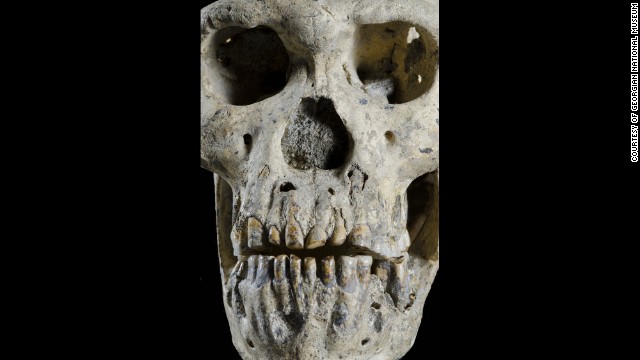
Skull of ancient hominoid; courtesy of CNN International

Skull of ancient hominoid; courtesy of CNN International

Rare Skulls Sparks Controversy Over Human Evolutionary Lineage. From CNN International: In the eastern European nation of Georgia, a group of researchers has excavated a 1.8 million-year-old skull of an ancient human relative, whose only name right now is Skull 5. They report their findings in the journal Science, and say it belongs to our genus, called Homo. The variation in physical features among the Dmanisi hominid specimens is comparable to the degree of diversity found in humans today, suggesting that they all belong to one species, Lordkipanidze said. But “if you will put separately all these five skulls and five jaws in different places, maybe people will call it as a different species,” he said. Now it gets more controversial: Lordkipanidze and colleagues also propose that these individuals are members of a single evolving Homo erectus species, examples of which have been found in Africa and Asia. The similarities between the new skull from Georgia and Homo erectus remains from Java, Indonesia, for example, may mean there was genetic “continuity across large geographic distances,” the study said. [Editor’s Note: This find highlights the challenges of trying to put together the human evolutionary tree with any degree of precision. We just do not currently have sufficient data to draw definitive conclusions and we likely never will. That does not make this science any less interesting. I am taking a Coursera class next year on “Human Evolution: Past and Future“.] which leads to:

No Known Hominin is Common Ancestor of Neanderthals and Modern Humans?  From Science Daily: The search for a common ancestor linking modern humans with the Neanderthals who lived in Europe thousands of years ago has been a compelling subject for research. But a new study suggests the quest isn’t nearly complete. The researchers, using quantitative methods focused on the shape of dental fossils, find that none of the usual suspects fits the expected profile of an ancestor of Neanderthals and modern humans. They also present evidence that the lines that led to Neanderthals and modern humans diverged nearly 1 million years ago, much earlier than studies based on molecular evidence have suggested.

Europa Contains Compounds That Led to Complex Life on Earth. From Daily Galaxy: Most scientists believe that the liquid seas are locked under tens of kilometers of ice on Jupiter’s moon Europa.  Europa might not only sustain, but foster life, according to the research of  University of Arizona’s Richard Greenberg, a professor of planetary sciences and member of the Imaging Team for NASA’s Galileo Jupiter-orbiter spacecraft. A recent study this past June led by NASA researchers shows that hydrogen peroxide is abundant across much of the surface of Jupiter’s moon Europa. The study concludes that if the peroxide present on the surface of Europa mixes into the ocean below, it could be an important energy supply for simple forms of life, if life were to exist there, in the same way that life exists in extreme habitats on Earth.

distant_galaxy

Astronomers Discover the Most Distant Known Galaxy. From Science Daily: University of California, Riverside astronomers Bahram Mobasher and Naveen Reddy are members of a team that has discovered the most distant galaxy ever found. The galaxy is seen as it was just 700 million years after the Big Bang, when the universe was only about 5 percent of its current age of 13.8 billion years.

ghost_cold

Ghostly Shape of Coldest Place in the Universe Revealed. From Science Daily: At a cosmologically crisp one degree Kelvin (minus 458 degrees Fahrenheit), the Boomerang Nebula is the coldest known object in the Universe — colder, in fact, than the faint afterglow of the Big Bang, which is the natural background temperature of space. Astronomers using the Atacama Large Millimeter/submillimeter Array (ALMA) telescope have taken a new look at this intriguing object to learn more about its frigid properties and determine its true shape, which has an eerily ghost-like appearance.

Discovery of Higgs Boson Results on Nobel Prize. From Reuters: Britain’s Peter Higgs and Francois Englert of Belgium won the Nobel Prize for physics on Tuesday for predicting the existence of the Higgs boson particle that explains how elementary matter attained the mass to form stars and planets. The insight has been hailed as one of the most important in the understanding of the cosmos. Without the Higgs mechanism all particles would travel at the speed of light and atoms would not exist. [Editors Note: I previously wrote about the comparisons between the Higgs Boson and the theology of Teilhard de Chardin, specifically The Divine Milieu.]

Focusing on Your Spouse Makes for Better Sex. From the Wall Street Journal (subscription required to view article): In 2007 a study from the University of Texas identified 237 expressed motives for sex. The reasons ranged from the mundane (stress reduction) to the spiritual (to get closer to God) and from the altruistic (to make the other person feel good) to the spiteful (to retaliate against a partner who cheated by cheating). Now, two studies by University of Toronto researchers published this month in the journal Personality and Social Psychology Bulletin, have divided the most common reasons why people have sex—and the ones most relevant to long-term relationships—into two broad categories of motivation: approach and avoidance. Approach motives pursue a positive outcome. (“I want to increase intimacy with my spouse” or “I want to feel closer to my partner.”) Avoidance motives aim to evade a negative outcome. (“I want to avoid conflict” or “I don’t want to feel guilty.”) Each category is also divided into subcategories: self-focused or partner-focused. The researchers paid particular attention to partner-focused goals. “They have the greatest impact on the outcomes of a relationship,” says Amy Muise, a postdoctoral fellow at the University of Toronto and lead researcher on the study. On days when a person’s motivation to have sex is more positively oriented, he or she felt more satisfied—both in the relationship and sexually—and had a higher level of desire. Conversely, on days when someone was motivated to have sex by more negative goals, he or she felt less satisfied and less desire. Even more interesting, the researchers say: A person’s sexual motivation affected his or her partner’s gratification. When someone had sex for positive reasons, the partner felt more desire and relationship satisfaction. When someone had sex for negative reasons, the partner felt less satisfied in the relationship and less sexually satisfied.

Posted in Uncategorized | Tagged , , , , , , , , , , , | 9 Comments