Loneliness, an illusion of the Ego

This is really good and it highlights some of the themes I have blogged about this week with the movie Gravity, Type A egos and companionship.

gigglinginthegutter's avatargigglinginthegutter

Loneliness. The first and fundamental pain, which stems from the loss of birth. We arise from a state of Being ” a pulse in the eternal mind, no less”; and being born we are bounded. The edge that defines each as individual also encloses and imprisons. The pain of our loss is the absence of connection to all that is. The struggle toward consciousness – the vital urge that drives evolution – is surely the need to re-connect. It is a mistake to equate consciousness with thought or the ego. Consciousness observes the mind and emotion. Consciousness springs from the space between Ich und Du. It is the force (be with us!) that de Chardin names as Love. It is Jung’s insight – the drive toward integration (of opposites).

Without separation and boundary there is no form; no possibility of self-awareness, of perspective. Indeed there is no internal and no…

View original post 139 more words

Posted in Uncategorized | Leave a comment

Ignatian Spirituality and Companionship

Venerable Mother Marie-Madeleine d'Houët, F.C.J.

Venerable Mother Marie-Madeleine d’Houët, F.C.J.

“It’s always said that the Jesuits were founded by Ignatius of Loyola, but I like the thought that the Jesuits were founded by a committee, not by one man. And it’s crucial because if the real mainspring of Jesuit spirituality is companionship, then our being together in a company is really right out of that reality, that we are together in a companionship.”

-Father Joseph Tetlow, S.J. (from Shared Vision: Jesuit Spirit in Education)

When I started this blog approximately six months ago I had no idea what to expect. To be honest, I really had no rational reason to do it, but I had this overriding urge to have an outlet for my thoughts. This is contrary to my normal way of doing things where everything has a reason and is planned out in excruciating detail. However, after some additional prayer, I decided to take the plunge into the evolving Noosphere of the internet and see what happened.

One of the interesting things that happened early in my journey was that I connected with others around the world who use Ignatian Spirituality as a cornerstone of their lives. One of the first blog to pick up one of my reflections was Keeping Company, an online initiative on behalf of the Faithful Companions of Jesus (FCJ Sisters) in Australia. I was not previously familiar with the FCJ Sisters but this connection (which never would have happened 20 years ago) provided me with the opportunity to learn more about the FCJ Sisters and their remarkable founder Venerable Marie Madeleine de Bonnault d’Houët.

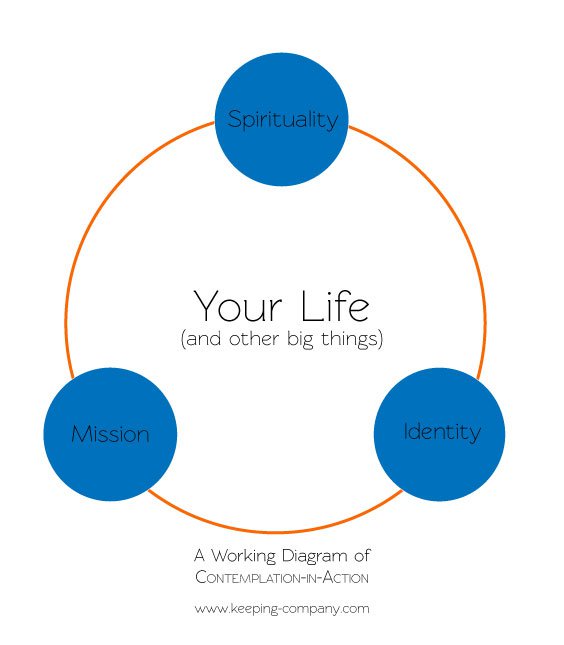
Ignatian spirituality is at the root of the FCJ way of life. Through discernment and reflection, Faithful Companions of Jesus seek to discover God’s invitation in all aspects of daily life, with the idea of being contemplative in action. ‘Contemplatives-in-action’ are those who carry out their lives from a place of depth and faith. Although the general concept of living mindfully and integrally is not exclusive to Christianity, the FCJs express this as followers of Christ, drawing as well, on the influences of Ignatian spirituality. It is not a spirituality that hides behind closed doors, but one that is expressed in all areas of life.

model

Over the next several months I had the pleasure of interacting with others of the Ignatian tradition, both the official Jesuit sites and individual lay people with a deep Ignatian outlook. This includes not only websites but those you have contributed to the comments section of the blog. I sincerely appreciate your insights.

Set forth below are links to some the virtual companions I have on my journey (in alphabetical order because that’s the way WordPress does it 🙂

[Edit: There many more companions on my journey than those listed below but for this post I arbitrarily limit it to those sites focused on Ignatian Spirituality]

What interesting Ignatian resources did I miss? Please let me know in the comments section.

Posted in Ignatian Spirituality | Tagged , , , , , , | 8 Comments

Ignatian Spirituality and the Type A Personality

IgnatianSpiritualityFindingGodInAllThings2

One of the great things about blogging over the last six months, is that I have had the pleasure of virtually “meeting” a lot of interesting people. One of the blogs I follow is Ancient Christian Wisdom, a site run by Fr. Alexis Trader. Fr. Alexis has an interesting background in faith and science. Fr. Alexis is a chemist who became an Orthodox Christian monk. Later, Fr. Alexis also obtained a Ph.D. in psychology and has published a book on the intersection of psychology and ancient Christian wisdom. You can find his full biography here. According to Fr. Alexis, the purpose of his blog is to:

“use both my scientific background and my faith for a common aim: to lead a healthy life for the mind, for the heart, and for the soul. For the purpose of the blog, I try to take what is the best that science can presently offer using the consensual criteria of science on the one hand, and then the sanctifying truth of Christian revelation as understood by those who have lived the faith wholeheartedly on the other.”

Fr. Alexis’ extensive training in chemistry and psychology as well as his vocation as an Orthodox Christian monk presents a fair amount of common ground with the purposes of this blog. As such, I was very interested when Fr. Alexis started a series on spirituality and the Type A personality. For me, the interest was more than an academic exercise as I am a hard-core Type A personality.

According to Wikipedia, the Type A personality is

” ambitious, rigidly organized, highly status conscious, can be sensitive, truthful, impatient, always try to help others, take on more than they can handle, want other people to get to the point, proactive, and obsessed with time management. People with Type <!–aA personalities are often high-achieving “workaholics” who multi-task, push themselves with deadlines, and hate both delays and ambivalence.–>

In his 1996 book, Type A Behavior: Its Diagnosis and Treatment,  Friedman suggests that Type A behavior is expressed in three major symptoms: free-floating hostility, which can be triggered by even minor incidents; time urgency and impatience, which causes irritation and exasperation usually described as being “short-fused”; and a competitive drive, which causes stress and an achievement-driven mentality.”

Yes, that describes me fairly accurately. Fr. Trader goes on to expand on this description with even less flattering terms:

“[T]hose who exhibit this type of behavior tend to have issues with time, people and events. . .  [T]hese persons view the passage of time, the presence of others, and the unexpected interruptions of occurrences as enemies and obstructions to personal fulfillment. In fact, time, people, and events are secondary to the fulfillment of personal goals, however small and ultimately trivial those goals may be. Time becomes “my time” and such persons might be overheard saying, “My time is precious, don’t waste my time.” People become a means to an end so that others are not appreciated for their intrinsic value as icons of the living God, but rather as “what can you do for me in order for me to accomplish my goals?” The logic is my goals determine your value in my mind. And even events, parsed into my events and not my events, are perceived as always within the scope of control of the individual who does not like surprises.”

Ouch! This makes me sound pathological. Looking to bolster my self-esteem and for a little support, I asked my wife to read the descriptions, knowing that she would come to my defense. Instead, she simply smiled a mischievous smile and nodded her head :-). Double ouch!!

It took more no more than a few seconds to realized that the diagnosis above is true in my case. Moreover, it helped put some of the events of the last five years of my life in perspective. For most of my 30’s, I was exhibiting the actions described by Fr. Alexis. I was outwardly successful in many areas (career, family, financial security) but my soul was paying a high price. I was focusing solely on myself and isolating myself from others (God was not even in the picture at the time). Not surprisingly, despite my apparent “success” I was becoming increasingly angry and unhappy.

It was during this period that I rediscovered Ignatian Spirituality. One of the themes of Ignatian Spirituality is that we can discern God’s will by deep self-reflection and prayer and by listening to our thoughts and feelings during prayer. Fr. Trader also emphasizes the need for self-reflection:

“A good starting point for those with (and without!) Type A behavior would be the Socratic “know thyself.” The ancient Christian writer, Clement of Alexandria, wrote, “We have received a mind, that we may know what we do. And the maxim ‘Know thyself’ means here to know for what we are born. And we are born to obey the commandments, if we choose to be willing to be saved” (Stromata, Book VI, chapter 3). Elsewhere he explains that “know thyself” means to know “in whose image you are fashioned; and what is your nature, and what is your creation, and what is your relation to God” (Stromata, Book V, chapter 4). This knowledge has a calming effect on the soul, for the soul knows that she can place her trust in a loving God Who arranges all things for her ultimate salvation. This knowledge further reveals that low self-esteem is not based on the bedrock truth of being created in the image and likeness of the Creator, but on the whisperings of the enemies of the human soul. This knowledge finally changes the way the soul looks at others, they become brothers and sisters also made in God’s image, also made for freedom, also made for paradise, and ends each of them in their own right.”

Fr. Trader, coming from the Orthodox tradition, does not mention Ignatian Spirituality, but the prescription of “knowing thyself” is a crucial component to a healthy spirituality and a healthy person. Ignatian Spirituality, especially the Examen and the annual retreats, has been instrumental in helping me better understand myself and refocusing my energies away from my selfish desires and towards God and others.

Further, I want to be clear that despite some of the negative stereotypes about Type A personalities I am very proud to be one because that is the way God made me 🙂 Moreover, I work around a lot of Type A personalities and I enjoy their energy and commitment to make things better. Many of the people who have made significant contributions to society and the Church have been Type A personalities (St. PaulSt. Ignatius of Loyola and St. Teresa of Ávila come to mind). Ignatian Spirituality was developed by a Type A personality (St. Ignatius of Loyola). The key for Type A personalities (or anyone) is to have a a healthy balance in the physical, emotional, spiritual and intellectual components of one’s life. For me, Ignatian Spirituality helps me to discern God’s will and find that balance.

What is your personality type? Are you a Type A personality? Do you live with or work with a Type A personality? What spiritual practices do you recommend to Type A personalities? Please let me know your thoughts in the comments section.

Set forth below are links to Fr. Alexis’ blogposts on the Type A personality:

Introduction: Type A Personality
An Initial Sketch of a Type A Behavior and a Needed Change in Perspective

Self-knowledge, Free Will, and Type A Personality
Hostility, Anger, and the Type A Personality
Materialism and the Type A Personality
Type A Behavior and the Need for Control
Bank Teller Lines, Type A Behavior, Self-Monitoring and Prayer
From Type A Personality to Christian Convictions: Inner Changes That Lead to Peace
Monitoring Self to Modify Type A Behavior
Type A Behavior and the Answers of Poets and Ascetics

Posted in Ignatian Spirituality | Tagged , , , , , , , , , , , , , , | 14 Comments

Theology of the Movie Gravity: Evolution, Death and Teilhard de Chardin

Alone and Isolated: The Christian Concept of Hell

Alone and Isolated: The Christian Concept of Hell

Note: Spoiler Alert below for the movie Gravity

Last weekend, I finally went to see the movie Gravity, one of the few times in the last ten years that I have seen a non-childrens’ movie in a theater. As I expressed earlier, I am largely ignorant of pop culture. I am glad I did as it was simply an outstanding movie, although I would highly recommend watching it in 3D for maximum effect. 

The fantastic blog Vox Nova provided an outstanding summary of the movie as well as some of its theological implications. My post is going to expand on Vox Nova’s discussion so I encourage you to read their post here. One big caveat: it is doubtful that the writer and director Alfonso Cuarón intended for the movie to have the theological themes set forth below. These interpretations are mine, although one does not have to reach too far to see them.

The protagonist of Gravity is Dr. Ryan Stone (played by Sandra Bullock). Stone is a mission specialist with minimal astronaut training who is on her first space shuttle mission. During her final spacewalk to service the Hubble Space Telescope, debris from a Russian missile strike on a defunct satellite has caused a chain reaction of destruction that hit Explorer. All of Explorer’s crew are dead, other than Stone and mission commander Matt Kowalski (played by George Clooney), who become untethered from Explorer and tumble through space. The rest of the movie is about Stone’s attempts to make it back to Earth but the real focus is on Stone’s spiritual life in the adversity of facing death and being alone and unconnected with God and others.

The interplay between the physical and the spiritual realms of reality are profound. As the Vox Nova review says:

Gravity tries to portray what it is like to be utterly lost, to be cast adrift in a great sea of nothingness, helpless and entirely alone. In that sense, it acts as a metaphor for the absence of God, especially in terms of what Christians call the second death. No vision of hell, not even Dante, can come close to matching this kind of terror. There is a reason for that. We believe that we are made for the Creator and drawn to the Creator. Floating through the darkness of space, completely untethered, conveys the ultimate absence of God and of meaning. No wonder it feels so terrifying.”

Indeed this imagery from Gravity echos the Catechism of the Catholic Church:

“This state of definitive self-exclusion from communion with God and the blessed is called ‘hell.’ . . . [H]ell is eternal separation from God, in whom alone man can possess the life and happiness for which he was created and for which he longs.”  — (CCC 1033, 1035)

The movie then traces Stone’s path from spiritual and physical isolation to reunion with God. On the physical plane, Stone is assisted by Kowalski who rescues her and brings her to International Space Station (ISS). The ISS is damaged and that the parachute from the rescue capsule has been accidentally deployed, rendering it useless for return to Earth. However, Kowalski suggests that the Soyuz capsule can still be used to travel to the nearby Chinese space station Tiangong to retrieve another module that can take them to Earth. Out of air and maneuvering power, the two try to grab onto the ISS as they fly by. At the last moment, Stone’s leg becomes entangled in the Soyuz’s parachute cords, but Kowalski realizes that his momentum will carry them both away; over Stone’s protests, he detaches himself from the tether so that Stone might survive, and the tension in the cords pulls her back towards the ISS. As Kowalski floats away, he radios additional instructions and encouragement to Stone.

Stone enters the ISS via an airlock and she maneuvers the capsule away from the ISS, the tangled parachute tethers prevent Soyuz from separating from the station until she spacewalks outside to release the cables (one of many symbols of Stone’s prior baggage that she needs to let go of). Stone aligns the Soyuz with Tiangong but discovers the craft’s thrusters have no fuel. Despairing, Stone begins decompression of the cabin in order to commit suicide by painless hypoxia. As she begins to lose consciousness, Stone has a hallucination of Kowalski (who is presumably already dead) appearing and telling her to use the Soyuz’s landing rockets to propel the capsule toward Tiangong. The image of Kowalski (either in Stone’s imagination or from the spiritual plane) gives Stone the strength to continue.

Stone enters the Shenzhou capsule and uses it to return to Earth. The capsule lands in a lake, but an electrical fire inside the capsule forces Stone to attempt an evacuation. As water rapidly fills the cabin, Stone attempts to escape. Here is where my artistic interpretation takes over: unlike the directors’ intent or most (but not all) viewers, I actually believe the story is better if Stone drowns in the space capsule in the lake.

Stone eventually emerges (symbolically in my interpretation) from the capsule and sinks to the bottom of the lake. She then sheds the baggage of her spacesuit and ascends towards the surface, accompanying by fish, reptiles and amphibians, which are obvious evolutionary references. The evolutionary imagery continues as she exits the water on all fours before standing upright and taking her first shaky steps onto a beautiful island, which is the symbolic heaven, which is the dimension of reality waiting on the other side of this existence.

Throughout the story, the references to evolution and Christian spirituality are striking. Stone starts off alone and completely isolated, physically and spirituality. To escape from her isolation, she needs help from others, specifically Kowalski, but also all of the other diverse people and cultures that have contributed to the ISS, Russian space station and Chinese space station. Moreover, along her journey, Stone needs to shed the baggage that has built up in her soul, which is represented by objects such as the parachutes that are caught and her spacesuit. On the spiritual plane, Stone needs to discover a relationship with a transcendent Being, which is represented by the Orthodox icon of Jesus in the Russian space station and the Buddha statue in the Chinese space station. Her life journey is complete (at least under my interpretation) when she accomplishes this task and then she passes through the portal of death into the next dimension of reality upon re-entry to Earth.

The arc of Stone’s evolutionary experiences from utter isolation and despair to rejoining the community of humanity to find a union with God are the archetype of the Christian experience. Humans are meant to shed the isolation of our individual egos and, with God’s grace, evolve towards greater unity. This was one of the great insights that Pierre Teilhard de Chardin had. As Pope Benedict XVI said, citing Teilhard de Chardin:

Faith sees in Jesus the man in whom—on the biological plane—the next evolutionary leap, as it were, has been accomplished; the man in whom the breakthrough out of the limited scope of humanity, out of its monadic enclosure, has occurred; the man in whom personalization and socialization no longer exclude each other but support each other; the man in whom perfect unity—“The body of Christ”, says St. Paul, and even more pointedly “You are all one in Christ Jesus” (Gal 3:28)—and perfect individuality are one; the man in whom humanity comes into contact with its future and in the highest extent itself becomes its future, because through him it makes contact with God himself, shares in him, and thus realizes its most intrinsic potential. From here onward faith in Christ will see the beginning of a movement in which dismembered humanity is gathered together more and more into the being of one single Adam, one single “body”—the man to come. It will see in him the movement to that future of man in which he is completely “socialized”, incorporated in one single being, but in such a way that the individual is not extinguished but brought completely to himself.

Ratzinger, Joseph Cardinal; Pope Benedict XVI; Benedict; J. R. Foster; Michael J. Miller (2010-06-04). Introduction To Christianity, 2nd Edition (Kindle Locations 2873-2881). Ignatius Press. Kindle Edition.

Ultimately, Stone’s journey is a journey that all of us are called to make. We are called to step out of our own isolation, our own ego, to enter into communion with God and others, and ultimately contribute to the evolving Noosphere.

Posted in Uncategorized | Tagged , , , , , , , , , , , | 7 Comments

Teilhard de Chardin Quote of the Week (October 21, 2013): Universe and Incarnation

creche


“[I]t appears contradictory (to the nature of participated being) to imagine God creating an isolated thing. Only one being can exist in isolation: Ens a se (Being which exists only in itself). Everything which is not God is essentially multitude—multitude organized in itself, and multitude organizing around itself. If God, then, is to make a soul, there is only one way open to his power: to create a world. In consequence, man includes among his fully realized conditions of possibility more than just ‘animality and rationality’; the notion of man implies also ‘mankind, earth, universe … This takes us a long way from the facile ‘possibility’ which the logicians imagine for things. But at the same time it adds to our stature—and, most of all, when applied to our Lord, it suggests the idea of an astonishing unity in creation. For now at last we can see that if God wished to have Christ incarnate, to launch a complete universe and scatter life with a lavish hand was no more than he was obliged to do. Strictly speaking, then, is there, in all that moves outside God, anything else in act today, other than the actualizing of Jesus Christ, for which each fragment of the world is, proximately or distantly, necessary (ex necessitate medii—as a necessary means)? We need have no hesitation in saying that there is not.”

Teilhard de Chardin, Pierre (2002-11-18). Christianity and Evolution (Harvest Book, Hb 276) (Kindle Locations 364-374). Houghton Mifflin Harcourt. Kindle Edition.

Posted in Teilhard Quote of the Week | Tagged , , , , , , , | 1 Comment

Stages of Cosmic Consciousness

terrishcj's avatarecospirituality resources

A cosmology is not just a theoretical enterprise, but a way also to gain our bearings in the inner world.  
Mary Conrow Coelho

More and more people are deepening their awareness of Teilhard de Chardin‘s insight:lead_teilharddechardin

In Teilhard’s estimation . . . it is in us, and as far as we yet know, only in us, that the Creation has become self-aware. Our eyes are the eyes through which the Earth finally beholds her own beauty, and, just as importantly, knows that she beholds it. Human beings are not above the Creation, but are themselves the Creation, that part of the Creation that is self- conscious.  John R. Mabry

I found that a hard saying when I first heard it (from Miriam MacGillis in 1979). It took me years to identify myself that way, steeped as I was in a cultural paradigm of separate, isolated components with…

View original post 949 more words

Posted in Uncategorized | 5 Comments

Sunday Reflection: 29th Sunday in Ordinary Time (October 20, 2013): Prayer and Persistence

persistence

This week is the 29th Sunday in Ordinary Time. You can find the readings here. The theme is persistence in prayer. Today’s reflection is from James Predmore, S.J. You can find the full reflection here, but set forth below is an extended summary:

“Each of the readings tell of persistence in prayer as a virtuous habit, but we have to know the difference between a virtue and hardheaded stubbornness. In Exodus, when Joshua is defending Israel from the attacks of Amalek, Aaron and Hur assist Moses in keeping his hands raised and the troops motivated. The raised hands become a symbol for victory because of God sees the persevering efforts of its spiritual leader. Paul in his letter to Timothy encourages all people to be faithful, whether convenient or not, to proclaim the word and to help others accept the invitations to gain salvation.

The Gospel presents a different portrait of persistence when we learn of a widow who petitions an unjust judge for a fair and correct decision against her adversary. We know little about the merits of the case, but we know the widow swayed the judge’s decision. For all we know she may have bullied him, but we presume that since she was a widow she was on the border line of subsistence and that an unjust ruling would have made her precariously vulnerable. We presume that she was able to get him to look at the unjust law and rule in her favor thus giving her a chance to live without worry. This is the type of advocacy we need against unjust laws and the people who are swayed by political pressures. We want to make it uncomfortable for those leaders who are actively working against helping others come to the right decisions for the common good. Relentless advocacy will make unjust influential leaders do the right thing for society and the individual.

We have to know the difference between a virtuous act and unhealthy boundaries. Two weeks ago, I sat in my office after saying Mass and had my two regularly scheduled morning meetings. When those meetings were over, I noticed I had fourteen phone calls from the same person. She later called six times and had a mutual friend call me three times. I texted her back three times and called her several times over the next few days to address her request, but apparently I did not give her the satisfaction at the time and manner she wanted it and she never returned my calls. This is not the type of persistence that Jesus praises, but it is the type of unhealthy behavior that tells us we must look at our dysfunction. This caller was not looking for a just decision, but was looking to control someone else’s behavior to satisfy her specific needs. If she approached the situation respectfully and for a laudatory goal, her persistence could have been rewarded. However, something else was going on with her and her problems had nothing to do with me. Such persistence only becomes unhealthy annoyances.

Prayer and silent listening will tell us if our desires are God- and other-centered. Jesus tells us that God will speedily provide justice for all those who call out to him day and night. God understands the plight of the poor and wants society to create policies that protects the fundamental rights of the most vulnerable. Therefore, we must bring hope to every situation where we find discouragement, whether it is in the political, legal, or cultural arenas. We must learn to be Christian activists who advance, not our own agendas, but those that represent God’s will for those whose zeal for life might be in danger of getting extinguished. Be patient. We will know it is God’s will if we watch the unfolding of grace before our eyes.

Persevere in small matters as a start. A friend told me the other day that he was going to start painting with watercolors until he saw my second painting. He reasoned that he would not be able paint like me so he wanted to give up, but we have to try. We cannot defeat ourselves until we give a sustained effort first. We do not know what will emerge until we try and we find out how we feel about the process. Everyone can succeed at painting. Everyone can exceed at something that is unique and particular to him or her. I was going to throw my painting in the trash until someone said that he really liked it and thought it should be framed.

The evil spirits run rampant in the world and they are looking for ways to defeat us. We can become our worst enemies if we listen to their words of downfall. These spirits always try to prevent a good person from becoming better – whether blatantly or through silky barely-detectable deceptions. A Christian must always remember that these forces are at work to challenge and defeat our good spirit and therefore we must use greater courage and energy to persist in our good efforts. After all, we are Christians and our Lord has decisively claimed victory over these spirits. We live in the freedom that the Holy Spirit affords us. Therefore our work, whether it activism or striving to actualize our potential, is blessed by God. Give yourself over to the good Spirit’s promptings because it will guide to you holy and life-giving places. Cultivate a habit of patient persistence in prayer and allow God to sanctify your desires.  Give God the freedom to extol your gifts in service to others and to invite others to salvation through you. Show the world that your perseverance, with God’s blessing, can bring a just victory to a world in search of balance and order.”

Ignatian Spirituality: Set the World Ablaze Homily

Posted in Sunday Reflections | Tagged , , , , , , , , , , , , , , | 1 Comment

Feast of St. Luke the Evangelist (October 18)

St. Luke

St. Luke

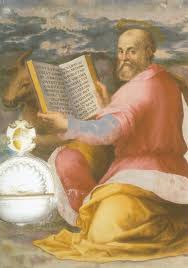
Practically all we know of Luke (and it is not very much) comes from the New Testament. We do not know the place or date of his birth. In Paul’s Letter to Philemon (v.24) Paul refers to “Luke, my fellow worker”. In the Letter to the Colossians (4:14) he speaks of Luke “our dear physician”, so it is taken that he was a medical practitioner of some kind. In the Second Letter to Timothy (4:11) Paul says, “I have no one here with me but Luke”. He seems to have been a close companion of Paul on some of his missionary journeys and on his final journey to Rome. This is based on the belief that the Acts of the Apostles was written by Luke and that in the Acts a number of passages use the word “we”, suggesting the writer was a companion of Paul (Acts 16:10-17; 20:5-15; 27:1-28:16).

As well as being the author of the Acts, Luke also taken to be the author of the gospel bearing his name. The two works are linked by his referring at the beginning of Acts to “the former treatise which I wrote” (Acts 1:1). Both books are dedicated to someone named Theophilus and no scholar seriously doubts that the same person wrote both works, even though neither work contains the name of its author.

A number of assertions about Luke are based on a document believed to date (in part) from the 2nd century:

Luke, a native of Antioch, by profession a physician. He had become a disciple of the apostles and later followed Paul until his [Paul’s] martyrdom. Having served the Lord continuously, unmarried and without children, filled with the Holy Spirit he died at the age of 84 years.

However, there is no way that these statements can be historically verified. There are legends that Luke was with Jesus as one of the 72 disciples or that he was one of the two disciples on the way to Emmaus on Easter Sunday, a story which, incidentally, only appears in Luke’s gospel. Based on the quality of the writings attributed to him, Luke is thought to have been well educated. The Letter of Paul to the Colossians (4:11) seems to include Luke among the non-circumcised companions of Paul and hence that he was a Gentile. In which case, Luke would seem to be the only non-Jewish author of New Testament books.

Luke’s gospel has many special characteristics which perhaps tell us something about the kind of person he was. Unique to him is the account of the circumstances leading to the conception and birth of Jesus (Luke 1-2); some of the most touching parables in the Gospel, such as that of the Good Samaritan and the Prodigal Son; the words of Jesus during his Passion to the women of Jerusalem and the so-called ‘Good Thief’. While presenting an all-or-nothing following of Jesus with an emphasis on radical simplicity of life, there is at the same time great emphasis on the compassionate nature of Jesus. He shows Jesus praying before every important phase of his public life and there is an openness to the Gentiles to whom the gospel is especially directed.  

Women figure more prominently in Luke’s gospel than in any of the others – the mother of Jesus, her cousin Elizabeth, the sisters Mary and Martha, the widow of Nain, and the striking story of the sinful woman in the house of Simon the Pharisee. In the Acts of the Apostles Luke is revealed as a very accurate observer, skilfully linking the sacred events with secular history. Many of his details have been confirmed by archaeology.

His writings have received high endorsements from secular scholars:

“Luke is a historian of the first rank; not merely are his statements of fact trusworthy…[he] should be placed along with the very greatest of historians.” (Sir William Ramsay, archaeologist)

“Luke is a consummate historian, to be ranked in his own right with the great writers of the Greeks.” (E.M. Blaiklock, Professor of Classics at Auckland University)

“In all, Luke names thirty-two countries, fifty-four cities and nine islands without a [factual or historical] error.” (Dr. Norman L. Geisler).

However, it should also be strongly emphasised that Luke did not write as a historian but as an evangelist, proclaiming the message of Jesus as the Word of God to the world. Some early Church documents say that Luke died in Thebes, the capital of Boeotia. There is a tradition that he was a painter and one well-known icon of the Virgin Mary has been attributed to him but with little claim to historical accuracy. Here is a link to icons of Mary that may have been painted by St. Luke (courtesy of Julie, an outstanding artist and friend of the blog).

It is understandable why Luke should be made the patron of artists and doctors. When represented with the other three evangelists his symbol is an ox, perhaps referring to the sacrifice in the Temple mentioned at the beginning of his gospel in the scene of Zechariah and the angel announcing the birth of John the Baptist. The earliest pictures of him show him writing his gospel but in later art works he is represented as painting the Virgin Mary. Both Constantinople (Istanbul) and Padua in Italy claim to have his relics.

St. Luke is the patron saint of artists, physicians, surgeons, students and butchers.

Sources:

Living Space
Catholic Encyclopedia
Wikipedia

Posted in Uncategorized | Tagged , , , , , , , , , | 2 Comments

Feast of St. Ignatius of Antioch (October 17)

St. Ignatius of Antioch and a lion

St. Ignatius of Antioch meets his final earthy fate

“It is not that I want merely to be called a Christian, but to actually be one. Yes, if I prove to be one, then I can have the name”. — St. Ignatius of Antioch

This is a great week for Saints of the Church as we have three outstanding saints, including an author of one of the Gospels (St. Luke on Friday), a great Spanish mystic and Doctor of the Church (St. Teresa of Avila on Tuesday) and a Church Father (St. Ignatius of Antioch, today). Ignatius was the third Bishop of Antioch, and was a student of St. John the Evangelist. En route to Rome, where according to Christian tradition he met his martyrdom by being fed to wild beasts, he wrote a series of letters which have been preserved as an example of very early Christian theology.

Ignatius is believed to have been born about the year 35 and to have come from Syria. Nothing is known of his early life and career except that he became the third Bishop of Antioch in Syria about the year 69 (only about 40 years after the death of Jesus). He is said to have become bishop after St. Peter and St. Evodius, who died about the year 67. Eusebius in his history of the Church records that Ignatius succeeded Evodius. Tradition also holds that St. Peter appointed Ignatius bishop.

What we do know about Ignatius begins with his final journey from Antioch to Rome, which he made as a prisoner condemned to death for being a Christian during the persecution of the Emperor Trajan. In a letter to the Christians at Rome he wrote: “From Syria even to Rome I fight with wild beasts, by land and sea, by night and by day, being bound amidst ten leopards, even a company of soldiers, who only grow worse when they are kindly treated.”

On this journey he wrote altogether seven letters, which give us important insights into the theology of the Churches in the period immediately following the Apostolic Church period. They speak of ecclesiology (the nature of the Church), the sacraments (which were still developing) and the role of the bishops (whose role was also being developed). Four of these letters were written at Smyrna, where he had been received with great honour by Polycarp and many other Christians. These letters were addressed to the church communities at Ephesus, Magnesia, Tralles, and Rome. At Troas he wrote the remaining three letters to Polycarp and to the church communities at Philadelphia and Smyrna.
The letters reveal and affirm strongly Ignatius’ devotion to Christ and his belief in the Divinity and Resurrection from the dead. They also urge unity in the communities in and through the celebration of the Eucharist and its chosen presider, the local bishop. Ignatius speaks of the Church at Rome as being founded by Peter and Paul and hence deserving of special reverence. He calls himself both a disciple and a ‘bearer of God’ (theophoros), so convinced was he of Christ’s presence in him and whom he longed to meet after his death.

In Rome he was sentenced to die in the Colosseum. The Roman authorities hoped to make an example of him and thus discourage Christianity from spreading. Instead, his journey to Rome gave him the opportunity to meet with and instruct Christians along the way through his letters to the local churches and to Polycarp.

Describing himself as the “wheat of Christ”, he was thrown to the lions in the Roman Colosseum and died almost at once. This happened between the years 107-110.
His letters, originally in Greek, were soon translated into Latin and other Eastern languages.

Along with Clement of Rome and Polycarp of Smyrna, Ignatius is one of the chief Apostolic Fathers, early Christian authors who reportedly knew the apostles personally.
He is also responsible for the first known use of the Greek word katholikos (καθολικός), meaning “universal”, to describe the Church.

His most famous saying is contained in the letter he wrote to the Church at Rome “I am writing to all the Churches and I enjoin all, that I am dying willingly for God’s sake, if only you do not prevent it. I beg you, do not do me an untimely kindness. Allow me to be eaten by the beasts, which are my way of reaching to God. I am God’s wheat, and I am to be ground by the teeth of wild beasts, so that I may become the pure bread of Christ”.

Sources:

Living Space
Wikipedia

Posted in Uncategorized | Tagged , , , , , , , , , , , , , | 6 Comments

Babylon and Western Culture

The ancient depiction of the Tower of Babylon

The ancient depiction of the Tower of Babylon

One of my favorite prayer sites is Sacred Space, run by the Irish Jesuits. Their daily prayers consist of a modified Examen of Ignatian Spirituality. Every week they have a reflection as you enter into prayer. A reflection from a couple of weeks ago was particularly interesting, in part because I am currently teaching the history of Israel in my 6th grade Catechism class and I am taking a Coursera course on the Fall and Rise of Jersualem with a focus on the Babylonian exile.  Set forth below is the reflection:

“Babylon

In the Christian scriptures, Babylon is a godless construction, which tries to reach to the skies and displace God.

Today the term can stand for a widespread culture that is seductive, glamorous, but unreal and unsatisfying. It is superficial and one-dimensional. It is black-and-white rather than abundant in color. Instead of fostering healthy imagination, it limits and pre-packages it. Thus, advertisements tell us what to eat and drink, what to do and what to wear. Babylon impoverishes us. It cuts us off from many enriching dimensions of human life. It imprisons the spark that is within us, the soul that is invisible, intelligent, free and immortal.

The churches are not safe from this culture. In the United States today there are 22 million ex-Catholics. Their over-riding reason for leaving their Church is that their spiritual needs were not being met. They were looking for sustaining spiritual nourishment but they felt that they were being fed on junk food. The task of the churches is to rediscover the riches of faith, for God has bigger hopes for us than Babylon could ever entertain. God offers us an undreamt-of gift, conveyed to us by his Son. We need divine food, because we are made for greatness. We live in an open-ended world where we can risk becoming who we really are, persons who can love without limits. We need then to cultivate our Christian imagination carefully.”

What are the items that replace God in our lives: Career success? Material possessions? Money? Needing to be right? Status? Sexual lust? Focusing on getting ahead at the expense of others? For me, it has been all of these items. I have been guilty of falling into the seductive materialism trap of modern Western civilization.

This week, I am praying for the graces of appreciating the beauty of the world while not falling prey to its nihilistic dark side.

Posted in Ignatian Spirituality | Tagged , , , , , , , , , , | 2 Comments