Jesuit Guy Consolmagno Wins Carl Sagan Medal from the American Astronomical Society


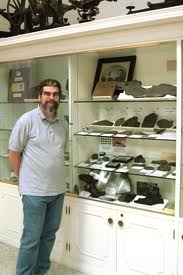
Brother Guy Consolmagno, S.J. at the intersection of faith and science

Brother Guy Consolmagno, S.J. at the intersection of faith and science

As readers know, I am a big fan of astronomer and Jesuit Guy Consolmagno.  I was delighted to learn that he won the prestigious Carl Sagan Medal from the American Astronomical Society this week.  Set forth below is an excerpt from the Jesuit website:

Because of his unique perspective as both a scientist and a man of faith, Jesuit Brother Guy Consolmagno has been awarded the Carl Sagan Medal from the American Astronomical Society (AAS).

 The Division for Planetary Sciences of the AAS, which gives the award to one individual each year, chose Br. Consolmagno because he “occupies a unique position within our profession as a credible spokesperson for scientific honesty within the context of religious belief.” The award is named after the late astronomer Carl Sagan, who was a popular author and writer of the 1980 television series “Cosmos.”

* * *

“As a Jesuit Brother, Guy has become the voice of the juxtaposition of planetary science and astronomy with Christian belief, a rational spokesperson who can convey exceptionally well how religion and science can co-exist for believers,” the AAS wrote.

Read Entire Article

You can find interviews with Guy Consolmagno, SJ below:

Intersection on Faith and Science
Vatican Astronomers Contemplate God and Science
Meeting Point of Science and Religion
Asteroids, Stars and the Love of God


Posted in Ignatian Spirituality, Reason and Faith | Tagged , , , , , , , , , | 1 Comment

Stacy Trasancos on God and the Mystery of the Big Bang

Big-Bang-e1404760424833

Earlier this week author and scientist Dr. Stacy Trasancos wrote an excellent article on how studying the unique properties that exist in our universe from the Big Bang to today can give insights into the mind of God.  I encourage you to read the entire article here but set forth below is an extended excerpt:

“In the first roughly one trillionth of a trillionth of a trillionth of a second after the universe’s birth, scientists are discovering a fine line between chaos and stability. Physicist and atheist Sean Carroll remarked that the mass of the latest discovered particle, the Higgs boson, turns out to be “right on the edge” in terms of the universe’s stability. Tia Ghose of Live Science described it, “A little bit lighter, and the Higgs field would be much more easily perturbed; a little heavier, and the current Higgs field would be incredibly stable.”

While it is inappropriate to extract theological meaning from incomplete scientific theories, it is insightful to note consistencies with Christian thought.

Obviously, the idea that the universe had a beginning is consistent with the first words of Genesis, and so is the idea of order and symmetry. St. John referred to Christ as the “Father’s only-begotten Son full of grace and truth,” using the Greek word monogenes to express “only begotten.” In ancient Greece monogenes referred to the eternally emanating cosmos. In Latin it translates as unigenitus, or universum. To Plato, the monogenes was the Unknown God, the universe itself. When John called Christ by the same words, it marked a radically different view of God and of the cosmos. The Unknown God was named the Christian God, a Trinitarian and Incarnational God. Christ, the Second Person of the Holy Trinity, the Son,became man. Christ, as God, created the universe. Christ, the Word, the Logos, is Rationality Itself.

Catholic physicist Peter Hodgson once wrote something similar to Carroll’s comment about the fine line between stability and chaos, but it was in reference to God and the overall order of the universe. “There is here a delicate balance between the rationality and the freedom of God.” To believe God set the world in motion and left it to run, leads to determinism. A God of unpredictable volition, gives us chaos. Both beliefs are inimical to the growth of science, and Christianity accepts neither.

In the context of Christianity, physical symmetry and fine-tuning give insight into the language of God who freely chose to create an ordered universe, but who interacts in human history and holds everything in existence by His will. That scientists, both atheist and Christian, search for such insight is evidence they trust such stability and symmetry exists. Is it any wonder that science was born in a Christian culture?”

Read Full Article

Posted in Reason and Faith | Tagged , , , , , , , , , , , , , , | 3 Comments

Religion News Service: Teilhard de Chardin as an Antidote to “feel-good” Faith


Note the Roman Collar

Pierre Teilhard de Chardin

A. James Rudin had a recent outstanding commentary titled “Insights of these 3 religious thinkers may be an antidoe to ‘feel-good’ faith”.  The three thinkers are Teilhard de Chardin, Martin Buber and Reinhold Niebuhr.  These three giants are perhaps more relevant today than they were during there lifetimes, influencing a wide range of world leaders including Pope Benedict (Teilhard de Chardin and Martin Buber) to President Obama (Niebuhr).


Martin Buber

Martin Buber

I encourage you to read the full article here but set forth below is an excerpt:

“When people utter the mantra “I’m moving on,” it usually means they are leaving behind a crisis, conflict or controversy. But “moving on” sometimes results in abandoning valuable lessons of the past.

This is especially true in religion. When spiritual leaders don’t deliver instant inner fulfillment, people quickly “move on” and embrace new teachers or gurus who promise their followers blessedness. It is a depressing and disillusioning process that creates holy burnout.

I have a modest proposal for those who constantly “move on” in their quest for authentic faith: “Move back” and explore the insights of three major religious thinkers whose once “radical” teachings are receding into the mists of forgetfulness.

During the mid-20th century, Martin Buber (Jewish), Pierre Teilhard de Chardin (Roman Catholic) and Reinhold Niebuhr (Protestant) influenced the religious scene. . .

Read Full Article


Reinhold Niebuhr

Reinhold Niebuhr

Posted in Uncategorized | Tagged , , , , , , , , , , , , , , , , | 4 Comments

Teilhard de Chardin Quote of the Week (July 14, 2014): Creation and Convergence

cosmic_christ

“The great cosmic attributes of Christ, those which (particularly in St John and St Paul) accord him a universal and final primacy over creation, these attributes… only assume their full dimension in the setting of an evolution… that is both spiritual and convergent.”

(Catholicism and Science, 1946, IX, 189) (courtesy of the American Teilhard Association)
Posted in Teilhard Quote of the Week | Tagged , , , , , , , , , | Leave a comment

Sunday Reflection, 15th Sunday in Ordinary Time (July 13, 2014): The Sower, Connection with Creation and Teilhard de Chardin


sower

“We know that all creation is groaning in labor pains even until now; and not only that, but we ourselves, who have the firstfruits of the Spirit, we also groan within ourselves as we wait for adoption, the redemption of our bodies.” — Romans 8:22-23

This Sunday is the 15th Sunday in Ordinary Time.  The readings can be found here.  The Gospel reading is the wonderful parable of the sower.  I can especially relate to this parable as I have (and continue to) fit each of the descriptions in my life.  While I strive to fit the description of the fertile soil where the seed takes root, way too often I fall short.

This week’s reflection comes from St. Mary of the Woods Parish in Chicago, IL USA. You can find the full reflection here but set forth below is an excerpt which focuses on the wonderful Second Reading from St. Paul (including an apt reference to Teilhard de Chardin):

“If we pay attention to St. Paul, we are the hopeful apocalypse for our time.

Christian faith stresses, not the technologies, but the persons who use them, making the connection between person and community. Our image of the future universe is not a thing or a process, but a person, Jesus Christ, the Risen One. Teilhard de Chardin tells us that “… it is in no way metaphorical to say that man finds himself capable of experiencing and discovering his God in the whole length, breadth and depth of the world in movement. (The Phenomenon of Man, P.297).”  In Jesus, our humanity connects with God’s Word and with the universe created through that Word.

St. Paul’s complaint is that we don’t recognize the unifying possibilities of our humanity nor the positive and practical effects we can have on the world we live in.  In Paul’s understanding, we are giving birth with the universe to a new and exciting world.  How can we claim boredom and apathy in this perplexing adventure of human life?

It seems that someone has fooled us into thinking that soul saving spirituality has to do with separation rather than solidarity. Only by straining do we see ourselves as connected, one to another, or to the world around us.  It seems that we, while we seek to leave our loneliness by connecting with others, history or life itself, we don’t quite know what to do with ourselves once we connect.  We end up scratching around to find more reason for separation than cooperation.

As Christians, we are not the celebrants of the scattered and chaotic.  We are rather a sacrament of humanity’s connection to the universe that is loved and the God who is love.  We say we believe in Christ who transforms our world; why not, then, act on our belief and, in our glorious diversity, celebrate being one?”

Read Full Reflection

Posted in Sunday Reflections | Tagged , , , , , , , , , , , , , , , , , | Leave a comment

Lessons on God from an Atheist

Meg Stapleton Smith's avatarDaily Theology

Leaves and Rain Getty Images, Ulf Borjesson

By Meg Stapleton Smith

The essence of my teaching has always had much less to do with concrete facts about faith, and much more to do with developing an interpersonal relationship with God. My goal as a teacher is to create a foundation upon which my students’ images of God can be nurtured. Throughout this process, I have undoubtedly come to learn immensely from my students. As their images of God matured, mine deepened as well. Yet, in the beginning of the school year, I never would have anticipated that the most meaningful lesson I would receive on God would come from the one student who doubted God’s very existence.

George is a student of mine that struggles with loneliness and depression. The trials and tribulations of his personal life have led him to constantly grapple with the very reality of God.  In the beginning of…

View original post 1,030 more words

Posted in Uncategorized | 1 Comment

Teilhard de Chardin Quote of the Week (June 23, 2014): Rejecting Divisions and Finding Unity


infinity


“[I]n order to match the new curve of time Christianity is led to discover the values of this world below the level of God (the creation of God), while Humanism finds room for a God above the level of this world. Inverse and complementary movements: or rather, the two faces of a single event which perhaps marks the beginning of a new era for Mankind.

THIS DOUBLE transformation is something more than a speculation of my own. Throughout the world at this moment, without distinction of country, class, calling or creed, men are appearing who have begun to reason, to act and to pray in terms of the limitless and organic dimensions of Space-Time. To the outside observer such men may still seem isolated. But they are aware of one another among themselves, they recognize each other whenever their paths cross. They know that tomorrow, rejecting old concepts, divisions and forms, the whole world will see what they see and think as they do.”

– Pierre Teilhard de Chardin, The Future of Man, pp. 88-89


Posted in Teilhard Quote of the Week | Tagged , , , , , , , , | 1 Comment

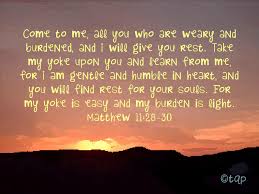
Sunday Reflection, 14th Sunday in Ordinary Time (July 6, 2014): The Peaceful Yoke of Christ

Yoke2

This weekend our readings return to Ordinary Time as it is the 14th Sunday in Ordinary Time. The readings can be found here.

The passage above from Matthew has been a source of great consolation for me in recent years.  My “reconversion” has involved a deep personal transformation spiritually and psychologically so that my old ways of living: focused on myself, getting ahead in my career and financial security have been transformed in a manner of living in Christ and in relationship with family and friends.  I still have a long way to go but I am experience the shedding of my old skin and being drawn into a deeper union with Christ.  There are times when I struggle with the demands that comes with this but the passage from Matthew helps put things in perspective.

This week’s reflection comes from Living Space and the Irish Jesuits. You can read the entire reflection here but set forth below is an extended excerpt:

“Whatever demands Jesus may make on our following of him, he wants to be at all times truly a source of comfort, of consolation and of forgiveness and reconciliation.  Whatever demands life may be making on us, he is there too to be called on.  When we are in difficulties and pain, we can ask him to take them away.  He may not always do so but we can expect him to restore our peace.  For we need to remember that Jesus is not to be seen as an escape from our problems.  Sometimes he will give us peace not from our pain but within our pain.  There can be the danger that we expect Jesus or his Mother or some other saint or the Church to be there to wave a magic wand that wipes away all our problems, all difficulties, all obstacles.

Jesus’ own life is an excellent example.  In the garden of Gethsemane, faced with imminent arrest, torture and execution, he did not want to have to go through it.  This is a perfectly normal human reaction to the threat of death.  Anything else would be very strange (yet one sometimes hears people speak as if Jesus actually wanted to go through all those terrible experiences).

Jesus begged his Father to spare him going through this appalling ordeal.  “Father, if it is possible, let this cup pass from me,” he prayed but then, at the end of his prayer, said: “Nevertheless, not as I will, but as you will.” (Matthew 26:39)  The Father was silent and his will was clear.  Jesus should face what is coming.  And, when sometime later, Jesus rises from his prayer, he is a very different person.  From that moment on and for the rest of his Passion experience he reveals nothing but quiet dignity and strength in the face of all kinds of abuse and humiliations.

He is full of an inner peace, which had come once he had said that total ‘Yes’ to his Father.  His prayer in the garden had been answered, although not in the way he originally requested.”

Read Entire Reflection

 

Posted in Sunday Reflections | Tagged , , , , , , , , , , , , | 1 Comment

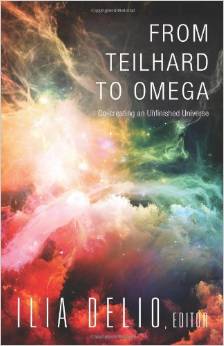
Book Review: From Teilhard to Omega

from_teilhard_omega

I was hoping to have a series of book reviews over the Northern Hemisphere summer. However, daily activities such as work, kids baseball games and family activities present precious little time for reading much less writing reviews.

One book at the top of (way too big) to-read list is From Teilhard to Omegaa compilation of essays edited by Sr. Ilia Delio, one of the world’s foremost Teilhard scholars.  As I have not yet read it, I was pleased to discover that the outstanding site of the British Jesuits, Thinking Faith, recently had a review of Sr. Delio’s book.  Set forth below is an excerpt:

In “From Teilhard to Omega”, the Franciscan theologian and scientist, Ilia Delio, has challenged thirteen experts on Pierre Teilhard de Chardin (1881-1955) to update for a new generation the writings of this French Jesuit and paleoanthropologist. Delio chose her experts carefully and so we are presented with a series of wonderful essays through which we can better understand Teilhard, but the real challenge of this book is to assimilate its words into one’s person and practice.

* * *

The collection as a whole expounds Teilhard’s conviction, one based on his science, that the world in which we live is not something static. It has been, is, and for as long as it exists will be, changing. God is committed to that change for, as creator, He imparted it, sustains the world in change, and in Christ is its goal. Given the reality of evolution, we too must be committed to finding God in the Christocentric future towards which we are inevitably moving.

* * *

So for those who last read Teilhard back when his writing first started coming into regular print, or for those who have heard of him but not read him, I thoroughly recommend this book. Be prepared to be challenged and changed by it. As it concludes (p.240), we are immersed in the adventure of evolution and as humanity are at ‘the growing tip of this evolutionary trend’. With the help of “From Teilhard to Omega’s” expert team we can (re-)discover the power of Christ’s love that will ‘lead us onward to a new reality.’

Read Entire Review Here

After reading the review, I am more excited to read the book.


Posted in Reason and Faith | Tagged , , , , , , , , , , , , , | 2 Comments

Pope Francis: Church Rejoices at the Progress of Science; Encourages Sharing of Knowledge


Science and Faith

Science and Faith

Last week, Pope Francis addressed professors and students at the Vatican Observatory (Thanks to Gaudete Theology for the reference). It is an excellent read on the symbiotic relationship between science and faith in their mutual pursuit of truth. You can read the entire speech here but set forth below is an extended excerpt:

The Vatican Observatory School in Astrophysics is thus a place where young people the world over can engage in dialogue and collaboration, helping one another in the search for truth, which in this case is concretized in the study of galaxies.  This simple and practical initiative shows how the sciences can be a fitting and effective means for promoting peace and justice.

Here too we see a further reason for the Church’s commitment to dialogue with the sciences on the basis of the light provided by faith: it is her conviction that faith is capable of both expanding and enriching the horizons of reason (cf. Evangelii Gaudium, 238).  In this dialogue, the Church rejoices in the marvelous progress of science, seeing it as a sign of the enormous God-given potential of the human mind (cf. ibid, 243), even as a mother rejoices and is rightly proud as her children grow “in wisdom, and age and grace” (Lk 2:52).

Finally, I would also encourage you to share with people in your own countries the knowledge about the universe which you have acquired.  Only a fraction of the global population has access to such knowledge, which opens the heart and the mind to the great questions which human beings have always asked:  Where do we come from?  Where are we going?  Does this universe made up of hundreds of millions of galaxies have any meaning? … The search for an answer to these questions can lead us to an encounter with the Creator, the loving Father, for “in him we live and move and have our being” (Acts 17:28).

Read Entire Speech

Posted in Reason and Faith | Tagged , , , , , , , , , , , , , | 6 Comments