
Poems From Prison: Elements of Love

element_love

I recently became part of a prison ministry group in my local community.  I am still confused as why I was drawn, or called to, this ministry as it is far outside my comfort zone.  I am introverted by nature so I am not a natural person with strangers and my skills as a corporate attorney do not naturally lend themselves to helping those in prison as I am not qualified to provide legal assistance.  Nevertheless, I had been dabbling around the edges for a couple of years before I had a very interesting meeting.

A few months ago, I was coming back from a breakfast meeting and saw a person in the lobby of our building.  This person, we will call him “John”, asked me what time the bank opened and we struck up a conversation.  It was a natural conversation as John is outgoing and charismatic.  Eventually we got around to professions and he said that he worked with our local Urban Ministry program who works with persons who are transitioning from prison to the world outside prison.  We agreed to meet for coffee in a couple of days.

We met for coffee and had another fascinating conversation.  I learned that John had a troubled youth and fell in with the wrong crowd.  Not surprisingly, given his intelligence and personality, John rose to leadership of a drug syndicate in Chicago and eventually got caught and did hard time in prison.  Although John did not then have formal education beyond high school, he used his prison time to educate himself by reading and studying college and graduate level material.  During this time, John also did a lot of soul searching about purpose and the meaning of life.  The end result is John is an exceptionally interesting and well-rounded person with more depth than most of the people I am around (despite many of them having advanced degrees).  I enjoy John’s company because we can easily switch from talking about Plato to the practical aspects of what it means to be a father raising boys in today’s society.

During his time in prison, John composed some wonderfully rich poems and other writings that he shared with me.  Periodically, I will post some of John’s writings to give a flavor of the richness of his writings and the depth of his character.

John wrote the poem below “Elements of Love” in 2002.

“Elements of Love”

Patience-is a gift painted with skill,
With so many beautiful colors,
Softly kissed with a golden seal,

Friendship-is most definitely the cornerstone,
It’s like a work in progress,
Always setting the tone,

Trust-in itself is revered and pristine,
Often times we earn it,
If you don’t believe me, ask “Neen”

Honesty-is said to be our north star,
Shining ever so brightly,
While reaching down on us from afar,

Loyalty-is the benchmark of something great,
Firmly standing in its place,
Proudly showing its character trait,

Fear-is a natural substance of love,
You need not be afraid of it,
Just treat it with kid gloves,

Faith-is what we’re taught to believe,
Proven to be tried and true,
Constantly helping us to achieve,

These very special gifts from God above,
Gliding so heavenly like the dove,
With these wonderful “Elements of Love”

— Composed by “John”, December 2002

Posted in Poems From Prison | Tagged , | 2 Comments

A Here and Now Kingdom

kingdom_now

Part of my prayer life involves doing a modified Examen and Ignatian Lectio Divina in the evening under the structure set forth by the Irish Jesuit website Sacred Space.  One of the features of Sacred Space is a weekly reflection to think about and pray during the week.  This week’s topic struck a chord with me as it speaks about the immediacy of the Kingdom of God.  Below is the “Something to think and pray about this week” reflection from Sacred Space in its entirety:

A Here and Now Kingdom

What does Jesus mean when he states that his kingdom ‘is not of this world’ (John 18:36)? Does he mean that his kingdom belongs to another world, so that we can ignore it for now? No! He means rather that his project for our world comes from God, not from human beings. And when Matthew uses the term ‘Kingdom of Heaven’ is he referring to a kingdom distant from ours? No! He is respecting Jewish sensitivity about God’s holy name, but he tells us clearly that the kingdom is at hand.


Jesus ushers in a new world order in which divine values prevail right now. He tells us to pray that God’s will be done here on earth, in the present time. This is our task. God will look after the heaven of the future.

We think of Mary as mild: we would not expect to find her in a protest march! But her Magnificat is an impassioned comment about what God is doing right before our eyes. ‘He has scattered the proud. He has brought down the powerful, and lifted up the lowly; he has filled the hungry, and sent the rich away empty’ (Luke 1:46-55). She sees the kingdom already being made visible in human history.

Mary’s spirituality is contemporary, outward-looking, other-centred. It focuses on serving those around us in justice and love. Her concern is to be in tune with the divine project in the here and now. This concern is to be ours also.

Posted in Uncategorized | Tagged , | Leave a comment

Teilhard de Chardin Quote of the Week (June 3): Pervasiveness of God

godfuture

“God is as pervasive and perceptible as the atmosphere in which we are bathed.  He encompasses us on all sides, like the world itself”

— Pierre Teilhard de Chardin, The Divine Milieu

Posted in Teilhard Quote of the Week | Tagged | Leave a comment

Sunday Reflection: Corpus Christi (Transubstantiation of the World)

corpus_christi

cosmic_corpus_christi

—————————————-

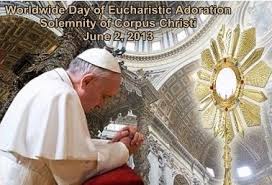
This Sunday is the Solemnity of the Most Holy Body and Blood of Christ, also known as Corpus Christi.  For Catholics, the Eucharist is the focal point of our Liturgy and our prayer life so today is a very special day as we celebrate the Unity of the Church and all of humanity.  Today’s reflection is from a homily given in 2012 by Fr. Frank Schuster, Pastor of Blessed Teresa of Calcutta Parish in Woodinville, Washington.

Fr. Schuster does a wonderful job of teaching the importance of the Eucharist, going back to the Baltimore Catechism and the sacramental life of the Church.  Fr. Schuster then weaves the exceptionally high Christology of Teilhard de Chardin into the real presence of the Eucharist.  The full homily can be found here, but below is an extended excerpt:

There is only one Mass celebrated throughout the world throughout space and time. When we receive the Body and Blood of Christ, and if Mom is correct when she says, we are what we eat, when we leave the church after Mass, we should become Christ to the world. We are to be Eucharistic ambassadors, participating in what Jesuit theologian Teilhard de Chardin called the Transubstantiation of the World. Transubstantiation is the word we use to describe how the bread and wine become the body and blood of Christ without destroying the appearance of bread and wine in the process. When Teilhard refers to the transubstantiation of the world, he speaks of the transformation of the entire world into the body of Christ if we live out our Eucharistic calling.

I want to conclude this homily with a paraphrased excerpt and prayer from Teilhard de Chardin’s work entitled The Divine Milieu. Theilhard writes, “When the priest says the words hoc est Corpus meum, [this is my body], his words fall directly on to the bread and directly transforms it into the individual reality of Christ. But the great sacramental operation does not cease at that local and momentary event…[Indeed], a single event has been developing in the world: the incarnation, realized, in each individual, through the Eucharist. All the communions of a life-time are one communion. All the communions of all human beings now living are one communion.

All the communions of all human beings, present, past and future are one communion…As our humanity assimilates the material world, and as the Host assimilates our humanity, the Eucharistic transformation goes beyond and completes the transubstantiation of the bread on the altar. Step by step it irresistibly invades the universe. It is a fire that sweeps over the hearth; the stroke that vibrates through the bronze…”

Teilhard therefore prays…”Grant, O God, that when I draw near to the altar for communion, I will … discern the infinite perspectives hidden beneath the smallness and nearness of the Host in which you are concealed. I have already accustomed myself to seeing, beneath the stillness of that piece of bread, a devouring power, which, in the words of the greatest doctors of your Church, far from being consumed by me, [the Eucharist] consumes me.”

Posted in Sunday Reflections | Tagged , , | 3 Comments

New Cosmology: Eulogy for Thomas Berry (June 1)

thomas-berry-3

Today is the four year anniversary of the death of Thomas Berry.  Fr. Berry was a was a Catholic priest of the Passionist order, cultural historian and ecotheologian.  I first came across Fr. Berry’s writings when I found the American Teilhard Association, of which Fr. Berry led it to where it is today.

In honor of the memory of Fr. Berry, attached is an excerpt from his eulogy from his Passionist Community:

“In the beginning, the story of Genesis says. In my own life as a Passionist, I especially remember two things that date all the way back to 1951. (I won’t tell you how old I was.) Fr. Coleman Haggerty was teaching us about evolution. This was so far back I don’t know whether he was for it or against it, but for some reason he made a point of the Greek translation of that phrase: “in the beginning” . . . en arche (ἐν ἀρχῇ). He noted that these were the same words with which St. John’s Gospel begins . . . because linking the two texts suggests a cosmic dimension of Christ.

* * * 

But Thomas gave us a challenge in what he called the Third Mediation of the Divine. Succeeding the Christian mediation found in sisterly and brotherly love, but not dispensing with it, the Third Mediation of the Divine is discovered in the numinous universe. He said: “The basic mood of the future might well be one of confidence in the continuing revelation that takes place in and through Earth. . . . Sensitized to such guidance from the very structure and functioning of the universe, we can have confidence in the future that awaits the human venture.”

You can find the full eulogy here.

Posted in Uncategorized | Tagged | 2 Comments

Empty Your Cup, and Become What You Receive

cup_zen

I will post the regular Sunday reflection tomorrow afternoon but one of my favorite Deacons, David Backes, is preaching this weekend and he was kind enough to share his homily online.  His homily is a wonderful story of how a young Jesuit novice opens himself up to others (in this case, youth who are perceived as outcasts of society) and in doing so, both the Jesuit and the youths are changed.  As part of the homily, Deacon Backes includes a wonderful zen parable that highlights the need to open up to others:

A university professor went to a Zen master to learn about Zen. The master served tea, and when he had filled the professor’s cup he kept pouring. Finally the professor cried out, “Stop pouring! The cup is full!” The Zen master replied, “Like this cup, you are full of your own opinions and speculations. How can I show you Zen unless you first empty your cup?”

I encourage you to read the full homily here.

Posted in Uncategorized | Tagged , , | Leave a comment

Why Bad Science Is Like Bad Religion

bad_science

A couple of weeks ago, I did a blogpost on a recent article by Sean Carroll that highlights the tendency of many well-respected scientists to engage in a logical sleight of hand I call scientific, materialistic, reductionalism.  This post generated a lot of feedback from blog comments, e-mail, Twitter and Facebook feedback.  I thought it would be useful to have a follow up post discussing the intersection of science and philosophy and the dangers of scientists doing philosophy while claiming to be doing science.

Catholic theology teaches that there are two realms of reality, the material and the spiritual.  The material deals with our bodies and the physical universe we live in.  The spiritual realm deals with everything else, and includes, our relationship with God, the intangible bonds with others, love, art, poetry, consciousness, etc.  Both of these realms are integral to living a complete life.  If you attempt to separate the two realms, you are less than a complete person.  For example, persons who deny the material realm in the belief that the spiritual is the only legitimate component of existence are broadly classified gnostics.  Persons who deny the spiritual realm in the belief that the material universe is the only component of existence are classified as materialists.

Science plays a crucial role in understanding the material universe that we live in, which is a significant component of reality.  Hence, science is naturally complementary to Catholic and mainstream Protestant Christianity as good science helps to understand the Creator.  However, the danger becomes when science is used as a tool to make ontological claims that there is no reality beyond the material world.  That statement is a philosophical statement that science, which is the subject to verifying or falsifying statements about the material world.  Too many scientists (e.g. Dawkins, Hitchens) are blurring these lines and creating a materialistic fundamentalism that has as chilling effect on our culture as religious fundamentalists do.

Last December, Dr. Rupert Sheldrake had a great article in the Huffington Post which summarizes this new form of materialistic fundamentalism that is prevalent is science: 

“Bad religion is arrogant, self-righteous, dogmatic and intolerant. And so is bad science. But unlike religious fundamentalists, scientific fundamentalists do not realize that their opinions are based on faith. They think they know the truth. They believe that science has already solved the fundamental questions. The details still need working out, but in principle the answers are known.

Science at its best is an open-minded method of inquiry, not a belief system. But the “scientific worldview,” based on the materialist philosophy, is enormously prestigious because science has been so successful. Its achievements touch all our lives through technologies like computers, jet planes, cell phones, the Internet and modern medicine. Our intellectual world has been transformed through an immense expansion of scientific knowledge, down into the most microscopic particles of matter and out into the vastness of space, with hundreds of billions of galaxies in an ever-expanding universe.

Science has been successful because it has been open to new discoveries. By contrast, committed materialists have made science into a kind of religion. They believe that there is no reality but material or physical reality. Consciousness is a by-product of the physical activity of the brain. Matter is unconscious. Nature is mechanical. Evolution is purposeless. God exists only as an idea in human minds, and hence in human heads.

These materialist beliefs are often taken for granted by scientists, not because they have thought about them critically, but because they haven’t. To deviate from them is heresy, and heresy harms careers.”

Posted in Uncategorized | Tagged , , | 1 Comment

Orthdoxy of Teilhard de Chardin (Part VI) (Henri De Lubac)

Cardinal De Lubac

Cardinal De Lubac

“We need not concern ourselves with a number of detractors of Teilhard, in whom emotion has blunted intelligence”.  Cardinal Henri Cardinal de Lubac, S.J.  – The Religion of Teilhard de Chardin

This is part of a continuing series that will hopefully put to rest any questions that the vision of Teilhard de Chardin is not a part of mainstream Catholic, Christian theology.  In Part I through Part V (you can see a summary and links to these parts at the end of this blogpost) of our series on the orthodoxy of Teilhard de Chardin, we discussed how Teilhard’s ideas have been incorporated into mainstream theology using the writings of Pope Emeritus Benedict XVI.

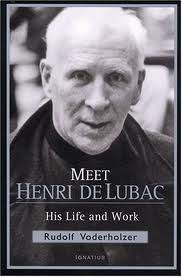
Today, I was hoping to start a series on the thoughts of one of the most respected theologians of the last 50 years, Cardinal Henri de Lubac, SJ.  Cardinal de Lubac was a theological expert to the Second Vatican Council and a prolific writer on numerous topics including the Church, Christ and engagement with the world.  According to Ignatius Insight, Blessed John Paul II, who had the highest esteem for de Lubac, once stopped his address during a major talk when he noticed de Lubac and acknowleged the presence of de Lubac saying, “I bow my head to Father Henri de Lubac.”

Cardinal de Lubac published several books on the writings of Teilhard de Chardin and put Teilhard’s vision in more traditional theological language.  I was hoping to have a systemic discussion of de Lubac’s synthesis of Teilhard, primarily based on a review of de Lubac’s book “The Religion of Teilhard de Chardin“.  Unfortunately, I ordered the book late and have been super busy at work and home and have not had the chance to review the book.  Hence, the more detailed analysis will be put off to the future.  Instead, I will share the briefest summary of Teilhard through the eyes of Cardinal de Lubac.  The following excerpt is from the fantastic book by Hans Urs von Balthasar, “The Theology of Henri de Lubac“:

“Teilhard’s work nevertheless provides an occasion to develop more intensively a whole dimension – the cosmic dimension of Catholicism – in de Lubac’s thought.  Teilhard is a visionary; he is a scientist; but not least is he a great and conscious apologist who was concerned, as was de Lubac, to reflect upon creation on as noble a scale as possible – and thus upon the Creator.  His ambition was to propose a ‘mysticism of the West’ as an alternative to the apersonal-atheistic mysticism of the East and to modern Western atheism.  A mysticism that would be personal down to its very roots.  The incarnation of God in Jesus Christ occupies the central position in the world.  Both the inner-historical and the eschatological nature of this position let the entire world genesis converge upon Christ, in an ascending movement from matter to life to personal spirit. In the genesis of spirit the movement is at the same time realization (of what was potential). ‘Christ is more real than every other reality in the world‘ says Teilhard. . .

God’s plan of creation completes the edifice that has been begun by Christ, who is the keystone and who integrates into his mystical or eucharistic body all persons (who let themselves be inserted into his universal person). The world is ‘thus held together ultimately only from above.’ Evolution, as coherent, only becomes possible through what comes last, the omega of evolution. It is the final synthesis that explains everything, and Teilhard attempts to build up his ‘proof of God’ by starting here . . . The entire universe attains its real, substantial footing ultimately only in the person of the God-man.” (emphasis added).

_________________________________________

Summary of Orthodoxy of Teilhard de Chardin series:

In Part I, we described how Pope Emeritus Benedict held Teilhard’s theological vision of Christ as a central feature of the Christian liturgical and Eucharistic experience

In Part II, Pope Emeritus Benedict discussed statements made by St. Paul and Teilhard of the cosmos being a living host.

In Part III, we started to discuss the concept of the role of the Cosmic Christ (the pre-existent logos who is the second person of the Trinity) in the creation of the cosmos.

In Part IV, we continued the discussion of the ontological evolution of humanity, we discussed how Pope Emeritus Benedict discussed the evolution of humanity from mere matter to spiritual consciousness.

In Part V, we continued Pope Emeritus Benedict’s discussion on the evolution of humanity in the Christian context towards the Omega Point, or the Cosmic Christ.

Posted in Orthodoxy of Teilhard de Chardin | Tagged , | 2 Comments

Following Christ in a Consumer Society: The Way Out of the Cultural Cul de Sac

consumer

The Gospels for the daily mass the last two days (Mk: 10:17-31) have been particularly hard for those of us living in advanced Western society, especially the U.S.:

“How hard it is for those who have wealth to enter the Kingdom of God!” The disciples were amazed at his words. So Jesus again said to them in reply, “Children, how hard it is to enter the Kingdom of God! It is easier for a camel to pass through the eye of a needle than for one who is rich to enter the Kingdom of God.” 

This message is not to condemn wealth, which is inherently neither good nor bad.  The message is to condemn a disordered attachment to wealth or material possessions which prevent us from a closer union with God.  This message of detachment from material possessions is a strong counter-cultural message in the United States, where the overwhelming message from mainstream media, advertising and culture that the acquisition of material items will increase our happiness.  This message was so pervasive that, despite growing up as a cradle Catholic, I was never fully exposed in an intellectual level to the Gospel counter-message until I read the late Fr. John F. Kavanaugh’s “Following Christ in a Consumer Society” during my undergraduate years.

Unfortunately, despite this exposure and the broader exposure to a tremendous Jesuit education, I bought into the libertarian consumer culture, with an Ayn Rand intellectual justification.  I blithely followed this individualistic path and had some superficial economic and status success.  The problem was that I found increasing angst as I tried to keep up with the cultural treadmill of “keeping up”.  Despite achieving most of my career and economic goals, I was increasingly unhappy.  This disconnect between how I “should” feel according to society and how I actually felt cause me to question more core beliefs and ultimately led to my “reconversion” to Christianity.  Later, I came to realize that this gap was the longing for God as expressed so eloquently by St. Augustine.

Following up on the Gospel readings of the last two days, the Irish Jesuit prayer site, Living Space, eloquently hits on the disconnect between the Gospel message and consumer culture, and the inner angst that I felt.

“This is a reality which, unfortunately, has not been realized among many Christians who live their daily lives in the rat race for acquisition characteristic of our modern capitalist societies and who believe that what they cannot get by their own efforts they will never come to enjoy.

* * * 

by and large, we have to a great extent failed to realize that Christianity is not meant to be a religion where individuals, rich and poor, live individualistic lives and carry out certain ‘religious’ acts to “save their own souls” but that it essentially consists of creating a whole new way by which people relate to each other in mutual love and care.”

I am still tempted by the consumer culture and I try to live the Ignatian way of being an active contemplative in the world, still having the same career that I had when I left school.  However, my mindset is entirely different; I am not doing it for my personal ambition or success, I am trying to be an agent for God in the world.  I often fail in my thoughts and my actions.  However, I try to bring myself back to God and the sense of radical detachment for material items by praying the beautiful Suscipe prayer of St. Ignatius:

Take, Lord, and receive all my liberty, my memory, my understanding, and my entire will, All I have and call my own. 

You have given all to me. To you, Lord, I return it.
Everything is yours; do with it what you will. Give me only your love and your grace, that is enough for me.
Posted in Uncategorized | Tagged , , , | 6 Comments

Orthodoxy of Teilhard de Chardin: (Part V) (Resurrection, Evolution and the Omega Point)

omega

In Part I of our series on the orthodoxy of Teilhard de Chardin, we described how Pope Emeritus Benedict held Teilhard’s theological vision of Christ as a central feature of the Christian liturgical and Eucharistic experience

In Part II of our series, we discussed Pope Emeritus Benedict’s approval of statements made by St. Paul and Teilhard of the cosmos being a living host.

In Part III, we started to discuss the concept of the role of the Cosmic Christ (the pre-existent logos who is the second person of the Trinity) in the creation of the cosmos.

In Part IV, we continued the discussion of the ontological evolution of humanity, we discussed how Pope Emeritus Benedict discussed the evolution of humanity from mere matter to spiritual consciousness.  Today, we will continue Pope Emeritus Benedict’s discussion on the evolution of humanity in the Christian context.  Specifically, the pre-existent Logos, (a/k/a Christ, Omega Point) became incarnate in Jesus of Nazareth.  This incarnation of Christ, when combined with his death and resurrection, represented an evolutionary leap in humanity towards the Divine.

Today, we conclude Pope Emeritus Benedict’s discussion of Teilhard’s ideas of the evolution of humanity towards the Omega Point, or the Christ.  Foreshadowing his future papal encyclical, Deus Caritas Est, Joseph Ratzinger takes up the Johannine and Pauline concept of God as love.  God, represented by the Omega Point of Teilhard’s terminology is continuing to draw humanity and all of creation towards him in an evolutionary spiritual ascension.  In the words of Pope Emeritus Benedict:

“Only where someone values love more highly than life, that is, only where someone is ready to put life second to love, for the sake of love, can love be stronger and more than death. If it is to be more than death, it must first be more than mere life. But if it could be this, not just in intention but in reality, then that would mean at the same time that the power of love had risen superior to the power of the merely biological and taken it into its service. To use Teilhard de Chardin’s terminology, where that took place, the decisive complexity or “complexification” would have occurred; bios, too, would be encompassed by and incorporated in the power of love. It would cross the boundary—death—and create unity where death divides. If the power of love for another were so strong somewhere that it could keep alive not just his memory, the shadow of his “I”, but that person himself, then a new stage in life would have been reached. This would mean that the realm of biological evolutions and mutations had been left behind and the leap made to a quite different plane, on which love was no longer subject to bios but made use of it. Such a final stage of “mutation” and “evolution” would itself no longer be a biological stage; it would signify the end of the sovereignty of bios, which is at the same time the sovereignty of death; it would open up the realm that the Greek Bible calls zoe, that is, definitive life, which has left behind the rule of death. The last stage of evolution needed by the world to reach its goal would then no longer be achieved within the realm of biology but by the spirit, by freedom, by love. It would no longer be evolution but decision and gift in one.”

****

To return to our argument, love is the foundation of immortality, and immortality proceeds from love alone. This statement to which we have now worked our way also means that he who has love for all has established immortality for all. That is precisely the meaning of the biblical statement that his Resurrection is our life. The—to us—curious reasoning of St. Paul in his First Letter to the Corinthians now becomes comprehensible: if he has risen, then we have, too, for then love is stronger than death; if he has not risen, then we have not either, for then the situation is still that death has the last word, nothing else (cf. 1 Cor 15:16f.).

Since this is a statement of central importance, let us spell it out once again in a different way: Either love is stronger than death, or it is not. If it has become so in him, then it became so precisely as love for others. This also means, it is true, that our own love, left to itself, is not sufficient to overcome death; taken in itself it would have to remain an unanswered cry. It means that only his love, coinciding with God’s own power of life and love, can be the foundation of our immortality. Nevertheless, it still remains true that the mode of our immortality will depend on our mode of loving.” (emphasis added)

Ratzinger, Joseph Cardinal; Pope Benedict XVI; Benedict; J. R. Foster; Michael J. Miller (2010-06-04). Introduction To Christianity, 2nd Edition (Kindle Locations 3726-3738, 3755-3763). Ignatius Press. Kindle Edition.

Tomorrow, we will continue our discussion of the confirmation of the orthodoxy of Teilhard de Chardin by looking at the writings of Henri de Lubac.

Posted in Orthodoxy of Teilhard de Chardin | Tagged , , , | 1 Comment