Feast of St. Teresa of Ávila (October 15)

St. Teresa of Avila

St. Teresa of Avila

Today is the Feast of St. Teresa of Ávila, also called Saint Teresa of Jesus.  Teresa was a Carmelite nun, writer of the Counter Reformation, and theologian of contemplative life through. She was a reformer of the Carmelite Order and is considered to be a founder of the Discalced Carmelites along with her protege, St. John of the Cross.

Teresa is one of the three great 16th century Spanish mystics (along with St. Ignatius of Loyola and St. John of the Cross). These great saints lived during troubled times of corruption in the Church, laxity in discipline and the reformation. The deep prayer life of these great Saints, combined with the influence they had in the reform of the Church, have lasting effects which are still felt today. Her books, which include her autobiography (The Life of Teresa of Jesus) and her seminal work El Castillo Interior (trans.: The Interior Castle) are an integral part of Spanish Renaissance literature as well as Christian mysticism and Christian meditation practices as she entails in her other important work, Camino de Perfección (trans.: The Way of Perfection).

Teresa was born on March 28, 1515 and baptized as Teresa Sánchez de Cepeda y Ahumada. Following the custom that was expected of her upper class upbringing, she was educated at home up to the death of her mother, which occurred when Teresa was just 14. She then developed the usual teenage interests of romantic affairs and fashionable clothes. Her father then sent her to be educated by Augustinian Sisters in Avila. About 18 months later she became ill and spent her convalescence reading the letters of St. Jerome. This resulted in her desire to become a nun. Her father was at first opposed to the idea but then consented and Teresa, then 20, entered the Carmelite convent of the Incarnation in Avila. However, she soon became ill again from malaria. She was sent home to her family for medical treatment. She returned to the convent three years later.

At this time the convent had a large community of about 140 nuns and had become somewhat lax in its following of the Carmelite rule. The convent parlour was often visited by the gentry of the town and the nuns were even allowed to leave the enclosure of the convent. In this rather easygoing atmosphere, with not much time given to solitude or the observance of religious poverty, Teresa at first tried to live a life of prayer, then abandoned it, only, following her father’s death, taking it up again for the rest of her life. Teresa’s charm, cheerfulness, prudence and care for others were greatly admired, not least by those who came to visit the convent. Her own spiritual life was deepened by her prayer life. In 1555 she experienced an inner conversion when she identified herself with two famous penitents, St. Mary Magdalen and St. Augustine. His Confessions had a deep influence on her. She had both Dominicans and Jesuits as spiritual directors.

In 1559, Teresa became firmly convinced that Christ was present to her in bodily form, though invisible. This vision lasted almost uninterrupted for more than two years. In another vision, an angel drove the point of a golden arrow repeatedly through her heart, causing an indescribable happiness and pain. (Dramatically represented in the famous sculpture of Bernini, Ecstasy of St Teresa in Santa Maria della Vittoria in Rome.) The memory of this experience would inspire her for the rest of her life and was the motivation behind her lifelong desire to identify with the sufferings of Jesus, expressed in her prayer: “Lord, either let me suffer or let me die.”

Unfortunately her mystical experiences, including visions, became known and she was subjected to ridicule and even persecution. It was a time when such experiences subjected one to the investigations of the Inquisition. St Ignatius of Loyola would have similar experiences.

After 25 years of Carmelite life, which she felt was not living up to the ideals of the Order, she desired to set up a community where the original rule would be strictly observed. Her proposal met with strong opposition from both church and civil authorities. But she went ahead and set up the community of St. Joseph in Avila in 1562. Here 13 nuns lived in conditions of strict poverty and enclosed solitude. On moving to the new convent, Teresa got papal approval of her commitment to absolute poverty and renunciation of all property. Her plan was a revival of earlier, stricter rules. For the first five years of the new foundation, Teresa remained in prayerful seclusion, engaged mostly in writing.

The Avila convent would be the first of 16 similar convents set up during Teresa’s lifetime. It would also inspire the setting up of other reformed communities in other countries and in the generations that followed. The characteristics of this life were material simplicity, signified by the coarse brown wool habit and leather sandals. The lifestyle of manual work, supplemented by alms, provided the income for this way of life, which included a vegetarian diet.

In choosing candidates for this challenging way of life, she emphasized piety, intelligence and good judgement (“God preserve us from stupid nuns!”). It was her conviction that intelligent people can better be aware of their faults and, at the same time, see the need to be guided. This, she felt, would not be the case with the less able and narrow-minded who could become complacent and see no need for change.

In 1576 a series of persecutions began on the part of the older observant Carmelite order against Teresa, her friends, and her reforms. Pursuant to a body of resolutions adopted at the general chapter at Piacenza, the “definitors” of the order forbade all further founding of convents. The general chapter condemned her to voluntary retirement to one of her institutions. She obeyed and chose St. Joseph’s at Toledo.

Finally, after several years her pleadings by letter with King Philip II of Spain secured relief. As a result, in 1579, the processes before the inquisition against her, Gracian, and others were dropped, which allowed the reform to continue. A brief of Pope Gregory XIII allowed a special provincial for the younger branch of the discalced nuns, and a royal rescript created a protective board of four assessors for the reform.

Teresa died on October 4, 1582 at the age of 67. She was canonized in 1622 by Pope Gregory XV. In 1970, Pope Paul VI proclaimed her as the first woman Doctor of the ChurchHer usual emblems are a fiery arrow or a dove above her head.

Sources:

Living Space
Catholic Online
Christian Catholics Ethereal Library
Wikipedia

Posted in Uncategorized | Tagged , , , , , , , , , , , , , , , | 4 Comments

St. Callistus I, Pope and Martyr

I am reblogging this excellent writeup on St. Callistus I as I did not have time to do one myself. I did not know much about him previously but he seems like a fascinating person who was very instrumental in the direction of the early Church.

Kawsa Ni Maria's avatarThe Holy Ones

Imagine that your biography was written by an enemy of yours. And that its information was all anyone would have not only for the rest of your life but for centuries to come. You would never be able to refute it — and even if you couldno one would believe you because your accuser was a saint.

That is the problem we face with Pope Callistus I who died about 222. The only story of his life we have is from someone who hated him and what he stood for, an author identified as Saint Hippolytus, a rival candidate for the chair of Peter. What had made Hippolytus so angry? Hippolytus was very strict and rigid in his adherence to rules and regulations. The early Church had been very rough on those who committed sins of adultery, murder, and fornication. Hippolytus was enraged by the mercy that Callistus showed to these repentant sinners, allowing…

View original post 834 more words

Posted in Uncategorized | Tagged , , , , , , , , , , , | Leave a comment

Teilhard de Chardin Quote of the Week (October 14, 2013): Reason and Miracles

candles

“God is knowable by human reason. And yet, the miracle is absolutely necessary, not only because it is needed in apologetics, but also for the joy it brings to our hearts: the heart cannot find complete rest in a God whom it does not feel to be stronger than anything that exists. How are we to succeed in apprehending the presence of the divine current beneath the continuous web of phenomena—the creative transcendence through evolutive immanence?”

Teilhard de Chardin, Pierre (2002-11-18). Christianity and Evolution (Harvest Book, Hb 276) (Kindle Locations 324-328). Houghton Mifflin Harcourt. Kindle Edition.

Posted in Teilhard Quote of the Week | Tagged , , , , , | 3 Comments

Sunday Reflection, 28th Sunday in Ordinary Time (October 13, 2013): Belief, Obedience and Gratitude

Naaman

This week is the 28th Sunday in Ordinary Time. The readings can be found here. The themes are belief, obedience and gratitude. The first reading talks about the how the pagan General Naaman believed in and followed the instructions of the prophet Elisha to heal his leprosy. The second reading continues Paul’s letter to Timothy. The Gospel tells about how Jesus healed ten lepers but only one returned to thank you.

For this week’s reflection, we again go the land down under with the Australian priest Fr. John Speekman. Fr. Speekman discusses the themes of belief, obedience and gratitude by focusing on General Naaman in the first reading. To capture the full benefit of the power of the story of Naaman, I encourage you to read all of Chapter 5 of the second book of Kings which is found here.  Fr. Speekman then discusses its significance:

“Naaman was a well-respected and successful army commander to the king of Aram and although he was a pagan he was pleasing to God. This fact is worthy of consideration. God has friends everywhere – among Buddhists, Anglicans, Hindus, Moslems – and even among Catholics.

Naaman would have cut a fine figure; army commanders are not usually drawn from the ranks of geekdom. He was probably tall and powerfully built, a man to be admired and perhaps, even, to be envied. But, as Hollywood has taught us, even the rich and famous are tarred with mortality, and so was Naaman.

Unfortunately for Naaman somewhere along the line he had contracted leprosy and this, understandably, made him somewhat desperate. Leprosy was not like the flu or a bad head cold; it was a terminal disease.

Now on one of their raids, the Aramaeans had carried off from the land of Israel a little girl who had become a servant of Naaman’s wife.

What a wonderful dramatic effect! There stands the army commander Naaman and on stage walks a little girl, a servant, a Hebrew slave. Aren’t God’s ways mysterious?

Not only does God choose to speak to us in totally unexpected and unforseen ways but he does so through the most unlikely people; the conqueror of cities is saved by a lowly serving maid.

Somehow another young Hebrew comes to mind, Joseph, sold into slavery in Egypt by his brothers. He, too, was a servant and he, too, quite providentially came to the aid of his captors.

Then again one thinks quite naturally of the wedding feast of Cana at which the wine disastrously ran out. Who could have anticipated that it would be Mary, one of the guests, who would see a way out of this impossible situation? His mother said to the servants, ‘Do whatever he tells you’. (John 2:5)

The little girl said to her mistress, ‘If only my master would approach the prophet of Samaria. He would cure him of his leprosy.’ You can almost hear her saying, ‘Go to the prophet and do whatever he tells you.’

And then, when Egypt needed saving Pharaoh said to the people: Go to Joseph and do what he tells you. (Genesis 41:55)

The thread connecting each of these incidents is the simple and binding command: obey the word.

So off goes Naaman. He takes with him all that he thinks he will need to purchase his healing – ten talents of silver, six thousand shekels of gold and ten festal robes. Poor Naaman, he does not yet understand the goodness and mercy of God which money cannot buy!

So Naaman came with his team and chariot and drew up at the door of Elisha’s house.

The learning curve immediately becomes steeper; the prophet doesn’t even bother coming out to meet the great commander but via his messenger gives him a simple command: Go and bathe seven times in the Jordan, and your flesh will become clean once more.

Do you get the picture? Believe and obey! That is the secret of God; that is the secret of healing and life.

But Naaman is still not on God’s wavelength. He is still thinking in worldly terms and feels humiliated. He wants a little respect from the prophet; he wants a personal healing session with a little hocus pocus, with chanting and hand-waving. All he gets is an order.

To Naaman the notion of just believing and obeying made no sense: Surely … the rivers of Damascus, are better than any water in Israel? Could I not bathe in them and become clean?’ And he turned round and went off in a rage.

Once again the wise word which brings healing comes to the great man through his servants who approach him and say: My father, if the prophet had asked you to do something difficult, would you not have done it? All the more reason, then, when he says to you, “Bathe, and you will become clean”.

* * * 

All Naaman has to do is believe and obey.

So he went down and immersed himself seven times in the Jordan, as Elisha had told him to do. And his flesh became clean once more like the flesh of a little child.

With the healing of his flesh Naaman comes to faith in the one true God. Not only is he healed but, like the leper in today’s Gospel, he is saved.

‘Now I know’ he said ‘that there is no God in all the earth except in Israel … your servant will no longer offer holocaust or sacrifice to any god except the God of Israel.’

Naaman believed the word of the prophet and obeyed. That is when faith becomes effective. Surely this is a lesson for our own lives too. This world has no shortage of faith but a critical shortage of those who ‘obey’ their faith.

Let’s always remember:

It’s not medicine until you take it.
It’s not a parachute unless you open it.
It’s not a song till you sing it.
It’s not faith until you practice it.”

Fr. John Speekman’s Homily
Word on Fire Podcast (touches on same themes with Naaman)

Posted in Sunday Reflections | Tagged , , , , , , , , , , | 7 Comments

Interconnectedness, Gratitude and Debt to Others

interconnectedness

Today, we have a guest blogger, sort of. The following was written a couple of years ago by my wife for a now-dormant blog. I was meditating last weekend on the interconnectedness of humanity and how much I owe to others. I was going to write on the subject but I can not top what she has already done. As you can see, she is a much better writer than me:-)

___________________

I recently read an interview of a self-described, self-made man. Asked whom he felt he owed for his success, his reply: “I never had ANYTHING handed to me. I don’t owe anyone but myself.”

My balance sheet is not so clean. Though our house and cars are paid, my personal debt load is so high I’m not sure it’ll be discharged in a lifetime. I had my first inkling of this one night at age five when I vomited my way down the green shag steps of our old farmhouse, looking for the bath. Somewhere in the back of my head it occurred to me to be glad it was Mom, not me, who would clean up that awful, stinking mess. And though I didn’t say, “I owe you one” as she washed me up, put on my clean pjs, and tucked me into bed to tackle the stairs, I did owe her for that and a million other small sacrifices she made.

When my dad used money hard won from years of pre-dawn to late night days building up this redi-mix business to pay for my college and my older brother spent two rare days off to drive me straight through from IL to graduate school in CA – insisting he take the longest night shift – the debt grew.

My grandpa taking my anxious calls about college exams, collect of course, and telling me jokes to make me smile, my fantastic husband who fully supported my decision to leave the practice of law, despite halving our income, friends, some of whose friendship now dates thirty years – it all adds up.

And what about the patient elementary school teachers, compassionate maternity nurses, and my neighbor Bud, cheerfully jump starting my mini-van one frigid February morning?

And as a woman, how do I repay suffragists like Elizabeth Cady Stanton or Susan B. Anthony who faced a lifetime of heckling crowds to fight for my right to own property, vote, have a career, and not be beaten by an angry spouse?

One Friday this past fall, we took the neighbor kid with us to McDonald’s, then walked across the street to a big, old cemetery. Buried there is a man who died at the age of 102, named Nathanial Ames. Under his name is a plaque: “Served in the Continental Army Under General George Washington”.

I wonder if he was there with the other soldiers that bitterly cold Christmas night of 1776 listening to Paine’s words read by the General himself, “These are the times that try men’s souls. The summer soldier and the sunshine patriot will, in this crisis, shrink from the service of their country; but he that stands it now, deserves the love and thanks of man and woman…”

And as for him and the other soldiers beyond weary, without tents or proper winter clothing, willing to take a perilous journey not for a pirate’s share of gold, but for an ideal – an ideal of freedom and democracy and the thought that maybe all men WERE created equal, well how to you repay THAT?

So you see, my debt load is high, but I’m working to pay it down in bits and pieces. I’m patient with the elderly driver creeping down the street in gratitude to all those who were patient as my own 80 year old grandpa tried so hard to hold on to his independence through his car.

I take a deep breath (sometimes) when I want to shriek at my kids and nod to my now deceased grandmas who raised great human beings under far harsher circumstances.

I try, not always successfully by any means, not to always ask, “What’s in it for me?”. But rather, “Am I paying my own way, at least a bit today?”

And I start this morning a bit in awe of the generosity of the human spirit!

Posted in Uncategorized | Tagged , , , , | 15 Comments

Neutrinos, IceCube, South Pole and Wisconsin

Looking for the origins of the Universe from the Antarctic Tundra

Looking for the origins of the Universe from the Antarctic Tundra

What do Neutrinos, Ice Cube, South Pole and Wisconsin have in common? All of the above are components of one of the most interesting current scientific experiments to detect particles from shortly after the Big Bang. From a personal perspective, this experiment can provide incremental clues as to the mind of God who created the beautiful architecture of the Universe we live in.

Background

I am currently taking a Coursera course “From Big Bang to Dark Energy“. It has been a great experience but I am excited to be done with the “final exam” One of the concepts in the course that I was introduced to in more detail was a neutrino, which is described below. Interestingly, last week, NPR’s Science Friday had a segment on the Ice Cube Project at the University of Wisconsin and the South Pole to detect neutrinos. This has double interest for me. First, it is on an interesting subject that relates to the Coursera course I took. Second, it deals with University of Wisconsin, which is virtually in my backyard (at least compared to some of the readers of the blog).

Searching for the hard to detect neutrino

Searching for the hard to detect neutrino

What Are Neutrinos

Neutrinos are invisible, nearly massless subatomic particles that are electrically neutral. They can travel at nearly the speed of light from the edge of the universe without being deflected by magnetic fields or absorbed by matter. They travel in straight lines from their source. This makes them excellent messengers of information about the objects or events in which they originate.

Neutrinos originate in some of the most violent and least understood events in the universe. Events like supernovas and objects like active galactic nuclei and black holes are just a few possible sources of high-energy neutrinos. Other than particles of light, called photons, neutrinos are the most common particle in the universe.

From what we know today, a majority of the neutrinos floating around were born around 13.7 billion years ago, soon after the Big Bang. Since this time, the universe has continuously expanded and cooled, and neutrinos have just kept on going. Theoretically, there are now so many neutrinos that they constitute a cosmic background radiation whose temperature is 1.9 degree Kelvin (-271.2 degree Celsius). Other neutrinos are constantly being produced from nuclear power stations, particle accelerators, nuclear bombs and during the births, collisions, and deaths of stars, particularly the explosions of supernovae.

Neutrinos are very hard to detect because they do not generally pass through ordinary matter. The feeble interaction of neutrinos with matter that makes them uniquely valuable as astronomical messengers. Unlike photons or charged particles, neutrinos can emerge from deep inside their sources and travel across the universe without interference. They are not deflected by interstellar magnetic fields and are not absorbed by intervening matter. However, this same trait makes cosmic neutrinos extremely difficult to detect; immense instruments are required to find them in sufficient numbers to trace their origin.

Drilling 2,000 meters below the Antarctic surface to look for neutrinos

Drilling 2,000 meters below the Antarctic surface to look for neutrinos

IceCube Project

IceCube is a unique telescope at the South Pole. Most optical telescopes look at photons, but IceCube looks for evidence of a more mysterious neutrinos. Because of this, it is referred to as a neutrino telescope or neutrino detector. Using an optical telescope to look at the universe is like taking a photo, but looking at the universe with a neutrino telescope is similar to taking an X-ray.

Since neutrinos have a very small mass, they are hard to detect as they rarely interact with ordinary matter. IceCube is designed to record these rare interactions of a nearly massless neutrino. In addition, IceCube studies the neutrinos themselves; their energies far exceed those produced by accelerator beams. IceCube is the world’s largest neutrino detector, encompassing a cubic kilometer of ice. In 2012, the IceCube project detected the presence of two neutrinos (dubbed Bert and Ernie after the Sesame Street characters), the first neutrinos detected from outside the solar system since 1987.

IceCube uses a large volume of ice at the South Pole in Antarctica to hold basketball sized detectors called digital optical modules, or DOMs. Altogether, there are over 5,160 DOMs in the ice and an additional 344 on IceTop, a complimentary detector on the surface of the ice. It may seem strange to use the ice at the South Pole, but there are several reasons why it is an excellent location. First, the ice is very clear. IceCube is buried very deep in the ice, about 1,500 to 2,000 meters below the surface. At that depth, pressure has pushed all the bubbles out, which means it is easy for the DOMs to record neutrino interactions.

Second, it is very dark in the ice. This is important because when a neutrino interacts with an atom of ice, a particle called a muon is produced. The muon radiates blue light that is detected by the DOMs, and the DOMs can only detect this light in a very dark environment. The direction and intensity of the light allows us to determine where the neutrino was coming from in the Universe.

Finally, the last great thing about the ice at the South Pole is that there is a lot of it! The IceCube neutrino detector is enormous. It uses a cubic kilometer of ice and is the largest neutrino detector in the world. Currently, the IceCube project involves collaboration of people from 39 institutions in 11 countries.

Sources:

IceCube Project
NPR Science Friday
Wikipedia

Posted in Reason and Faith | Tagged , , , , , , , , , , , , , , | 5 Comments

Creeping Creationism in Latin America?

faith_reason“An important function of theology is that of keeping religion linked to reason, and reason, to religion. Both these functions are of essential importance to humanity. . . [T]here exist pathologies of religion and – not less dangerous – pathologies of reason. Each has a need of the other, and to keep them continually connected is one of the tasks of theology.” — Pope Benedict XVI

I have previously written about the startingly high degree of ignorance in the United States of both science and theology. This lack of knowledge has led to a misconception that there is somehow a conflict between science and religion. One of the many reasons I am a Catholic is that Catholicism had a 2,000 year old tradition of believing that faith and reason are inseparable. As Pope John Paul II stated in his 1998 encyclical Fides et Ratio:

“Faith and reason are like two wings on which the human spirit rises to the contemplation of truth; and God has placed in the human heart the desire to know the truth — in a word, to know himself — so that by knowing and loving God, men and women can come to the fullness of the truth about themselves”

God loves good science

God loves good science

Drawing on this long tradition, in recent times Catholic Church has supported science in this symbiotic relationship between faith and reason from its hosting a conference on Scientific Insights into the Evolution of the Universe and of Life (including the denial of speaking engagements to promoters of creationism and intelligent design) to being a strong advocate of being good stewards of the environment by addressing climate change. Mainstream Protestants and Evangelicals also support these causes. One of the better web-based resources for the relationship between faith and science is the BioLogos Foundation, which was founded by Francis Collins, the current head of the U.S. National Institutes of Health (NIH) and former leader of the Human Genome Project. Collins is also the author of the best-selling book The Language of God (It is worth noting that despite impeccable scientific credentials, Collins’ nomination to the NIH was opposed by the radical atheists such as Sam Harris, revealing both their intellectual bankruptcy and bigoted agenda).

Recently, BioLogos had an article that belief in anti-evolutionary creationism is starting to rise in Latin America:

 Concerns about the range of scientific literacy in America have been making headlines since the early part of the 20th century, and in classrooms and courtrooms across the United States, controversy continues to erupt over whether our textbooks should include material on creation or evolution or a mix of both. While our conversations about science and faith frequently refer to the concerns of American evangelicals about evolution and the old age of the earth, the influence of anti-evolutionists extends beyond our borders—biblical concordism is becoming a more and more popular view in the developing world, and concerns are rising about the effect these views could have on science education in places other than the United States.

In early June, we helped send evolutionary biologist Steve Roels to the Third World Summit on Evolution, convened in the Galápagos Islands, Ecuador, as an ambassador for BioLogos. The conference was designed as a showcase for cutting edge evolutionary science by Latin American academics, and several prominent scientists from other regions of the world, including a Nobel laureate, were invited as speakers as well.

* * *

Latin American scientists at the meeting regularly discussed the need for improved scientific literacy in their countries and more effective outreach to increase acceptance of evolutionary biology. More than one speaker was alarmed at the growing influence conservative religious groups have in framing public discussion of evolution. For many years, it seems that the conflict over evolution in the United States was regarded by international academics as a curiosity, but scientists are now very interested in opposing outspoken creationist groups that are starting to appear in their own countries.

While it is still true that most Latin American countries are predominately Catholic (and that the Catholic Church is “pro-evolution”), missionaries from other religious groups skeptical of evolution (e.g. Jehovah’s Witnesses and Seventh-Day Adventists) have been very successful and their ideas are gaining traction in several areas of Latin America. However, the skepticism with which Dr. Paz-y-Miño-C’s ideas were received suggests that Latin American academics, even professed agnostics and atheists, are looking for a more constructive and conciliatory strategy when it comes to addressing creationist voices in their society.

Biological evolution is currently the best scientific theory of how life formed on this planet. It is possible that will be another theory that better fits the data. But for now evolution is not only the best explanation of the scientific data, it provides amazing insights as to the nature of God and supports a God that is far more wonderful, majestic and amazing that the God creationists believe in. Christians who deny biological evolution are making a mockery of Christianity. As St. Augustine said 1,600 years ago:

“It is a disgraceful and dangerous thing for an unbeliever to hear a Christian, presumably giving the meaning of Holy Scripture, talking nonsense on these topics [the literal interpretation of Genesis] and we should take all means to present such an embarrassing situation, in which people show up a Christian’s vast ignorance and laugh it to scorn”.

It is unfortunate that the anti-evolutionary “curiosity” in the United States is starting to spread to other parts of the world. I am especially surprised that it is gaining steam in Latin America given the high education levels of the region and the historical influence of the Catholic Church. Hopefully this separation of faith from reason will not spread and I appreciate the efforts of the Catholic Church and organizations such as the BioLogos Foundation to promote the harmony of faith and science.

Posted in Reason and Faith | Tagged , , , , , , , , , , , , , , , | 12 Comments

The Book of Jonah and Me

Jonah sulking because of the mercy of God

Jonah sulking at the mercy of God

The first reading Monday through Wednesday this week is from the Book of Jonah. This is one of my favorite books from the Hebrew Bible, both for its brilliant writing style and because I can very much relate to it. Jonah is a very short postexilic writing, and its literary style is both parable and satire.

The story is about a disobedient, narrow-minded prophet who is called to deliver a message of repentance to the city of Ninevah, the one-time capital of the Assyrian Empire, which had conquered Israel and destroyed Jerusalem. As such, Jonah had a right to be angry at Ninevah, at least according to human standards. Jonah ignored his prophetic call and fled westward, the opposite direction of Ninevah. When Jonah’s ship encounters storms, Jonah tells the sailors to hurl him into the sea, which they reluctantly do. Jonah is swallowed up by a great fish where he stays for three days and nights until he ends up where he started.

Jonah was called a second time to go to Ninevah and preach repentance. This time he agrees to go. The Ninevahites did repent, fasting and putting on sackcloth. A logical reaction for Jonah would be to be very proud of himself for saving 120,000 lives and thankful for God’s mercy. Instead he become very angry with God for having compassion on a longstanding enemy of Israel. Jonah goes to the desert to sulk but God provides him with a gourd plant for shade. When a worm eats the plant, Jonah again becomes angry with God for his minor discomfort, but still lacks compassion for the inhabitants of Ninevah.

The story of Jonah is obviously about God’s unlimited love and compassion, even to those who have done very bad things, such as destroying the city that housed the Holy Temple. It is also about the prophetic call that each of us have to follow the divine plans that we were created for. Jonah tried to flee from his calling. I often want to flee from the callings I have in life, whether it be my commitments at work, to my family, to my Church, to my prison ministry, etc. Moreover, at times when I am brutally honest, like Jonah I only want God’s grace and mercy to extend to me and my immediate clan. I do not want God to show love and tenderness to those who have wronged me. It violates my infantile sense of justice.  I really enjoy the story of Jonah because in so many ways I am like him. I cling to my ego and sense of being right rather than showing infinite compassion like God does.

Ultimately, the story of Jonah helps keep me grounded. Whenever I get angry about some perceived sense of injustice, I reflect on Jonah sulking beneath the gourd plant which helps put the infinite nature of God’s love in perspective.

New American Bible Revised Edition Commentary
Living Space Commentary (Monday)
Living Space Commentary (Tuesday)
Living Space Commentary (Wednesday)
Vatikos Website on the Theology of the Book of Jonah

Posted in Uncategorized | Tagged , , , , , , , , | 2 Comments

Teilhard de Chardin Quote of the Week (October 7, 2013): Evolving Towards Unity

earth3

“Since the pleroma is the kingdom of God in its completed form, the properties attributed to it by Scripture must be regarded as specially characteristic of the entire supernatural organism, even if they are to be found only in an ill-defined form in any particular preparatory phase of beatification. Secondly, in no other reality is the physical and personal action of the theandric Christ made manifest to us by revelation more than in the Church triumphant. When we try to sum up the Church’s teaching and the thought of the saints on the innermost nature of beatitude, we find that in heaven both Christ and the elect must be regarded as forming one living whole, disposed in a strict hierarchic pattern. Each elect soul, it is true, possesses God directly, and finds in that unique possession the fulfillment of his own individuality. But, however individual this possession of the divine, this contact, may be, they are not obtained individually. The beatific vision, which illuminates each of the elect for himself alone, is at the same time a collective act performed by the whole mystical organism at once ‘per modum unius potentiae’ (as one single force).”

Teilhard de Chardin, Pierre (2002-11-18). Christianity and Evolution (Harvest Book, Hb 276) (Kindle Locations 146-155). Houghton Mifflin Harcourt. Kindle Edition.

Posted in Uncategorized | Tagged , , , , , , , , , , , | 3 Comments

Sunday Reflection, 27th Sunday in Ordinary Time (October 5, 2013): Patience and Faith

Nike may owe royalties

Nike may owe royalties

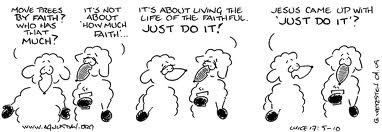
“If you have faith the size of a mustard seed,you would say to this mulberry tree,
‘Be uprooted and planted in the sea,’ and it would obey you.” 

This week is the 27th Sunday in Ordinary Time. The readings can be found here and they talk about faith and doing what we are called to do.

I have two wonderful boys. They are 9 and 6 years old, which are really fun ages as they are old enough that you can have interesting conversations with them and do fun activities but they are not yet at the teenage rebellion years. However, one of the things that annoys me is when they complain about the simplest household chores. Last evening I asked them to let our dogs out and help me with fold a load of laundry, all I heard was constant whining about “It’s not fair, I did it myself last time” and “I can’t do it, my arm really hurts” (they just came in from playing football in the yard!). They are really good kids but sometimes it is really hard for me to not lose patience.

However, there are some great life lessons in having children as there is a sincerity in them, even in the whining, that makes me look closer at myself. Just before I was about to tell my kids to stop whining, I realize that I often “whine” to God during prayer. I will often tell him that I do not believe it is fair that I am (or at least I perceive that I am) pulling more than my fair share at work or that I am exhausted and he is calling me to do yet another task! The thing is that even though I am whining, God wants to hear it, because he wants to have a personal relationship with me. However, once I “vent” during prayer, God’s grace reminds me of all the wonderful gifts he has bestowed on me, with a wonderful family, health, stable job, peace and security. God brings me back to the place where I break down for how grateful I am for the life I have and my trivial concerns melt away in God’s love. I then go forth and do my appointed tasks with great vigor for the greater glory of God.

One of those tasks is to be a patient and loving father that sets good examples for his children. After reflection I calmly told my kids I understand that they are tired as it has been a long week. There will be ample time to rest when we are done. However, now we need to fold the laundry and the sooner we get that done, the sooner we can tackle the dishes 🙂

Today’s reflection is from Fr. Larry Gillick, S.J. from Creighton’s Online Ministries. I encourage you to read the entire reflection here, but set forth below is an extended excerpt:

PRE-PRAYERING

Faith, like patience, is a hard grace to ask of God. We are oriented to know all things, especially about the future. We are impatient to grasp reasons for why events occur.

* * *

REFLECTION

Habakkuk is being prepared by God for a vision, but before that vision he makes a personal and communal complaint. This we hear in the First Reading of the liturgy. The Prophet sees nothing good around him. The nation Israel is being invaded and there is terror, discord, violence everywhere.

* * *

Jesus has been patiently leading his apostles along the narrow path of discipleship. Lately we have been listening to his teachings on freedom from the attachments to wealth and power. In the verses immediately preceding our Gospel today, Jesus has given them some encouragement to watch and act carefully in regards to leading anyone astray. He also is telling his followers about forgiving even their brothers seven times a day if they can express sorrow. As with most of Jesus’ teachings, the apostles, and ourselves, find difficulties in obeying. They see that to do so would take more faith than they seem to have.

This is the context then for our Gospel reading. The apostles ask for an increase in faith. Jesus seems to be harsh in his response. The apostles are pictured as having no faith, not even the size of a mustard seed. Then Jesus seems even more harsh by telling them about a servant who does what he is told to do and expects no special treatment from the master when the duties are finished. The master is not grateful for the servant’s having done their labors, including fixing the master’s dinner after finishing the farm labors.

When I was a lad, more than a few years ago, I had “chores” around our house. We all did, but my being the oldest boy; it seemed I got all the hard ones. I mowed the “huge” yard, washed the car, dug the garden, weeded it, and did the storm windows and screens as well as a thousand other household things. In the winter I shoveled the snow from our “long” driveway and “long” sidewalks. I never was thanked, not even once, as I now recall. Now, as then, my only reward is, as it was then, knowing that I was at least doing more than my younger brother Mike. I also was aware that though my father never said “thank you” at least he was not displeased or critical. I was doing what was expected, what I was told. It was all part of being in our family.

Even in the area of faith, as human beings, we want “affection”, that is getting the job done well, and “affection” a little praise or thanks. Our basic human and Christian struggle seems to be about present-time versus eternal-then. We are all in the family of God and we listen to what is “commanded”. Fr. Alexander of our staff is fond of saying, “Jesus is grateful.”  Though that can bring a smile to my face, I do wish Jesus would congratulate, praise, or thank me in person, especially when I feel like Habakkuk. We are all believers in the promises, the “eternal then” and we wait and keep washing windows, mowing lawns, plowing and tending the flocks in our care. Our faithfulness to our doing such things is our service for our Master and our pledge of trust in the life to come.

I am sure that God is grateful, but if God were to send me a thank-you card each time I did something good, I think I would end up serving my human and healthy need for affirmation. I think it is mostly just a joy to be a believer in the eternal love of God. I loved my family and I did my chores not to win more love, but to extend the love and life within that family. My father, like God, was doing what a father does. God, like my father, encourages us to stay faithful to who we are.

Sunday Reflection

Posted in Sunday Reflections | Tagged , , , , , , , , , , , | 9 Comments